
Job Shop Operations Management: A Simple Guide to Workflow
The lifts are occupied, the phone keeps ringing, and a technician is waiting for a part that hasn't arrived. Meanwhile, a customer wants a pickup time, an estimate still needs approval, and a straightforward service job sits outside with everything ready to go.
The problem isn't necessarily slow repair work. It's how work reaches the technicians, uses the bays, and waits between operations. Job shop operations management gives owners and managers a practical way to control those handoffs, so one stalled vehicle doesn't hold up the rest of the garage.
Table of Contents
- What a Job Shop Is and How It Differs from a Production Line
- The Core Processes That Move a Vehicle Through the Shop
- Dispatching Rules That Decide What Gets Worked On Next
- Seeing Every Job from Check-In to Checkout
- Handling Technician Shortages and Realistic Promise Dates
- Common Workflow Problems and How to Fix Them
- Start With One Operating View of Your Shop
What a Job Shop Is and How It Differs from a Production Line
A brake inspection, an intermittent electrical fault, and a cooling-system repair don't need the same route through a garage. Each vehicle needs its own diagnosis, parts mix, technician skills, and sequence of tasks. Some routes overlap, but the shop can't assume every vehicle will follow an identical path.
A job shop is an operation where individual orders move through their own sequence of activities while sharing resources. In a garage, those resources include bays, lifts, scan tools, alignment equipment, and technicians. A foundational describes jobs as multiple tasks that can follow different routes and require different service times.
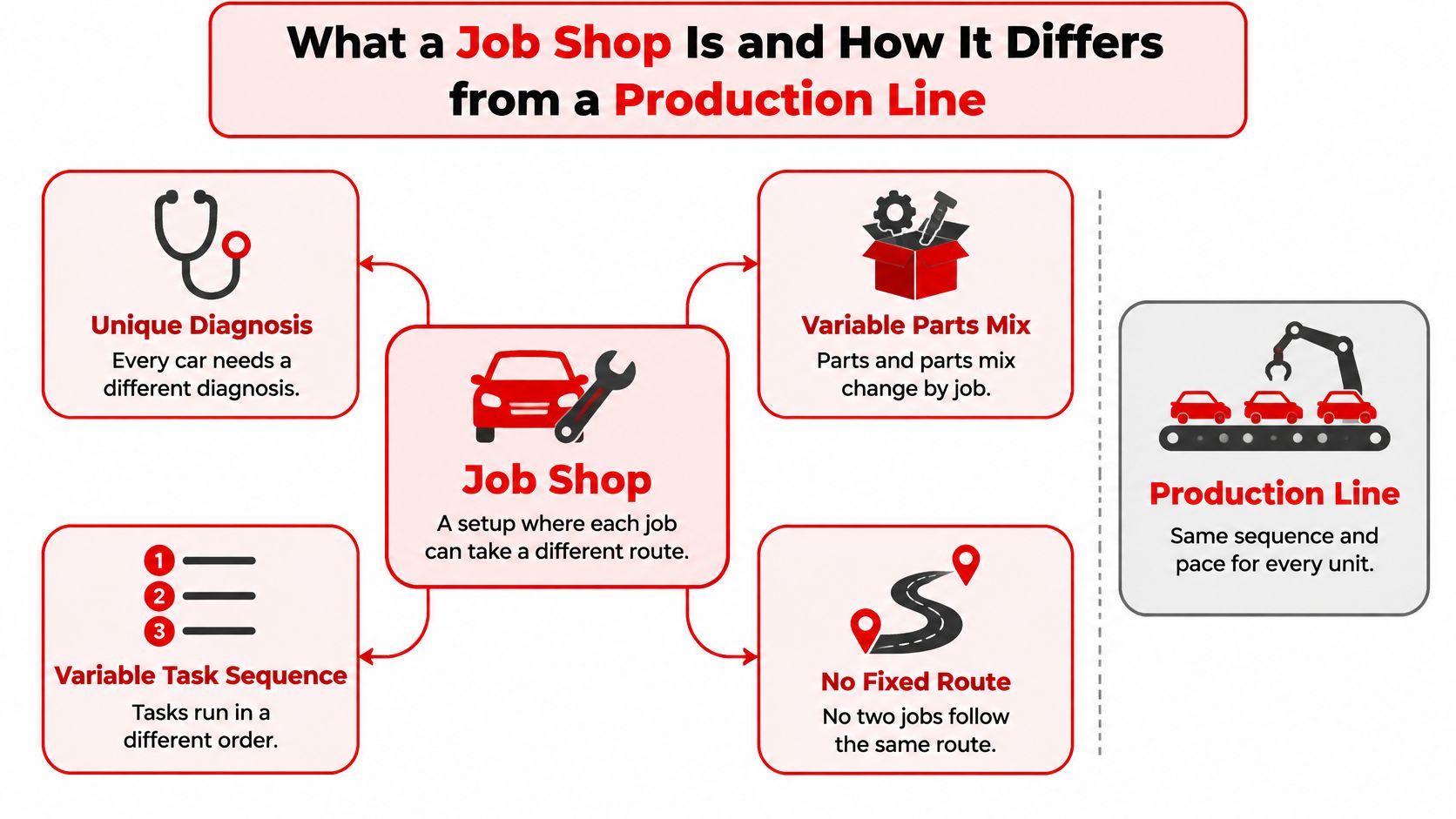
Different routes need different controls
A flow shop uses a fixed sequence. A car wash line, for example, moves vehicles through the same stations. A batch shop groups similar work together before moving the group to its next operation, much like a bakery preparing trays of the same product.
Job shop, flow shop and batch shop compared
| Shop type | How work moves | Typical example | Best fit |
|---|---|---|---|
| Job shop | Each order follows its own route through shared bays and technicians | Independent garage, custom machining, print jobs | Varied, one-off work |
| Flow shop | Every item follows the same fixed line in the same order | Car wash line, bottling line | Standard products at high volume |
| Batch shop | Similar items are grouped and processed together before moving on | Bakery trays, parts batches | Repeated runs with some variety |
Many independent garages and custom workshops operate as job shops because the work is varied and customer-specific. Even familiar repairs can require different operations once inspection reveals the vehicle's condition.
A hospital emergency room offers a useful comparison. Patients share staff and equipment, but each needs a different combination of tests and treatment. Managing that environment requires more than serving everyone strictly in arrival order.
The same applies to a garage. Job shop operations management means deciding which job uses which resource, when, and in what order, while keeping completion promises realistic. The manager coordinates the whole route, not just the moment a technician picks up a wrench.
The Core Processes That Move a Vehicle Through the Shop
Consider a vehicle arriving with steering vibration. The complaint starts the process, but it doesn't yet tell the advisor which parts, equipment, or technician the repair will need.
The broad journey runs from inspection to pickup. The operating details sit inside that journey.
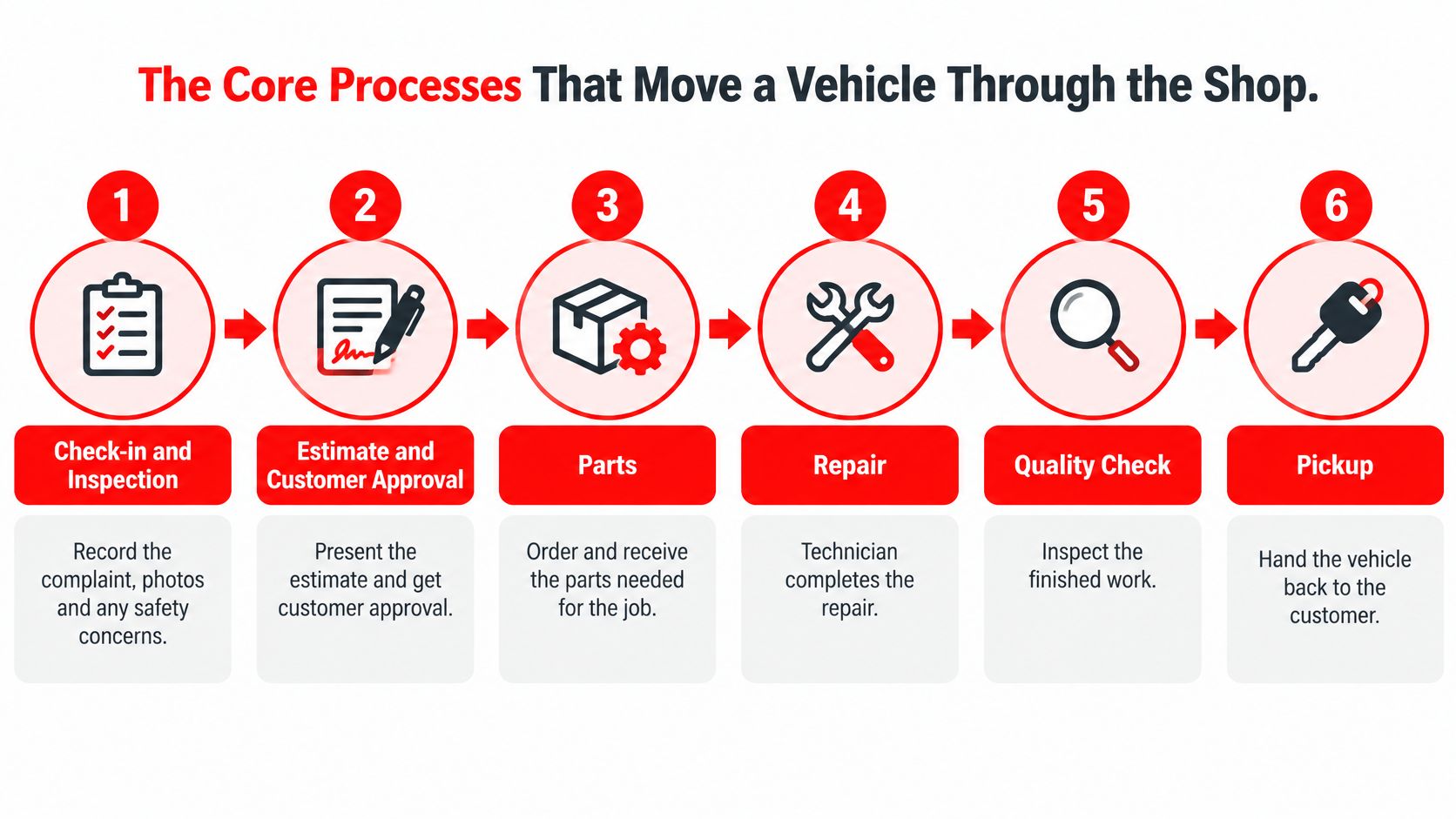
The handoffs that need an owner
Check-in and inspection. The advisor records the complaint, supporting photos, and safety concerns, including when the vibration occurs. A vague note such as steering problem forces the technician to repeat questions before diagnosis can begin.
Estimate and customer approval. The estimate lists the proposed operations, labor hours, and parts clearly. Starting repair work before approval creates avoidable disputes and can leave a dismantled vehicle occupying a lift.
Routing. The foreman identifies the required operations and their order, such as diagnosis, component replacement, alignment, and final verification. Missing a downstream operation can make a job appear almost finished when it still needs scarce equipment.
Parts ordering and receiving. Staff confirm availability, order the required parts, and check received items against the job. A delivery confirmation isn't enough if the box contains the wrong component.
Scheduling and dispatch. The dispatcher matches ready work to a technician with the right skills and an appropriate bay. Assigning a complex electrical fault to whoever happens to be free can create another handoff.
Execution. The technician completes the authorized operations and logs time against each one. Unrecorded additional work makes remaining labor difficult to judge and leaves the advisor with an outdated completion estimate.
Quality check. A designated person verifies that the original complaint has been addressed and checks the completed work. Treating repair completion as automatic permission for release skips this safeguard.
Invoicing, payment, and pickup. The advisor reconciles the completed work, explains the repair, and arranges payment and collection. An unfinished invoice can delay release even when the vehicle is ready.
These steps repeat across active jobs, often with a dozen vehicles at different stages in a hypothetical busy garage. Each handoff needs a named owner and a clear completion condition.
Practical rule: Before a vehicle occupies a working bay, staff should know what can happen next and what could prevent it.
The approval-to-parts handoff is a sensible first place to investigate delays. The shop's own waiting records should establish whether authorization, ordering, or receiving causes the longest hold.
Dispatching Rules That Decide What Gets Worked On Next
First in, first out feels fair and is easy to explain. It's also a weak default when the oldest job lacks parts and a later arrival is ready for repair.
Scheduling requires trade-offs. An describes the problem as NP-hard: jobs follow different routes while competing for limited resources, so practical decisions must balance completion time, waiting, lateness, and resource use.
Common dispatch rules and when to use them
| Rule | Picks the next job by | Best when | Watch-out |
|---|---|---|---|
| First in, first out | Arrival order | Simple, fair queue at low load | Ignores urgency and parts readiness |
| Earliest due date | Closest promised completion time | Capacity is tight and commitments matter | Can hold back short jobs that would free bays quickly |
| Shortest processing time | Least remaining labor | Bays are lightly loaded and throughput matters | Long repairs can wait too long |
| Critical ratio | Time left divided by work left | Mixed jobs with different deadlines | Needs reliable labor-time estimates |
| Composite score | Weighted mix of due date, labor, parts and skills | Most shops with varied repair types | Needs a board that shows each factor |
Readiness comes before priority
Suppose a brake repair is promised for 4 pm, but its parts are missing. A fully approved oil change with supplies available shouldn't remain outside because the brake job arrived first. Staff should escalate the missing delivery while dispatching work that can proceed.
Critical ratio compares the time remaining before the deadline with the work remaining. A lower ratio signals greater urgency, provided the shop uses consistent time units and realistic labor estimates.
No rule wins under every workload. A found that their relative performance changed with utilization. Short jobs can help when bays are lightly loaded; tighter capacity calls for closer protection of customer commitments.
For mixed repair work, a composite score is a practical starting point. Staff can screen out blocked jobs, then consider deadline risk, remaining labor, required skills, and downstream congestion. Short jobs shouldn't repeatedly displace a repair already at serious risk of lateness.
Rolling-horizon scheduling means updating the sequence as conditions change rather than defending the morning plan all day. Completed-job history helps staff estimate the actual pace of their own technicians and equipment, rather than relying only on book times. A queue review at opening and after lunch provides a useful minimum habit, with additional updates when parts, approvals, or repair scope change.
Seeing Every Job from Check-In to Checkout
A service advisor creates a card for a vehicle with a warning light. It starts in waiting, moves to diagnosed, then pauses until the customer authorizes the estimate. Once approved, the card carries the technician assignment and the next required action.
A Kanban-style board can use columns such as waiting, diagnosed, approved, in progress, parts waiting, quality check, and ready for pickup. Each card should include the vehicle, responsible person, promised completion, parts status, and blocker. A stuck card identifies where staff need to act instead of relying on the manager's memory.
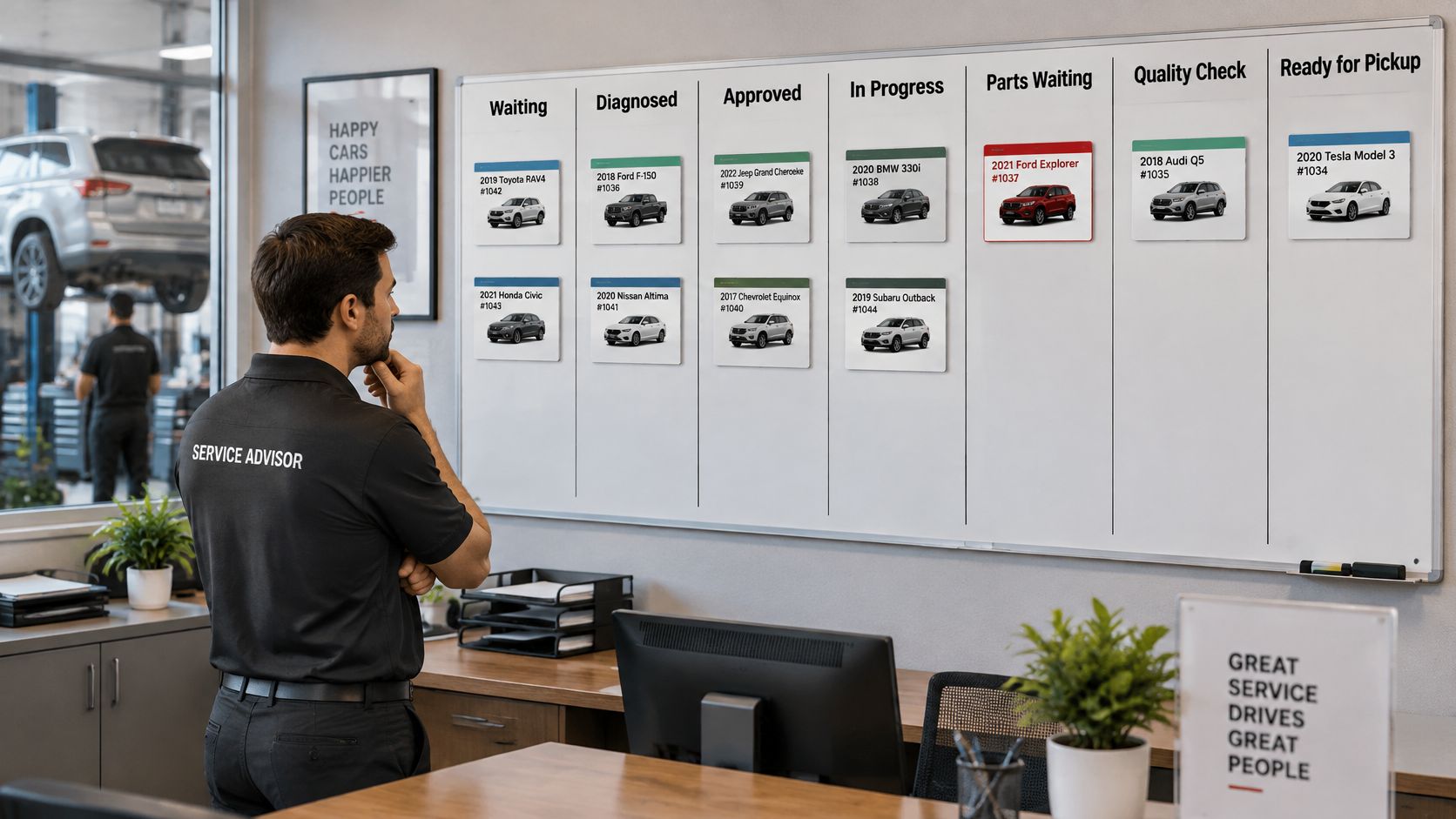
Busy repairs and productive days aren't the same
Individual accountability matters too. Each team member's own login lets the shop assign a technician to a job, see who wrote an estimate, and decide who can open the numbers.
The distinction between efficiency and productivity explains why a capable technician can still lose working time. In a, 42% of shops reported technician efficiency between 80% and 100%, while 37% reported productivity in that range.
Consider a technician who completes assigned repairs within their standard labor allowance but spends long gaps waiting for approved work. The repair-level result may be strong even though little of the full day becomes productive repair time.
Efficiency and productivity compared
| Metric | What it compares | What it reveals |
|---|---|---|
| Efficiency | Billed or standard labor time against actual technician time | How well each repair uses its allotted time |
| Productivity | Repair labor time against the full paid workday | How much paid time turns into repair labor |
A board helps supervisors distinguish a difficult repair from a preventable gap between jobs. That distinction matters before anyone concludes that a technician needs to work faster.
During a short morning huddle, staff should name the next action for each blocked card and assign someone to resolve it. The foreman can then redirect available people before an unanswered approval request or missing tool consumes more capacity.
Handling Technician Shortages and Realistic Promise Dates
Scheduling software can arrange open hours. It cannot manufacture skills or add a technician to the floor. When one bay depends on a single person who can diagnose a difficult fault, a missing part or an unapproved estimate does not stall only that vehicle. It holds the bay, and the next car waits behind it.
A reports that 31% of U.S. auto repair shops identified technician shortages as their biggest challenge, alongside approximately 70,865 annual automotive technician openings against projected supply of 50,085, a gap of 20,780 technicians per year. Capacity planning therefore has to account for who can do the work, not just how many appointment slots look open.
Protect the skills that limit output
Filling every bay can backfire when the same senior technician must diagnose faults, answer questions, and verify difficult repairs. More accepted work can produce longer queues, overtime, hurried checks, and repeat visits rather than more completed vehicles.
Managers have several decisions within their control:
- Separate work by skill scarcity. Reserve specialist attention for diagnosis and difficult repairs, while assigning suitable maintenance to other qualified technicians.
- Leave room for uncertainty. Diagnostic bookings need space for investigation and interruptions, not just a tightly packed repair allowance.
- Base promises on elapsed time. Completed-job cycle times include the practical waits that labor guides do not capture.
- Review the employment offer. Pay, equipment, training, workload, and predictable hours all deserve attention when retaining skilled staff. Retention conversations also run against the wider skilled-trade job market, where is a visible alternative.
A full appointment book is not evidence that the shop has enough capacity to keep its promises.
In a hypothetical four-technician garage, losing one technician while keeping every promised date leaves the remaining team absorbing the same workload. The owner needs to adjust the booking window and accepted job mix, not ask everyone to move faster.
Useful measures include cycle time, first-time-fix rate, waiting jobs, and technician interruption load. Billed hours alone will not explain whether the shop is completing dependable repairs. Honest lead times belong in job shop operations management because customers judge the shop partly by whether its promised dates hold.
Common Workflow Problems and How to Fix Them
Jobs look busy, but they finish late. The first task is to locate the delay, not assume that every technician needs to speed up.
A vehicle might wait at diagnosis, authorization, parts receiving, repair execution, or final inspection. Recording when each stage starts and ends gives the manager a place to investigate.
Workflow symptoms, likely causes and first fixes
| Symptom | Likely cause | First fix |
|---|---|---|
| Cars wait days for approval | Estimates sent without a clear follow-up step | Set an approval deadline and move the job to a waiting-for-approval column |
| Bays sit idle while parts arrive | Work released before parts were confirmed | Check parts status before dispatch and hold jobs until parts are received |
| Comebacks and rework rise | Final quality check skipped or rushed | Add a final inspection stage before ready-for-pickup |
| Promised dates keep slipping | Lead times based on book times, not history | Recalculate estimates from the shop's completed-job data |
| Technicians busy but few jobs finish | Hidden waits for tools, approvals or dispatch | Track wait time by stage each week |
Measure the problem being fixed
A reported that rework fell from 7.8% to 2.6%, technician efficiency rose from 89% to 105%, and average service completion time decreased by 1.6 days after selected quality-management tools were implemented. The study also recommends coordinating scheduling, parts inventory, and the shop floor around technician and equipment availability.
Those results describe the studied centers, not a guaranteed outcome for another garage. They also represent different operating questions. Rework exposes quality failures, efficiency reflects standard labor relative to actual repair time, and completion time includes the waits customers experience.
Efficiency above full standard allowance doesn't mean a technician worked more hours than existed. It means credited standard labor exceeded the actual time recorded for that work.
For a broader approach to choosing measures, the provides additional context. A repair shop should still choose measures that identify a specific operational problem.
Measure before expanding: A change should solve the identified delay without creating a new quality or workload problem elsewhere.
The manager should select a measure for the symptom, correct the first observable cause, and allow a short review period before judging the result. A one- or two-week trial is a practical starting point, provided the shop records job mix and checks that a different workload hasn't distorted the comparison.
Start With One Operating View of Your Shop
A shop doesn't need a complicated system before it can improve coordination. It needs a shared record that staff trust and update as work changes.
A small garage with one to three bays can start with a notebook and a whiteboard. The important test is whether the advisor, technician, and owner agree about each vehicle's status, next action, and completion commitment.
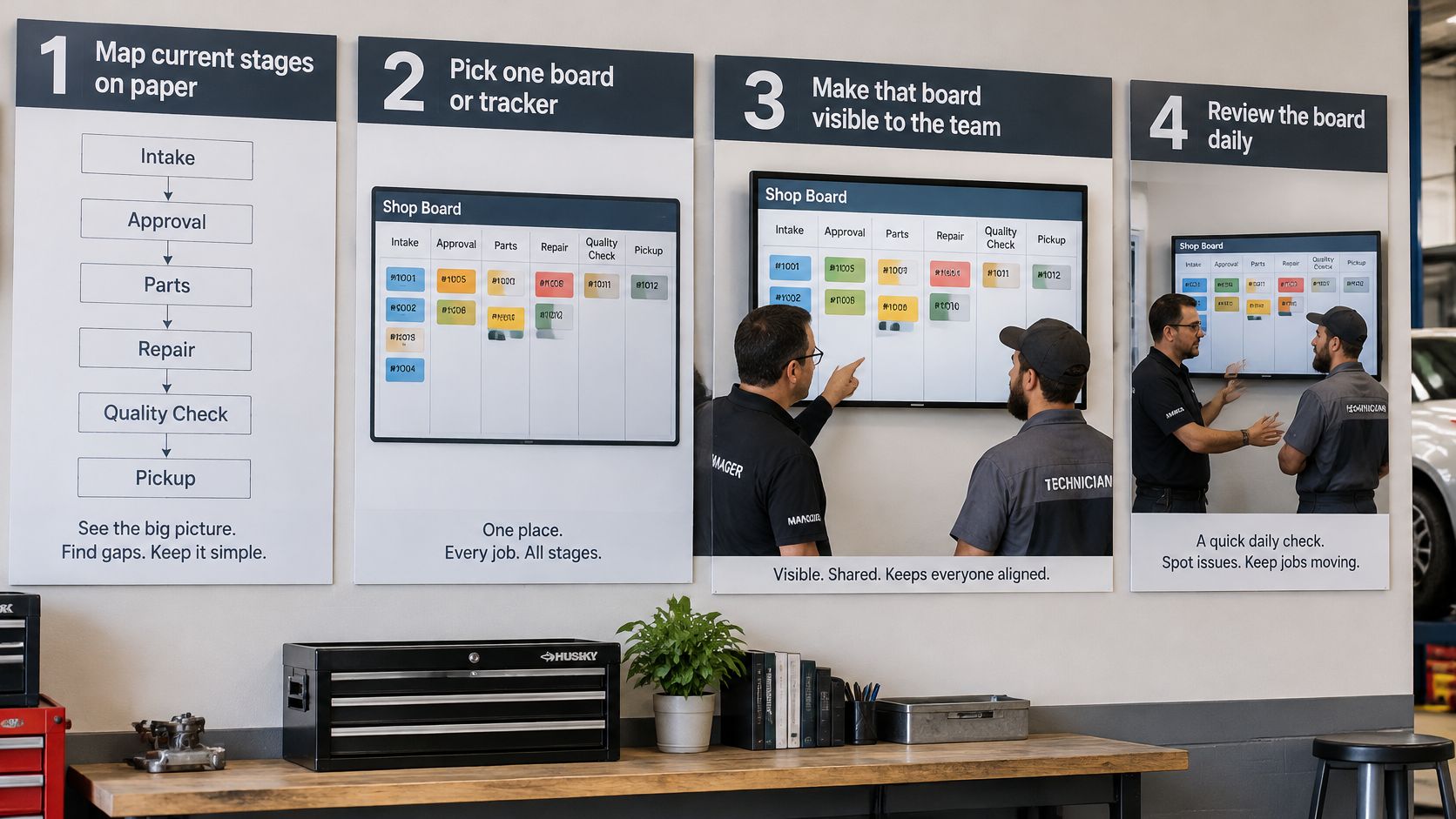
A practical first-week plan
Map the current stages on paper. Include intake, approval, parts, repair, quality check, and pickup. Staff should describe what happens, including informal holds, rather than draw an ideal process that nobody follows.
Choose a single operating record. Every active vehicle belongs on the same board or tracker, with a responsible person and next action. Team members should be able to identify their assigned work without asking the owner to reconstruct the day.
Track a small weekly scorecard. Average cycle time, late jobs, and comebacks provide a starting set for delay, delivery, and quality. Staff should agree on definitions, particularly what counts as a comeback and when cycle time begins.
Run a one-week pilot and review it. The owner should inspect stalled jobs with the team and choose a specific handoff to improve. If staff can't keep the record current, simplifying the process is more useful than adding more fields.
The first review should produce a concrete decision, such as assigning approval follow-up to the advisor or checking received parts before reserving a lift. A longer list of measurements isn't a substitute for that decision.
When software becomes useful, the RedAppy features bring the job board, inventory, team calendar, and analytics into one operating view. RedAppy reports that shops save 10+ hours weekly on admin and see a 20% higher average repair order; those outcomes shouldn't replace the shop's own measures of delivery and quality.
Owners can contact the RedAppy team to discuss their current stages, staffing constraints, and information needs before choosing a setup.
RedAppy offers auto repair shop management software that connects inspections, estimates, parts, job tracking, and payment. Owners ready to replace scattered job information with a shared workflow can visit RedAppy and explore how it could support their shop's daily operations.
Ready to Transform Your Shop?
RedAppy helps auto repair shops create professional digital estimates with photos and videos, send them instantly via text or email, and get customer approvals in seconds. No credit card required to start.