
Mechanic Customer Service: A Step-by-Step Guide for Shops
The pickup window is almost over. A customer hasn't heard from the shop, the replacement part hasn't arrived, and the advisor still needs approval for an added repair. The technician may have diagnosed everything correctly, but the customer is already wondering whether the original promise meant anything.
Mechanic customer service depends on what happens before that customer calls for answers. A clear intake, a readable estimate, and an early explanation of changes give the customer something solid to work with. Friendly conversation helps, but it can't replace a recorded decision or an honest completion window.
Table of Contents
- Six Customer Touchpoints and What to Do at Each
- How to Run the Intake Call and Greet Every Customer
- How to Choose Text, Call or Email for Each Update
- How to Write Photo-Driven Estimates Customers Approve
- How to Explain Delays and Price Changes Without Surprises
- Handling EV, ADAS and Work You Should Refer Out
- Track Five KPIs and Start Your Weekly Training Review
Six Customer Touchpoints and What to Do at Each
A customer who never heard back doesn't know whether the vehicle is waiting for diagnosis, parts, or approval. The service desk needs a working record that makes the next action obvious, including when another advisor takes over.
identifies attention to customer needs, status updates, prompt arrival acknowledgment, and post-service contact among influential satisfaction drivers. Those actions belong on the repair order, not just in an advisor's memory.
Customer touchpoints, actions and records
| Touchpoint | What to say or send | Record to save | Done when |
|---|---|---|---|
| Booking or first call | Confirm vehicle, symptom and preferred channel | Preferred channel on the customer profile | Customer has named one main channel and one backup |
| Arrival and greeting | Greet by name, confirm the symptom, state the promised completion time | Check-in timestamp and promised time | Promised time is written on the repair order |
| Written inspection | Send multi-point results with photos or video | Photos attached to the inspection | Customer has viewed or replied to the inspection |
| Approval | Ask for an approve or decline on each added item | Approval time, method and exact wording | Every added item has a recorded decision |
| Mid-job update | Message at diagnosis, parts arrival, or any timing change | Message history on the repair order | Customer knows the current status and the new time |
| Pickup and follow-up | Thank the customer and check in within two days | Follow-up date and outcome | Follow-up is logged and any concern is closed |
The arrival promise must distinguish diagnosis time from repair completion. If the technician hasn't inspected the vehicle, the advisor should confirm when findings will be available rather than invent a pickup time.
At pickup, the advisor should connect the invoice to the original complaint, explain completed work, and identify anything deferred. A concern raised during follow-up stays assigned to someone until the shop records its resolution.
Three useful checks are greeting wait time, first-time-fix rate, and post-service contact completion. Together, they show whether the shop acknowledges customers, solves the reported problem, and checks the result.
Silence is never approval. For an internal process audit, a missing record counts as a missed step even when the repair itself was good.
How to Run the Intake Call and Greet Every Customer
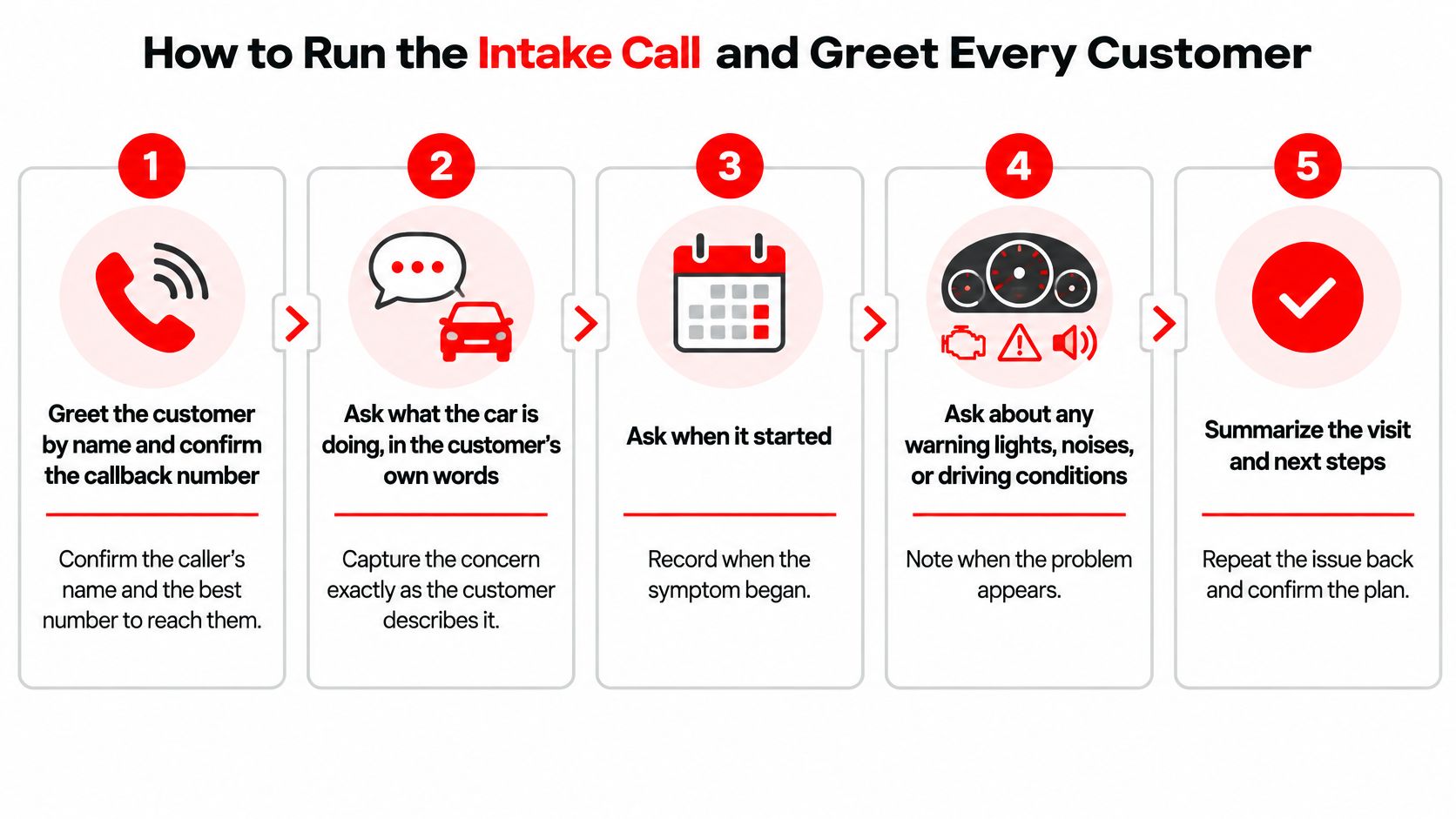
A useful intake captures the symptom without turning the customer's description into an untested diagnosis. Brake noise belongs on the repair order as brake noise, not automatically as a pad replacement.
The advisor also needs to establish what the shop has promised. A booking reserves a visit or diagnostic opportunity; it doesn't establish which parts the vehicle needs.
- Confirm the person and callback number. Greet the customer by name when available, then verify the number rather than assuming the caller ID is correct.
- Capture the concern in the customer's words. Ask what the vehicle is doing, when it started, and whether it happens cold, at highway speed, or only when braking. Record warning lights and intermittent conditions.
- Repeat the symptom back. Summarize the concern in a sentence and let the customer correct it. Keep separate complaints on separate lines.
- Explain the work sequence. Diagnosis comes first, followed by a written estimate and work after approval. Explain any diagnostic charge before accepting the vehicle.
- Promise a realistic diagnosis window. Base it on technician availability and the testing needed, not an empty parking space.
- Confirm the communication channel. Record text, call, or email preference and a backup contact method.
- Check transport arrangements. Confirm drop-off instructions, key handling, and any ride or loaner needs. Don't imply that transport is available unless it has been arranged.
You're hearing a grinding noise when you brake at low speed, and you'd like it checked before the weekend. We'll diagnose it first and send you a written estimate before any work starts.
Keep booking separate from technical judgment
For shops considering overflow call handling, Recepta.ai's guide to is a useful resource for evaluating intake support. Any answering system needs clear limits: it can collect symptoms and scheduling preferences, but technical findings and repair commitments need qualified review.
The most damaging intake slip is promising a repair date before a technician has seen the car. Parts availability, test results, and access difficulties can all change the job.
A completed intake leaves the customer's symptom, promised diagnosis time, and approved contact channel on the repair order. The next advisor shouldn't need to ask the customer to start again.
How to Choose Text, Call or Email for Each Update
In, 68% of customers wanted service updates by text message, compared with 16% who preferred phone calls. Text is a sensible starting option, but the customer's recorded preference should control the routine.
Text suits short status updates. A call works better when a customer has questions about authorization or a safety finding; email suits detailed estimates and invoices. After a call, the advisor should send the written decision summary rather than leave the conversation undocumented.
Messages that move the job forward
Each message should name the vehicle, explain its status, identify the next action, and offer a clear response.
- Booking confirmation: Hi Dana, the Civic is booked for a brake inspection. Please confirm the drop-off arrangements. Reply CONFIRM or CHANGE.
- Estimate ready: Hi Dana, the Civic's brake inspection is complete. Photos and the itemized estimate are ready. Please record APPROVE or DECLINE against each item, or reply QUESTION for a call.
- Diagnosis update: Hi Dana, the Civic's noise has been traced to the front brakes. The technician is checking the repair scope before the estimate is sent. Reply CALL if there's another symptom to discuss.
- Parts status: Hi Dana, the Civic's approved brake parts have arrived. The job is moving into repair, and the current pickup window remains unchanged. Reply CALL if transport arrangements have changed.
- Completion: Hi Dana, the Civic's brake repair and verification checks are complete. The invoice and pickup instructions are ready. Reply PICKUP or CALL.
SignalZen's offer additional context for organizing channel choice and response ownership. At a service desk, the important operational detail is assigning someone to monitor replies while the original advisor is busy.
Handle unanswered requests consistently
A practical starting protocol is an approval reminder after two open hours, followed by a phone call the same day if there's still no reply. Every unanswered attempt belongs on the repair order, and the backup channel collected at booking gives the advisor another route.
A retained message history shows what was sent, which estimate was referenced, and when a decision arrived. If status changes, the customer should hear it before having to ask.
A post-service template can stay simple: Hi Dana, thanks for choosing the shop today. How is the Civic driving since the brake repair? Reply GOOD, or describe anything noticed so an advisor can call. The reply and follow-up outcome belong with the job.
How to Write Photo-Driven Estimates Customers Approve
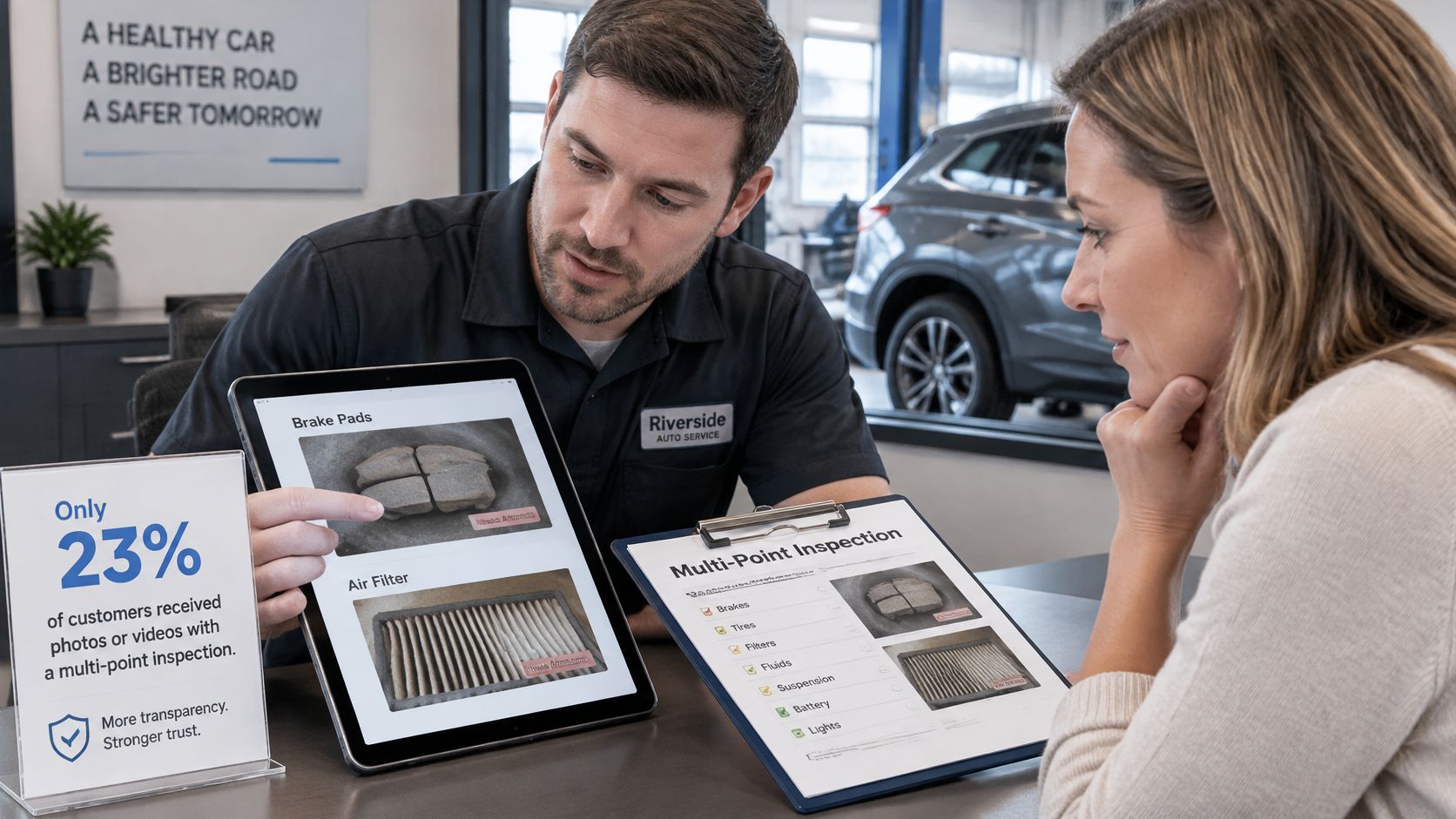
Only 23% of customers received photos or videos alongside a multi-point inspection, according to; customers receiving visual evidence authorized recommended work at 51%, compared with 24% without it, a 27-percentage-point difference. That association supports making inspection evidence part of the estimate, not an optional attachment.
A photograph alone isn't an explanation. The customer needs to understand which component is shown, what the technician found, and why the proposed repair follows from that finding.
The recommends a written estimate identifying the condition to be repaired, required parts, and anticipated labor charge, with customer contact before work exceeds a defined amount of time or money. That makes scope and re-approval conditions essential estimate fields.
Estimate fields and what each one must show
| Estimate field | What to include | Why it matters |
|---|---|---|
| Vehicle and condition | Model-year identification, make, model, mileage, and condition found | Ties the work to this exact car |
| Photos | Three to six per finding, each with a one-line caption | Visual proof supports the recommendation |
| Parts | Part name, part number, quantity, and source | Lets the customer compare and avoids surprise charges |
| Labor | Hours for each task and the shop labor rate | Matches the labor charge the customer sees |
| Priority label | Safety now, soon, or monitor | Helps the customer decide what to approve first |
| Re-approval trigger | The dollar amount or time limit requiring a new call | Defines when the shop must ask again |
Show the finding without overstating it
A practical photo standard is three to six useful images per finding: an orientation view, a close-up, and measurement or comparison views where relevant. More images aren't better when they repeat the same unclear angle.
Say an inspection finds a worn front brake pad that remains above the applicable service limit. The technician photographs the friction material beside a ruler for customer context, records the measurement using the appropriate measuring tool, and identifies the manufacturer's specification in the caption.
A soon, not urgent label is appropriate only if the full inspection supports that assessment. The advisor shouldn't use a reassuring label when another finding makes the vehicle unsafe, or use safety language merely because a sale would be convenient.
The estimate should also distinguish the complaint-related repair from maintenance recommendations. A customer should be able to approve the repair needed now without accidentally accepting every optional item.
The final test is straightforward: could the customer make an informed yes-or-no decision from the estimate alone? If a phone call is necessary just to discover the price, part choice, or reason for the work, the estimate needs revision.
How to Explain Delays and Price Changes Without Surprises
A late repair doesn't automatically destroy trust. A customer left rearranging work or transport without an explanation has a different problem from a customer who received an early warning and a realistic choice.
In, 24% of vehicle owners said service took longer than expected, 13% struggled to find out pricing, and 12% said the final price exceeded the estimate. Better mechanic customer service addresses those moments directly rather than relying on a friendly pickup conversation.
Explain a parts delay before the deadline
Once the repair scope is established, the advisor should give a completion window that includes parts delivery, installation, and verification. If the supplier changes delivery, the advisor shouldn't wait until the promised pickup time to pass that information along.
Example delay message: The Civic's rear rotor is cracked, and the approved replacement now arrives Thursday morning instead of Wednesday. The revised ready time is Thursday by 4 pm, provided the part arrives as confirmed and verification checks pass. Please reply KEEP to retain that plan, or CALL to discuss transport or transfer options.
A transfer isn't automatically safe or practical. The advisor needs to explain whether the car is disassembled or unsafe to drive, along with any collection arrangements and authorized charges.
If the supplier can't confirm delivery, the shop should give the next update time instead of inventing another completion promise. A reliable update deadline is better than an unsupported pickup deadline.
Make a price change easy to inspect
A revised estimate needs the original line, replacement line, reason, supporting photo, and new total. A usable message would read:
The original estimate covered rear pads. Inspection has also identified a cracked rear rotor, shown in the attached photo. The revised estimate replaces the pads-only line with the itemized pad-and-rotor repair and shows the new total. Please approve or decline the revised item before that additional work begins.
A genuine safety finding includes evidence, such as a measurement against the applicable specification, a visible defect, or a documented test result. An optional improvement shouldn't receive safety now language.
Every revision should retain its timestamp, the version it replaces, and the customer's decision. The advisor must also explain whether unrelated authorized work can continue or whether the vehicle must remain paused.
Handling EV, ADAS and Work You Should Refer Out
found that 70% of battery-electric-vehicle owners trusted independent workshops for simple repairs, but only 53% trusted them for complex repairs, compared with 73% for conventional vehicles. An advisor shouldn't try to close that gap by claiming capabilities the shop can't demonstrate.
A capability conversation needs actual credentials, suitable equipment, and a clear boundary around the work. Electric vehicle familiarity doesn't establish competence for every high-voltage procedure or advanced driver assistance system calibration.

Capability script: The assigned technician's relevant certification and the equipment used for this procedure are listed on the estimate. The shop can complete the specified battery-cooling diagnosis in-house. If the manufacturer's procedure requires software work or calibration beyond that capability, an equipped specialist will receive the findings and referral.
Refer based on capability, not confidence
- High-voltage procedures: Refer work outside the technician's validated training and the shop's safety arrangements.
- ADAS calibration: Refer when the correct targets, equipment, workspace, or procedure access aren't available.
- Software and specialist testing: Establish the required tools and access before promising an in-house solution.
A scan may establish the diagnostic starting point without identifying a failed part. Calibration may restore or verify system alignment after another repair, while a second inspection may validate conditions the first shop couldn't test.
Those are legitimate services when the advisor explains their purpose, scope, and charge. They aren't a license to bill for vague investigation without a plan.
Refusing work that the shop can't perform safely protects long-term trust better than accepting it and producing a comeback. A useful referral includes the findings, completed tests, and customer-approved next step.
Track Five KPIs and Start Your Weekly Training Review
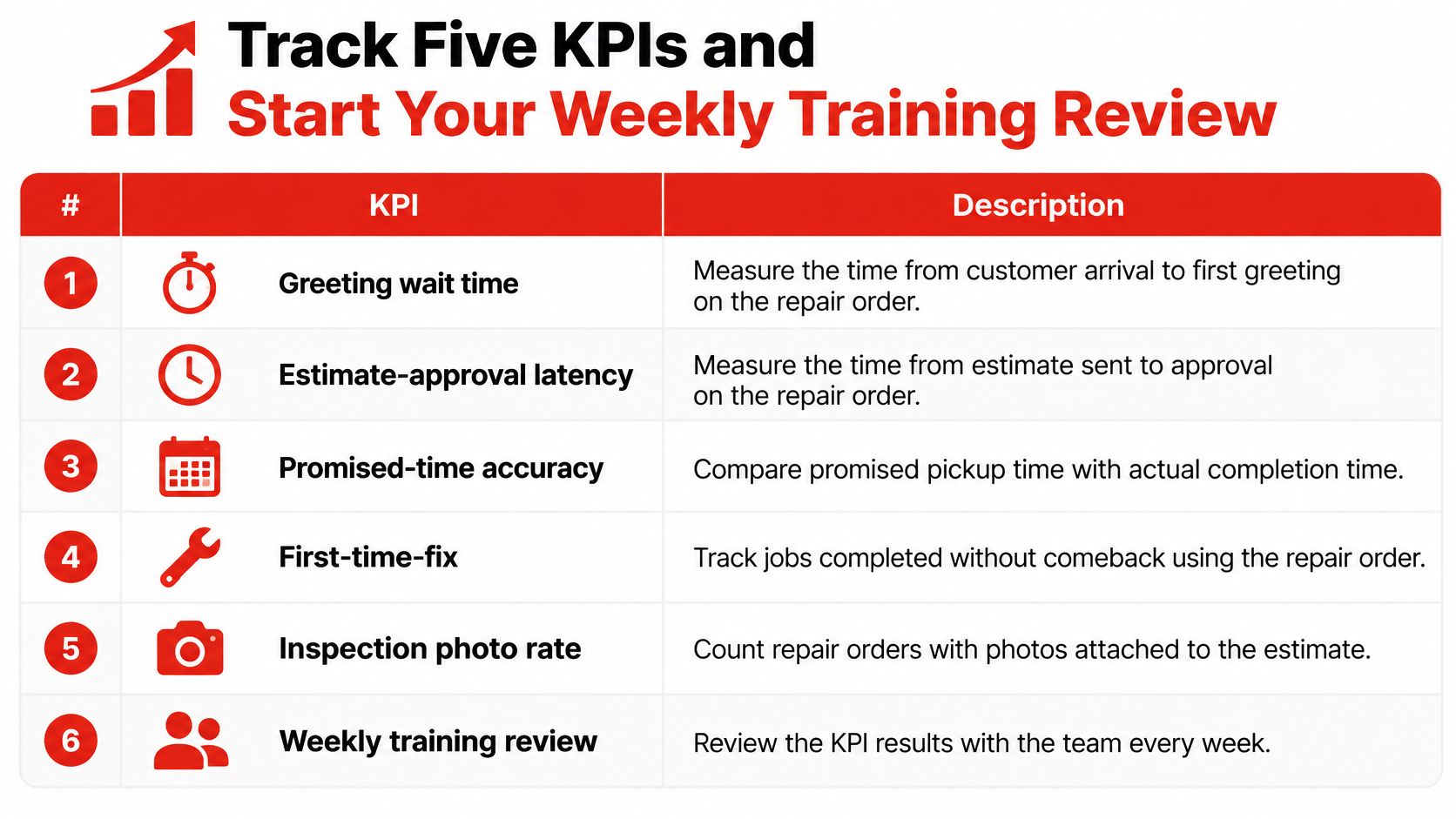
A shop needs a small scorecard that advisors can calculate from repair orders. Five core service measures can form that scorecard, with comeback rate kept alongside them as a repair-quality check.
The targets below are proposed starting controls, not industry benchmarks. After the first month, management should adjust them to the shop's workload and baseline without weakening authorization or safety requirements.
Customer service KPIs and starting targets
| KPI | Starting target | How to measure it |
|---|---|---|
| Greeting wait time | Under 1 minute | Check-in time minus arrival time |
| Estimate-approval latency | Under 2 hours in open hours | Estimate sent time to recorded decision |
| Promised-time accuracy | 90% or more of jobs | Completion time compared with promised time |
| First-time-fix rate | Improve from the initial baseline | Jobs closed without a return for the same symptom |
| Comeback rate | Reduce from the initial baseline | Returns for the same repair within the warranty window |
| Post-service contact completion | Every eligible closed job has a logged attempt | Follow-up logged on the repair order |
Greeting measurement needs an honest arrival timestamp, not just the moment an advisor opens the repair order. First-time-fix and comeback records also need consistent classification so a new, unrelated complaint doesn't count as a failed repair.
Turn the review into practice
A proposed training cycle keeps the meeting tied to actual work:
- Week one: Advisors role-play the intake script and a parts-delay message.
- Week two: The team reviews five inspection photo sets for focus, orientation, and useful captions.
- Week four: The manager audits ten estimates for missing fields, unclear revisions, and absent approval records.
The weekly checklist should identify the missed action, assign an owner, and confirm whether the previous correction worked. Faster approvals shouldn't be rewarded if advisors achieve them through pressure or incomplete explanations.
For software evaluation, the shop-management features page provides a starting point for reviewing digital inspections and estimates; a demonstration should show how message history fits the repair-order routine. The contact page offers a way to discuss that workflow with the team.
The immediate next step is to select two KPIs, measure them for two weeks, and bring the repair-order evidence to the next team meeting.
RedAppy offers digital inspections, estimates, invoicing, and a Digital Shop Board for managing work from check-in to checkout. Visit RedAppy to explore how those tools could support clearer customer decisions, documented changes, and more consistent service-desk handoffs.
Ready to Transform Your Shop?
RedAppy helps auto repair shops create professional digital estimates with photos and videos, send them instantly via text or email, and get customer approvals in seconds. No credit card required to start.