
Mechanic Invoice Software: The Best Tools for Auto Repair Shops in 2025
Chasing down payments, printing paper invoices, and manually tracking parts costs shops real money — and real time. The right mechanic invoice software can cut hours of admin work each week, reduce billing errors, and help you get paid faster. In 2025, shops that still rely on spreadsheets or generic accounting tools are leaving efficiency on the table.
According to a 2023 survey by the Automotive Management Institute, administrative tasks consume up to 30% of a shop owner's working week. That's time better spent on cars — not paperwork. Modern invoicing tools built specifically for auto repair do far more than generate a bill. They connect estimates, parts orders, labor times, and customer history into a single workflow.
This article covers the best mechanic invoice software options available in 2025. For each tool, you'll find a plain-English description of what it does, who it's best for, and where it falls short. Whether you run a single-bay garage or manage multiple locations, there's a solution here that fits your operation.
Table of Contents
- How We Compared Mechanic Invoice Software
- RedAppy — Best All-in-One Shop Management with Built-In Invoicing
- Tekmetric — Best for Data-Driven Large Shops
- Mitchell 1 Manager SE — Best for Repair Data Integration
- Invoice Ninja — Best Free or Low-Cost Option for Independent Mechanics
- Conclusion
- Frequently Asked Questions
How We Compared Mechanic Invoice Software
Choosing the right mechanic invoice software comes down to more than price. The best tools for auto repair shops handle the full job cycle — from writing an estimate to collecting payment — without creating extra steps for your team.
To compare these platforms fairly, we evaluated each one across six core criteria:
- Ease of use — Can a service advisor or technician learn it quickly without formal training?
- Auto repair-specific features — Does it include labor time guides, VIN lookup, and parts ordering, or is it a generic invoicing tool adapted for shops?
- Pricing and contract terms — Is pricing transparent? Are there month-to-month options?
- Payment processing — Can customers pay online? Are there multiple payment options?
- Digital inspections — Can technicians attach photos and send inspection reports directly to customers?
- Scalability — Does the platform work for a single-bay shop and still hold up for a multi-location operation?
We also considered real-world usability — not just feature lists. In practice, a tool with 50 features that takes three weeks to configure is less useful than a leaner platform your team actually uses every day.
Software built specifically for auto repair shops outperforms general invoicing tools in almost every workflow category that matters to a mechanic.
Comparison Table
| Platform | Starting Price | Month-to-Month | Mobile Access | Parts Ordering | Digital Inspections | Free Plan |
|---|---|---|---|---|---|---|
| RedAppy | Custom (transparent pricing) | ✅ Yes | ✅ Yes | ✅ Multi-supplier | ✅ Photo-rich | ❌ No |
| Tekmetric | ~$199/mo | ✅ Yes | ✅ Yes | ✅ Yes | ✅ Yes | ❌ No |
| Mitchell 1 Manager SE | ~$150–$300/mo | ❌ Annual contract | ✅ Limited | ✅ Yes | ✅ Yes | ❌ No |
| Invoice Ninja | Free – $14/mo | ✅ Yes | ✅ Yes | ❌ No | ❌ No | ✅ Yes |
Each platform reviewed below targets a different type of shop. A solo mobile mechanic has different needs than a 10-bay dealership-style independent shop. Use this table as a starting point, then read each entry to find the best fit for your situation.
The tools covered here range from free general-purpose invoicing to full shop management systems with AI-assisted diagnostics. If you're also thinking about how to build a professional auto repair website or tracking technician performance with shop analytics, the platform you choose for invoicing will directly affect how well those pieces connect.
RedAppy — Best All-in-One Shop Management with Built-In Invoicing
RedAppy is a shop management platform built specifically for auto repair businesses. It handles the full job lifecycle — from the first customer call to final payment — without needing to stitch together separate tools for invoicing, inspections, and scheduling.
Most invoicing tools make you do the work. RedAppy builds the invoice as you go, pulling from estimates, parts orders, and labor times automatically.
What RedAppy Does
The core of RedAppy's invoicing workflow is speed and accuracy. When a job is complete, one click converts an approved estimate into a finalized invoice. Customer details, vehicle information, parts, labor rates, and taxes are already populated — no retyping required.
Key features that directly support invoicing:
- One-click invoicing from approved estimates, reducing manual data entry
- Online payment processing so customers can pay from their phone via a link
- Digital inspections with photos that help customers approve more work before the invoice is even created
- Multi-supplier parts ordering with real-time inventory, so parts costs flow directly into the job
- AI Repair Assistant that provides labor times and diagnostic guidance on demand
- Vehicle history and VIN/plate/name lookup to pull up customer records instantly
The Kanban Digital Shop Board
The Digital Shop Board gives every team member a live view of where each job stands — from check-in through repair to ready for pickup. This isn't just a visual perk. In practice, it reduces the back-and-forth between the front desk and the bay that slows down invoicing and delays payments.
Jobs move through stages in real time, so the person writing the invoice knows exactly when a technician has finished. That visibility cuts down on the end-of-day rush to close out tickets.
Analytics and Business Insights
RedAppy includes real-time analytics that track:
- Revenue by day, week, or month
- Technician efficiency and billable hours
- Average repair order value
- Repeat customer rate
From experience, shops that track average repair order closely tend to find upsell opportunities they were previously missing. The built-in AI Repair Assistant also surfaces shop insights on demand, not just labor times.
Included Branded Website
Every RedAppy subscription includes a professional, branded website with contact forms and optional used-car listings. For a shop running on a tight budget, this eliminates one more monthly expense and keeps your online presence tied directly to your shop management system.
Pricing and Who It's For
RedAppy operates on month-to-month terms with transparent pricing — no long-term contracts locking you in. It scales from single-bay garages to multi-location operations, making it practical whether you're a solo mechanic or managing a team of ten.
| Feature | RedAppy |
|---|---|
| One-click invoicing | ✅ |
| Digital inspections with photos | ✅ |
| Online payments | ✅ |
| Multi-supplier parts ordering | ✅ |
| AI labor times and diagnostics | ✅ |
| Kanban shop board | ✅ |
| Real-time analytics | ✅ |
| Branded website included | ✅ |
| Month-to-month pricing | ✅ |
| Scales to multi-location | ✅ |
RedAppy reports that shops typically save 10+ admin hours per week and see a strong first-year ROI by replacing disconnected tools with one platform. If you want to compare shop management platforms side by side, the criteria covered earlier in this guide apply directly.
Best for: Auto repair shops of any size that want invoicing, inspections, parts ordering, and customer management in one place — without paying for multiple subscriptions or dealing with integrations.
Limitation: RedAppy is built for auto repair businesses specifically. If you run a general service business outside of automotive, a generic invoicing tool may suit you better.

Tekmetric — Best for Data-Driven Large Shops
is a cloud-based shop management platform built with reporting and workflow visibility at its core. It's designed for shops that want to make decisions based on real data — technician efficiency, gross profit per repair order, parts margins, and more. Invoicing is fully integrated into the workflow, so every estimate, approval, and payment is tracked in one place.
What Tekmetric Does Well
Tekmetric's invoicing tools go beyond generating a bill. The platform connects estimates directly to repair orders, which then flow automatically into invoices. This reduces manual re-entry and keeps everything consistent from the first customer touchpoint to final payment.
Key invoicing and workflow features include:
- Digital estimates with customer approval via text or email — customers can approve jobs remotely
- Integrated parts ordering from multiple suppliers with real-time pricing
- Labor time guides built in so technicians and service advisors pull accurate times without switching tools
- Online payment processing so customers can pay before pickup
- Detailed reporting on revenue, technician hours billed vs. clocked, average repair order value, and parts-to-labor ratios
According to Tekmetric, shops using their platform report an average increase of $200+ per repair order — attributed largely to better inspection workflows and real-time customer communication.
Tekmetric's Reporting Depth
This is where Tekmetric genuinely stands out. The analytics dashboard gives shop owners and managers a granular view of business performance. You can break down profitability by service type, by technician, or by time period.
For a shop running 15+ repair orders a day, this kind of visibility can identify profit leaks that would be invisible in a basic spreadsheet or simple invoicing tool.
Managers at multi-bay operations can monitor which technicians are consistently hitting flag hours, which service advisors have the highest approval rates, and where deferred work is building up in the customer base.
Who Tekmetric Is Built For
Tekmetric is best suited for established shops with volume — typically those processing 100+ repair orders per month. The platform's pricing and feature depth make the most sense when there's enough data flowing through the system to make the reporting genuinely useful.
| Feature | What It Means in Practice |
|---|---|
| Advanced analytics | Real-time KPIs for shop owners and managers |
| Multi-location support | Manage multiple shops from one account |
| Digital inspections | Photo-rich reports sent directly to customers |
| Third-party integrations | Connects with QuickBooks, parts suppliers, and CRM tools |
| Cloud-based access | Accessible from any device, no local server needed |
Honest Limitations
Tekmetric is not the right fit for every shop. A solo mechanic or a two-bay garage may find the pricing hard to justify relative to the features they'll actually use. In practice, smaller operations rarely need the depth of reporting Tekmetric provides, and simpler platforms will cover their invoicing and workflow needs at a lower cost.
The onboarding process also takes time. Shops migrating from paper or basic software will need to invest in setup and staff training before the platform runs smoothly. Based on user reviews, expect a few weeks before the workflow feels natural.
Tekmetric earns its place for high-volume shops — but if you're processing under 50 repair orders a month, the ROI case is harder to make.
For shops that are growing fast and want a platform that scales with them — and can support data-backed decisions at every level — Tekmetric is a strong contender. For shops that need full workflow management without the enterprise price point, RedAppy's all-in-one approach covers similar ground with more transparent, flexible pricing.
Mitchell 1 Manager SE — Best for Repair Data Integration
has been a fixture in professional auto repair shops for decades. It connects invoicing directly to one of the most comprehensive repair databases in the industry — covering OEM labor times, wiring diagrams, and diagnostic procedures. For shops where accuracy in labor billing is non-negotiable, that integration matters.
What It Does
Manager SE is a full shop management system, not just invoicing software. When a tech looks up a job, labor times pull in automatically from Mitchell 1's ProDemand database. That means your invoice reflects verified OEM hours rather than rough estimates — which reduces disputes and supports more accurate estimates upfront.
Key features include:
- Labor time integration pulled directly from OEM and aftermarket data
- Parts ordering connected to supplier catalogs
- VIN decoding to auto-populate vehicle details
- Customer history and vehicle tracking
- Digital vehicle inspections
- Invoicing with itemized labor and parts
- Fleet account management
Who It's For
Mitchell 1 is built for established shops that deal with complex diagnostics and rely on repair data daily. In practice, shops that already subscribe to ProDemand for repair information get the most value, since Manager SE and ProDemand work as a connected ecosystem rather than separate tools.
Shops that need repair data and invoicing under one roof will find this integration saves real time — but you're paying for that depth whether you use it or not.
Limitations to Know
The learning curve is real. Mitchell 1 is not designed for quick setup or casual users. Onboarding typically takes time, and the interface feels more traditional than newer cloud-based platforms. According to user reviews on Capterra, some shops report that the software feels dated compared to modern alternatives.
Pricing is also on the higher end and is quote-based, which makes it harder to compare directly. It's desktop-first, which can limit access for mobile or remote use — a notable contrast to cloud platforms like RedAppy or Tekmetric.
| Feature | Mitchell 1 Manager SE |
|---|---|
| Repair data integration | ✅ OEM + aftermarket |
| Cloud-based | ❌ Desktop-first |
| Pricing | Quote-based |
| Free plan | ❌ |
| Digital inspections | ✅ |
| Parts ordering | ✅ |
| Mobile access | Limited |
| Best for | Shops heavy on diagnostics |
Typical Use Case
A 4-bay independent shop that handles European imports and complex diagnostics. The service advisor builds an estimate using verified labor times, orders parts through the connected catalog, and sends the invoice — all without switching between systems. The repair data ties directly into every step, which reduces back-and-forth with technicians and supports accurate billing on the first try.
Invoice Ninja — Best Free or Low-Cost Option for Independent Mechanics
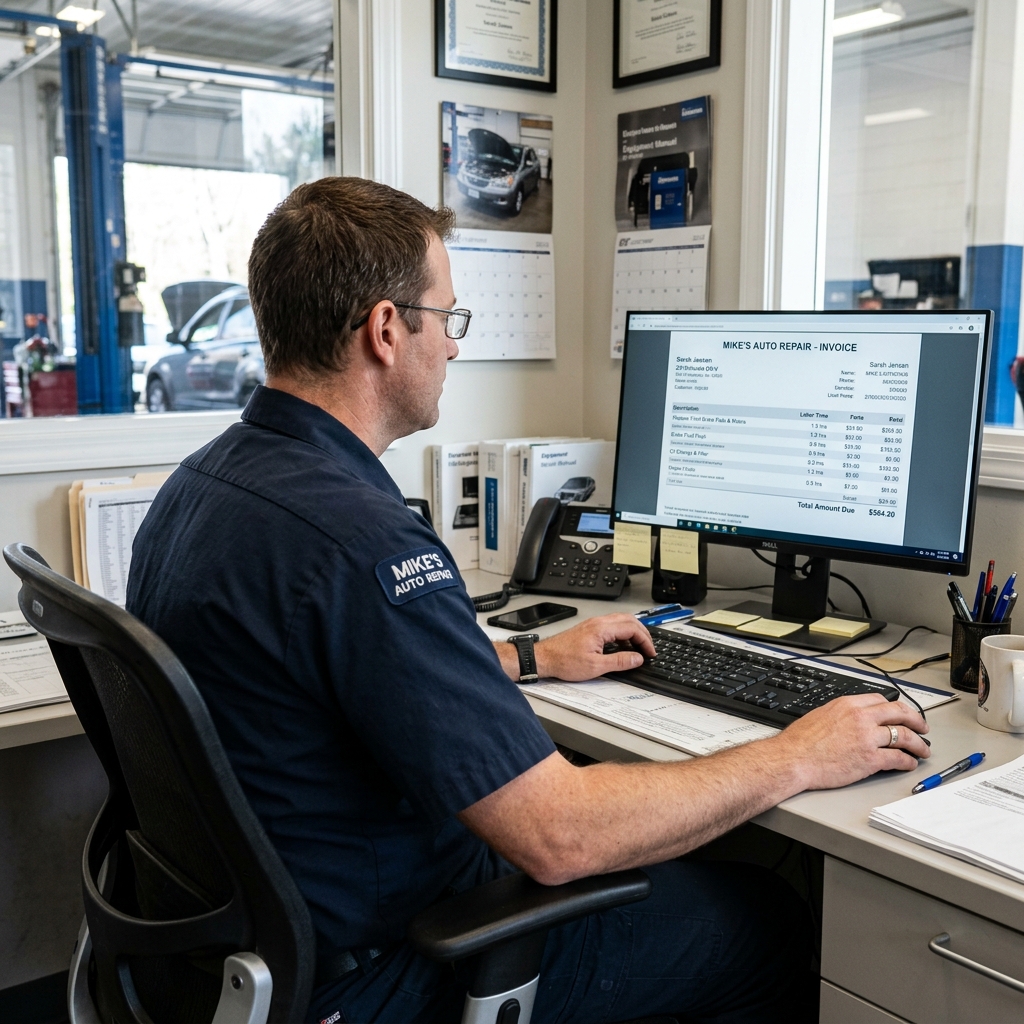
is a general-purpose invoicing platform, not an auto repair tool. But for independent mechanics, mobile technicians, or one-person operations who don't need a full shop management system, it's one of the most capable free options available.
The free plan supports unlimited invoices, client records, and payment links. The paid tier (around $10/month) adds features like recurring invoices, custom email templates, and advanced reporting. According to Invoice Ninja's own documentation, the platform has over 100,000 registered users worldwide — making it one of the most widely adopted free invoicing tools on the market.
What Invoice Ninja does well:
- Clean, professional invoice templates you can brand with your logo
- Client portal where customers can view and pay invoices online
- Payment integrations with Stripe, PayPal, and Square
- Expense tracking to log parts costs and shop overhead
- Mobile app for invoicing on the go (iOS and Android)
Use case: A mobile mechanic who handles 10–20 jobs per month and wants a professional invoicing tool without paying for a full shop platform. It's also a reasonable starting point for a new shop that isn't ready to commit to a subscription-based management system.
Invoice Ninja works as a stopgap, not a long-term solution for a growing auto repair business.
That gap becomes clear quickly. Invoice Ninja has no VIN lookup, no labor time guides, no parts ordering, and no digital inspection tools. You're building invoices manually, which means more time spent on admin and more room for pricing errors. There's no way to track technician efficiency, monitor repair order averages, or visualize job status across your shop floor.
From experience, shops that start with a general invoicing tool tend to outgrow it within the first year. Once you're handling multiple jobs per day, ordering parts from different suppliers, and trying to track which tech is working on what, a tool like Invoice Ninja creates more friction than it removes.
| Feature | Invoice Ninja (Free) | Invoice Ninja (Pro) |
|---|---|---|
| Unlimited invoices | ✅ | ✅ |
| Online payments | ✅ | ✅ |
| Client portal | ✅ | ✅ |
| Custom branding | Limited | ✅ |
| VIN lookup | ❌ | ❌ |
| Parts ordering | ❌ | ❌ |
| Labor time guides | ❌ | ❌ |
| Digital inspections | ❌ | ❌ |
| Starting price | Free | ~$10/month |
For a mobile mechanic looking for basic invoicing tools, Invoice Ninja is a solid pick. For any shop that wants to grow revenue, reduce admin work, and manage jobs efficiently, you'll hit its ceiling fast — and the switch to a purpose-built platform like RedAppy becomes a practical upgrade rather than an optional one.
Conclusion
The right mechanic invoice software depends on three things: your shop size, your budget, and how much of your workflow you want to manage in one place.
If you're an independent mobile mechanic or just need clean, professional invoices without paying for a full system, Invoice Ninja gets the job done at little to no cost. It won't know what a VIN is, but it handles the basics well.
If your shop leans heavily on OEM repair data and you want invoicing tied directly into labor guides, Mitchell 1 Manager SE is a proven option with decades of industry trust behind it. Expect a steeper learning curve and higher upfront investment.
For high-volume shops with dedicated service advisors and a need for deep reporting, Tekmetric delivers strong workflow visibility and analytics. The pricing reflects that — it's built for shops that can justify the cost through volume.
For most auto repair businesses — whether you're running a single-bay garage or managing multiple locations — an all-in-one platform replaces the patchwork of disconnected tools and pays for itself quickly.
RedAppy fits that middle and upper tier well. One subscription covers invoicing, digital inspections, parts ordering, online payments, a branded website, and an AI Repair Assistant. Shops using RedAppy report saving 10+ admin hours per week, which compounds into real revenue over the course of a year.
When comparing your options, run through this short checklist before committing:
- Do you need VIN lookup, labor times, and parts ordering — or just invoices?
- Will you process payments through the software, and what are the transaction fees?
- How many users or technicians need access?
- Do you want month-to-month flexibility or are you comfortable with an annual contract?
- Does the platform include a customer-facing experience like a website or inspection approvals?
The shops that get the most out of their software aren't necessarily using the most expensive tool — they're using the one that fits how they actually work.
If you're ready to move away from paper invoices and disconnected systems, start with a RedAppy demo to see how a purpose-built platform handles the full job cycle, from first call to final payment.
Frequently Asked Questions
What is the best invoice software for a mechanic shop?
Shop-Ware, Mitchell 1, and Tekmetric are widely regarded as top invoice software options for mechanic shops, offering features like labor time guides, parts ordering, and digital vehicle inspections. For smaller shops, solutions like Quickbooks or Invoice Ninja provide simpler invoicing with customizable templates. The best choice depends on shop size, budget, and whether you need full shop management or basic billing tools.
What is the best free invoice app for mechanics?
Wave is a popular free invoicing app that works well for independent mechanics, offering unlimited invoices, client management, and basic reporting at no cost. RepairShopr offers a free tier for single-user shops that includes repair tickets and basic invoicing. Both options allow mechanics to create professional invoices on mobile devices without upfront subscription fees.
How to create a mechanic invoice?
Start with your shop's name, contact information, and a unique invoice number, then list each repair job with a clear description, labor hours, and hourly rate. Itemize all parts separately with part numbers, quantities, and prices, then calculate subtotals, applicable taxes, and the final total. Most mechanic invoice software automates this process, reducing errors and saving significant time compared to manual templates.
What is the best software to generate invoices?
FreshBooks, QuickBooks, and Zoho Invoice consistently rank among the best general invoice generators, offering automation, tax calculation, and payment integration. For auto repair specifically, Tekmetric and Mitchell 1 are purpose-built solutions that combine invoicing with labor guides and parts databases. The ideal platform balances ease of use, industry-specific features, and pricing that fits your shop's revenue volume.
Ready to Transform Your Shop?
RedAppy helps auto repair shops create professional digital estimates with photos and videos, send them instantly via text or email, and get customer approvals in seconds. No credit card required to start.