
Online Auto Repair Quote Guide for Your Shop
The most popular advice about an online auto repair quote is to make it instant and lead with the lowest price. That's the weak version. A cheap headline doesn't help when the customer reaches the counter and discovers that hardware, diagnostics, or required calibration wasn't included.
A useful quote is a conditional, itemized authorization with a confidence label, not a claim that an inspection has already happened. It tells the customer what the shop knows, what remains uncertain, and exactly which work the customer is being asked to approve.
Table of Contents
- What an Online Auto Repair Quote Must Show
- Price Ranges When the Repair Is Still Uncertain
- How to Send a Quote Customers Can Approve
- Parts Options That Belong on the Quote
- Extra Work Rules Before You Add a Charge
- Turn On Quotes From Your Shop Website
What an Online Auto Repair Quote Must Show
A single total leaves too much room for disagreement. The customer can't tell whether the price includes rotors, premium pads, disposal, or only the labor to install customer-supplied parts. The advisor needs a record that explains the scope without another phone call.
An estimate is the price a shop quotes before work starts. California's describes an estimate as a paper or electronic document identifying the specific job and estimated parts and labor, and says the listed parts and repair method should be followed unless the customer agrees to a change.
That's a useful operating standard beyond a legal checklist: write the job clearly enough that another advisor could explain it accurately.
Build the customer record before the total
Start with the customer's contact details, shop identity, and an estimate reference. Identify the vehicle by model year, make, model, and VIN or plate, with the odometer reading when available. An unconfirmed vehicle should remain visibly unconfirmed rather than becoming the basis for a firm parts promise.
Describe the operation in everyday language. Replace front brake pads and rotors tells the customer considerably more than brake service. Keep the customer's complaint separate from the shop's proposed remedy, because a reported noise isn't proof of a failed component.
Line items every online auto repair quote should carry
| Line | What to show | How firm it is |
|---|---|---|
| Vehicle and job | Year, make, model, VIN or plate, odometer if known, and the specific repair in plain language | Required on every quote |
| Parts | Name, quantity, category, and price, not a lump sum | Itemized; category stated |
| Labor | Hours, rate, and dollar amount, separate from parts | Itemized |
| Fees and tax | Shop supplies, disposal, and tax on their own lines | Shown apart from labor |
| Confidence | Firm, likely, or needs inspection on each uncertain line | Stated before approval |
| Change rule | No unlisted work or parts without a new yes | Written on the quote |
Show labor as an operation, its estimated hours, the shop's rate, and the resulting amount. Put applicable supplies, disposal, and tax below the repair lines rather than folding them into labor. The total should be easy to reconcile with the individual charges.
Give each repair line a confidence label
Firm means the vehicle and defined operation are confirmed, such as an oil change with the correct oil specification and capacity. Likely means the proposed work reasonably matches the complaint but still needs confirmation. Needs inspection means the shop can't responsibly price the condition yet, including corrosion, seized hardware, or vehicle-specific electronic procedures.
Say a sedan arrives for front brake noise. The quote can name the proposed pad set, rotor quantity, selected parts category, and replacement labor while marking the diagnosis as unconfirmed until inspection. A hardware allowance should never become an approved replacement.
RedAppy estimates include parts and labor, support digital approval, and can carry inspection photos; video uploads are available with the Professional plan. Place that evidence beside the relevant operation, not in an unrelated message thread.
Practical rule: The customer should be able to identify the repair, the selected parts, the approved total, and the unresolved conditions without asking what the headline price left out.
Price Ranges When the Repair Is Still Uncertain
A warning light comes on, and the customer requests a price online. Quoting a replacement sensor immediately confuses a symptom with a diagnosis. The responsible starting point is a priced diagnostic operation with a clear boundary, not a guessed repair disguised as certainty.
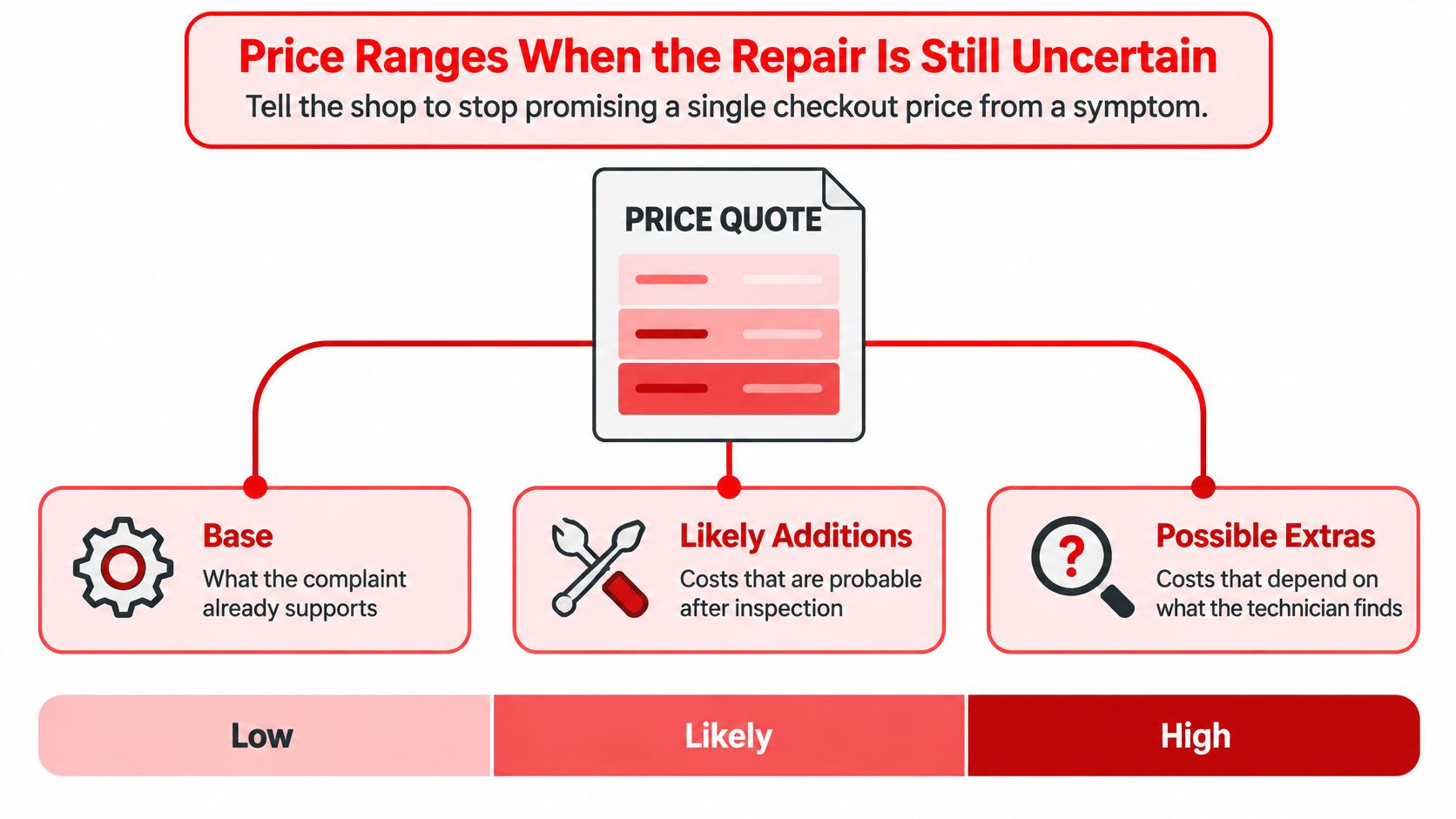
The advisor should separate the known work from probable additions and unresolved triggers. A range is useful only when the customer can see what moves the price from its lower end toward its upper end.
Separate the base from the unknowns
The base covers what the available information supports. For a confirmed maintenance operation, that may be the complete named job. For a warning light, it may cover diagnostic testing only, with repair pricing to follow.
Likely additions need a reason. Brake hardware may warrant a separate conditional line when the requested operation and vehicle application support it. The advisor should identify whether that line is included in the displayed range or sits outside the currently approved amount.
Possible extras remain named triggers until inspection establishes the need. Scans, programming, calibration, concealed damage, corrosion, and unavailable parts belong here when their scope hasn't been verified. An empty price field should say not yet priced, not appear as a free procedure.
How firm each online quote can be
| What you know | How to price it | What to tell the customer |
|---|---|---|
| Known maintenance on a confirmed vehicle | Firm parts and labor | This is the starting price for the named job |
| Symptom only, car not yet seen | Base range plus an inspection fee | The total can move after a look underneath |
| Scan, programming, or calibration may apply | Leave it as a named trigger, not a hidden zero | Added only after it is found and approved |
| Hidden rust, corrosion, or seized hardware | Do not invent one number | Photograph the finding and send a revision |
| Part not in stock | Show lead time and an in-stock alternate | Customer chooses before the shop orders |
Treat safety-system procedures as real scope
The documents widespread diagnostic scanning on direct-repair estimates and longer vehicle turnaround for repairs involving calibration. That's collision-repair evidence, not a claim that every maintenance ticket needs calibration, but it demonstrates why electronic procedures can affect both price and delivery.
A camera fault or collision-related complaint deserves an explicit note about potentially required procedures. The shop shouldn't promise a collection time while leaving the related specialist work unresolved.
A cheaper instant quote is less honest if it leaves required safety-system work off the page.
Put the authorization boundary in writing: contact the customer before exceeding the approved total. When inspection reveals seized hardware or hidden damage, the next communication should be a revised estimate with supporting evidence, not an unexplained invoice addition.
Diagnostic assistance can help prepare that revision. Nitro, available in RedAppy's Professional plan, provides labor times, diagnostic help, and repair guidance. Those suggestions support the advisor and technician; they don't replace inspection or turn an uncertain procedure into a confirmed charge.
How to Send a Quote Customers Can Approve
Consider a customer requesting a brake-noise estimate through the shop website. The strongest workflow keeps the request, vehicle details, findings, supplier selection, approval, and invoice on the same repair order. Retyping the job into separate documents creates opportunities to lose a part description or carry forward an outdated total.
The advisor owns the customer-facing explanation. The technician owns the inspection finding, and the estimate writer remains identifiable when another employee opens the job.
Keep the request and authorization together
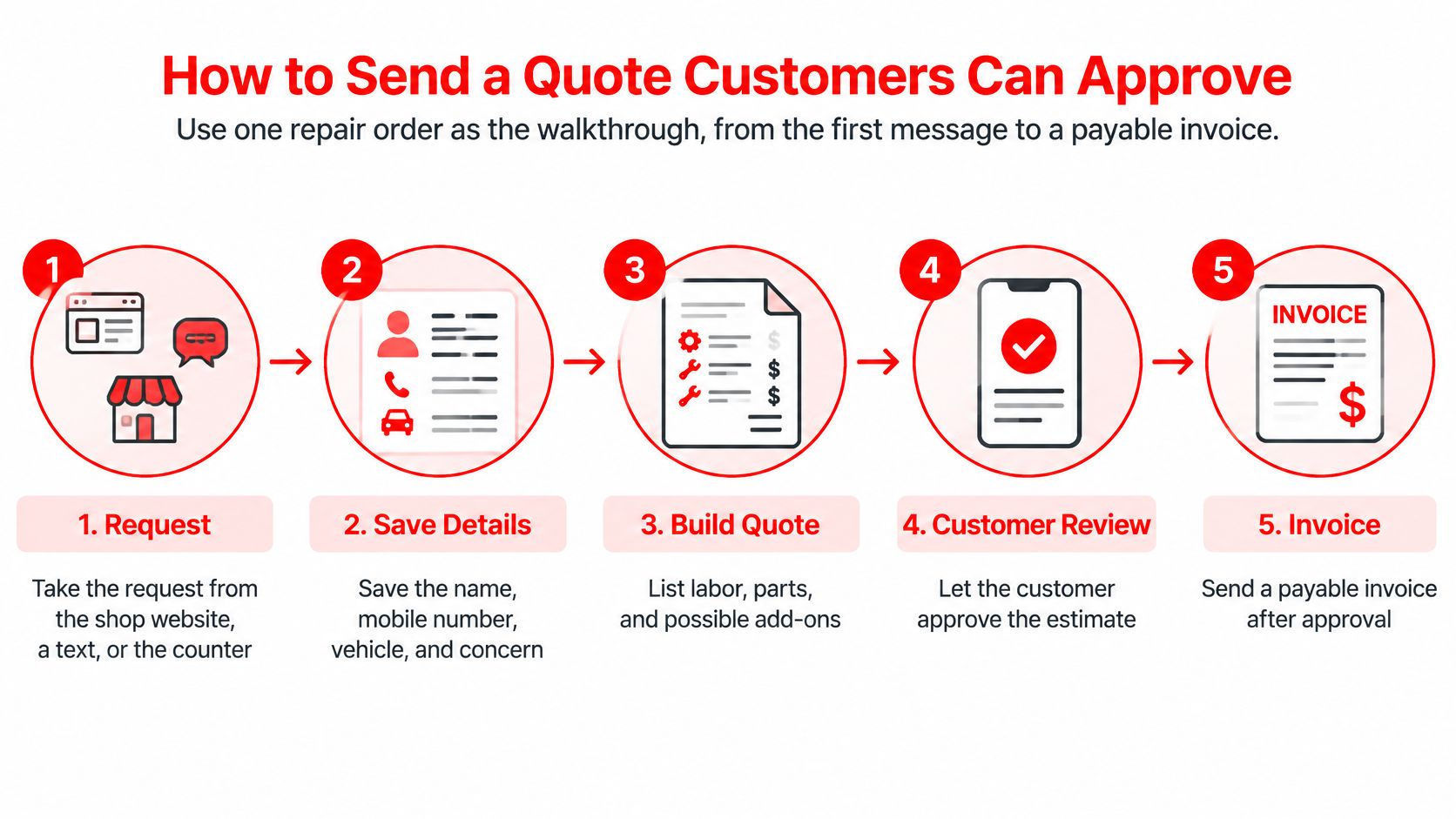
Capture the request on the job. The advisor saves the customer's name, mobile number, vehicle, and complaint whether the request comes from the website, a text, or the counter. Preserve the customer's description, such as noise during braking, without rewriting it as a confirmed diagnosis. That prevents the requested investigation from becoming an assumed repair.
Confirm the vehicle by plate or VIN. Before choosing parts or an operation, the advisor checks the vehicle record and available service history. Brake packages, engines, and production variants can change the appropriate selection. A recognizable model name alone isn't enough to establish fitment.
Build labor from a defensible operation. The estimate writer selects the work being priced and records hours rather than entering a round cash figure. Nitro combines industry-standard labor guides with the shop's historical data to estimate labor hours. The writer still checks for overlapping operations so related work doesn't carry duplicated labor.
Check supplier price and availability. The parts buyer or advisor checks live listings from suppliers such as O'Reilly, AutoZone, NAPA, and local sellers. Keep the selected part attached to the repair order, including the actual brand and availability. This prevents an attractive but unavailable listing from becoming a delivery promise.
Prepare the customer-facing estimate. The advisor separates parts and labor, applies confidence labels, and attaches the technician's photos to the relevant concern. Describe the proposed repair and distinguish it from optional recommendations. A photo of worn material needs an explanation of what the technician found, not just a red annotation.
Send the approval request. The customer receives the estimate by SMS or email, opens a link, reviews the labor, parts, and total, and approves it from a phone. The advisor checks that the message identifies the shop and the vehicle. An unexplained link from an unfamiliar number is a poor substitute for a clear request.
Carry the approved estimate into invoicing. The approved estimate becomes the invoice with one click. The advisor should still reconcile completed operations, approved revisions, and any declined work before presenting the payable invoice. Conversion removes re-entry; it doesn't remove the need for a final review.
Assign ownership before the first send
At the Monday-morning handoff, the advisor should own sending and follow-up, while the technician owns findings and evidence. The person responsible for the numbers should be visible on the repair order, so pricing questions don't circulate through the whole shop.
Unanswered quotes need a defined endpoint:
- Set an approval window. State when the pricing needs review, and expire the approval link where the system supports that control.
- Assign the follow-up call. Choose a shop-specific interval and name the advisor responsible.
- Record the outcome. Save the reason for a decline, release the reserved bay, and retain the quote so it can be reviewed before reopening.
A declined estimate isn't an abandoned record. Keeping the customer's decision attached to the job prevents a later conversation from starting with an outdated assumption.
Parts Options That Belong on the Quote
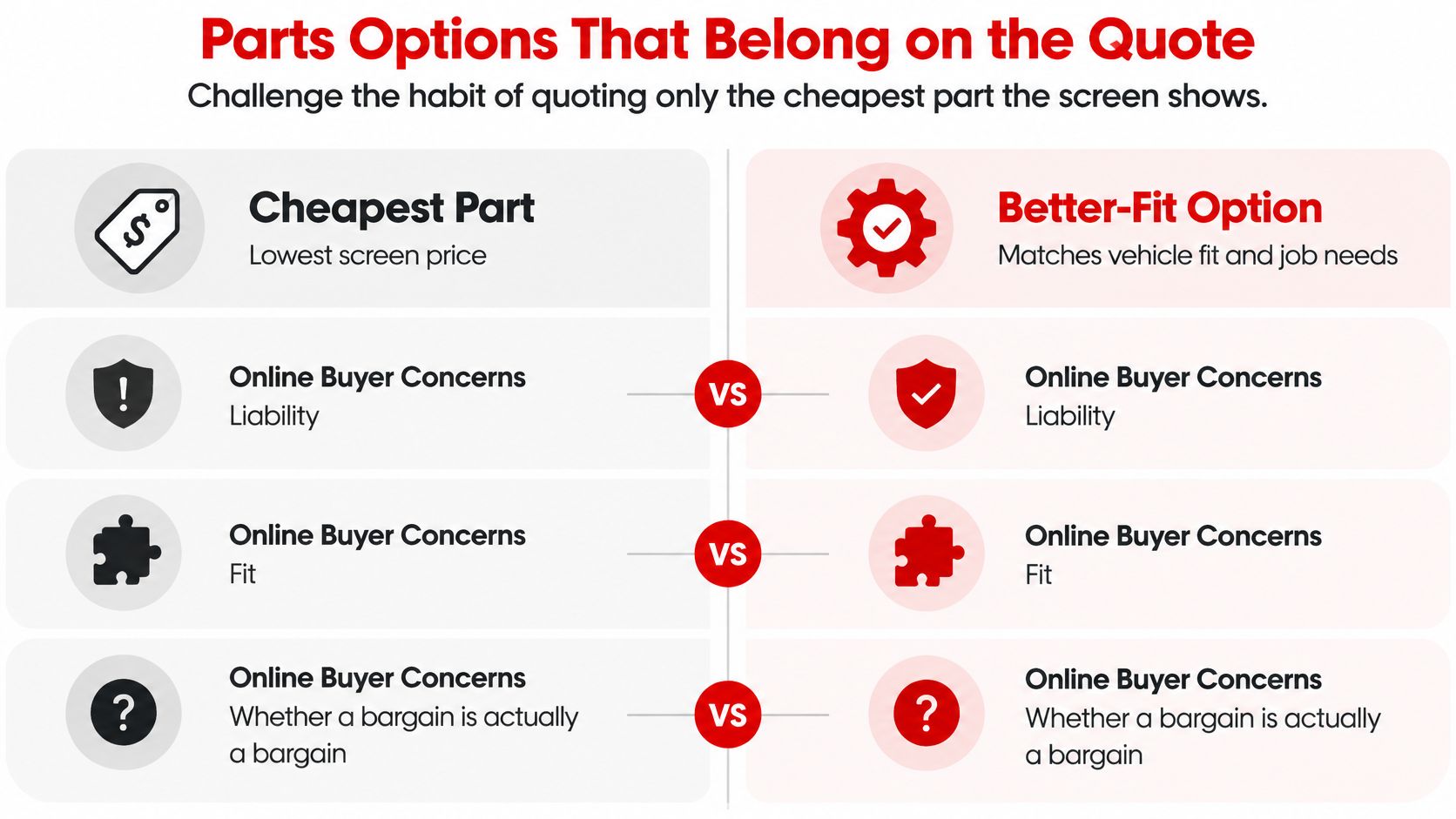
The cheapest part on the screen isn't automatically the best recommendation. A low purchase price can lose its advantage when the part arrives wrong, the warranty excludes a disputed failure, or the vehicle occupies a bay while another unit is sourced.
The identifies liability and whether a better deal exists elsewhere among online parts buyers' concerns. The practical response is to explain the selection, not assume every customer wants the lowest component price.
Compare categories against the actual job
For an alternator replacement, compare the available categories against fitment, condition, warranty, and delivery. New original-equipment and aftermarket units may be available alongside remanufactured or used units. That doesn't make every category an equally sensible recommendation.
Part types to show on the quote
| Part type | When it fits | Show on the quote |
|---|---|---|
| OEM | Safety systems and fit-critical parts | Higher price where applicable, traceable match to the vehicle |
| Aftermarket | Ordinary maintenance and wear items | Brand or grade, fitment, and warranty |
| Remanufactured | Alternators, calipers, steering, similar units | Core charge, warranty, and lead time |
| Used | Non-safety budget repairs with known condition | Condition notes and why it is acceptable |
OEM deserves consideration when a sensor or other fit-critical component must match a specific vehicle procedure. That doesn't mean every aftermarket component is unsuitable; the technician should verify the application rather than treating the category name as proof.
For ordinary pads or filters, a quality aftermarket option can be a reasonable default when the specification and warranty are clear. A remanufactured alternator may also be appropriate, but its core charge and return conditions belong in the comparison. A used unit requires a more cautious condition assessment and shouldn't be offered because it appears cheapest.
T1A Auto's explanation of offers useful background for customers comparing those categories. The shop's quote still needs to identify the actual product being recommended.
Preselect the defensible option
The advisor should preselect the verified-fit option with an acceptable warranty and realistic arrival, then present meaningful alternatives. The customer confirms any trade-off in price, delivery, or coverage. The technician retains responsibility for rejecting an unsuitable part.
Each recommendation should show the supplier, stock status, expected arrival if ordered, warranty terms, return restrictions, and total installed cost. Warranty wording should distinguish component coverage from any labor coverage rather than promising a blanket guarantee.
Nexpart Multi-Seller shows live supplier prices and availability and allows ordering from O'Reilly, AutoZone, NAPA, and hundreds more suppliers without leaving the repair order. Ordering from that record helps keep the promised brand aligned with the purchased component.
Parts-desk check: A verified in-stock alternative may be a better ownership decision than a cheaper part that leaves the vehicle waiting.
Extra Work Rules Before You Add a Charge
The technician removes a component and finds damage the original estimate didn't cover. Work on that additional scope stops while the advisor explains the finding, prices the new parts and labor, and obtains authorization. The approved total should be treated as a ceiling, not a suggestion.
requires customer consent for work or parts exceeding the estimate after the shortfall is identified and before the additional work is performed; it recognizes email and fax for approving increases. Other states have their own requirements, so the shop must check its governing rules rather than assume California's statute applies everywhere.
Save the decision, not just the conversation
A complete approval record identifies the customer, the additional work, the revised amount, and when consent occurred. It also connects the revision to the repair order and final invoice. A saved message saying that the customer called isn't the same as a documented authorization.
Ways a customer can approve a higher total
| Channel | What to save | When it counts |
|---|---|---|
| Phone | Name, time, amount, and the extra work described | Before the extra work, and written into the job |
| Text or estimate link | The customer's yes tied to the revised total | Before the extra work; keep the message |
| Explicit approval of the new parts and labor | Before the extra work; recognized for increases | |
| Signed or faxed copy | The revised estimate itself | Before the extra work; keep it with the invoice |
These are documentation practices, not a guarantee that every channel satisfies every jurisdiction. Telephone and electronic approvals need the records required by the applicable rules.
The recommends a written estimate identifying the condition, required parts, and anticipated labor, with approval sought before exceeding a specified amount of time or money where applicable under state law. It also recommends a completed repair order listing repairs, parts and their costs, labor, and odometer readings at drop-off and completion.
Fix the common documentation gaps
A rushed approval often fails because someone records the conversation but omits the decision. The correction belongs on the job before additional work begins.
- Verbal okay with no note. Record who approved, when, the described operation, and the authorized amount. Reconfirm anything that wasn't clearly agreed.
- Photo with no dollar amount. Send the priced revision. A photograph demonstrates a condition, not agreement to pay for its repair.
- Invoice that no longer matches approval. Reconcile the final lines against the saved authorization and investigate any difference before billing.
Limit pricing access as well as documenting consent. Individual team logins can identify who wrote an estimate, assign the technician, and control who can open the numbers. The shop should restrict editing authority so a technician's finding can't silently become a customer charge.
The advisor's final check is straightforward: every added invoice line should have an identifiable approval behind it. A missing record calls for investigation, not an assumption that someone else obtained permission.
Turn On Quotes From Your Shop Website
A quote request should be a front door to the shop, not a PDF produced after repeated phone calls. Service pages for oil changes, brakes, diagnostics, and AC repair give customers a relevant place to explain the work they're considering.
Ask for the customer's name, mobile number, plate or VIN, and symptom. Promise a reviewed estimate, not a final repair price before diagnosis. Route the request into the advisors' job board so the customer's information doesn't need retyping.
Launch with the working pieces connected
The website included with RedAppy is built to be search ready and includes pages for the services the shop offers. Its Starter plan costs $39 per month and is described as suitable for solo mechanics; Nitro and video uploads require the Professional plan.
Before publishing the request path, the shop should complete these checks:
- Load the template. Include the itemized repair lines and confidence labels.
- Enable labor guidance. Confirm the selected plan and operations support the intended workflow.
- Connect suppliers. Verify that quoted prices and availability come from the shop's suppliers.
- Test the message. Open the approval request on a staff phone.
- Print the change rule. Make additional-work authorization visible on every estimate.
Run a complete practice job through request, estimate, text link, approval, revision, and invoice before customers use it. Check both the customer's phone view and the advisor's saved record.
The feature examples show how estimates, inspections, and the shop website fit together. For a discussion of bay count, staffing, and the current handoff process, contact the team.
This week's action is concrete: the advisor sends the next real estimate as a phone link and holds any additional work until the revised link comes back approved.
RedAppy brings itemized estimates, digital inspections, customer approvals, parts ordering, and invoicing into the repair workflow. Visit RedAppy to explore a quote process that keeps the proposed work, customer decision, and final bill connected.
Ready to Transform Your Shop?
RedAppy helps auto repair shops create professional digital estimates with photos and videos, send them instantly via text or email, and get customer approvals in seconds. No credit card required to start.