
Parts Inventory Management for Auto Repair Shops
A technician is halfway through a brake repair when the expected part isn't on the shelf. The bay stays occupied, the customer calls for an update, and the service advisor starts searching distributor websites while the technician waits. The shop may eventually complete the job, but it has already lost productive time, customer confidence, and control of the repair order.
That situation rarely begins with one dramatic failure. It usually starts with a part received under the wrong description, a duplicate record, an unlogged return, or a component pulled from the storeroom without being assigned to a job. Parts inventory management turns those small process gaps into visible operating results by connecting what arrives, where it sits, who uses it, and how the cost reaches the invoice.
Table of Contents
- Why Parts Inventory Management Decides Shop Profitability
- The Four Core Components of Parts Inventory Control
- Key Performance Indicators Every Shop Must Track
- Common Pain Points and Hidden Cost Drivers
- Best Practices and Daily Workflows That Actually Work
- Software Features That Transform Parts Management
- Your Implementation Roadmap for Independent and Multi-Location Shops
Why Parts Inventory Management Decides Shop Profitability
A repair shop's parts room affects nearly every financial outcome on the front counter. When the right part is available and correctly assigned, the technician keeps working, the repair order moves forward, and the invoice reflects the actual work performed. When the record says a part is available but the shelf is empty, the same repair becomes a scheduling problem and a purchasing emergency.
The cost of a missing part reaches beyond the shelf
The obvious cost is the replacement order. The less obvious cost includes a delayed vehicle, a bay that can't be released, extra calls from the service advisor, and labor that can't be billed while a technician waits. A customer who was promised same-day service may also need a revised pickup time, a loaner arrangement, or a second explanation for why the repair has stalled.
A parts program also affects job costing. If a technician uses a filter, fluid, gasket, or hardware item without recording it, the shop may complete the repair while underreporting its material cost. The invoice looks complete, but the gross margin is weaker than the system suggests. That makes future pricing decisions unreliable because managers are comparing repair types using incomplete information.
Practical rule: Every part that enters a repair workflow needs a traceable path from purchase order to repair order, invoice, return, or approved adjustment.
Availability and cash must be managed together
Keeping everything on hand isn't a solution. Automotive parts move at different speeds and carry different levels of service importance. Published automotive guidance places overall dealership parts-counter turnover at 4 to 10 turns per year, while fast-moving filters and wiper blades may turn 12 to 30 times annually, and slow-moving body panels may turn fewer than 2 times per year. shows why one average turnover figure can conceal serious stocking mistakes.
A shop that treats a body panel like a fast-moving filter ties up cash in the wrong place. A shop that treats a frequently used service item like a special-order component creates avoidable delays. Good parts inventory management separates velocity, criticality, and customer ownership instead of applying one blanket rule to every SKU.

Independent shops feel these errors quickly because fewer people cover receiving, purchasing, service writing, and inventory control. Multi-location operators face another layer of exposure. A part may be available in one shop but invisible to another, so the second location places a new order while usable stock remains idle elsewhere. The result is duplicated purchasing, crowded shelves, and unreliable working-capital decisions.
The Four Core Components of Parts Inventory Control
Parts control works only when the physical movement and the digital record match. Four connected activities keep that alignment intact: receiving, stocking, tracking, and replenishment.
Receiving starts with verification
The receiving employee should compare the shipment with the purchase order and packing slip before putting anything away. The check should cover part number, quantity, supplier, condition, and any core or return requirement. Damaged packaging belongs in a review area, not directly in an active bin.
Logging the part immediately matters because end-of-day entry creates a gap between physical availability and system availability. During that gap, a service advisor may promise a repair based on a shelf item that hasn't been counted, priced, or assigned correctly.
Stocking creates physical clarity
Every active item needs a defined bin location and a readable label. Customer-sold parts should remain distinguishable from operating stock, such as fluids, shop supplies, filters used across routine services, and general hardware. The distinction is operational, not merely accounting-related. A customer-sold component belongs to a specific repair order, while operating stock supports the work itself and may be consumed across many jobs.
The guidance from uses this distinction to help shops decide whether an item is sold to customers, ordered regularly, and sold frequently. Mixing the categories makes job costing less accurate and can make a normal supply item look like unexplained shrinkage.
Tracking needs live status
A useful record answers three questions without a phone call to the parts room:
- On hand: What can be issued now?
- Allocated: What has already been reserved for a repair order?
- On order: What is expected, from which supplier, and at what cost?
Barcode scans can support this process, but the scan must connect to the repair order or purchase order. A whiteboard may show that a part was expected, yet it won't reliably record whether the part was received, installed, returned, or moved to another location.
Replenishment follows demand and lead time
Min and max settings should reflect usage velocity, supplier lead time, seasonal demand, and the part's service importance. Fast-moving maintenance items may justify regular shelf stock. A specialty component with irregular demand may belong in a controlled order-on-demand category unless a delayed repair would create an unacceptable service problem.
Key Performance Indicators Every Shop Must Track
A parts room can't be managed by shelf impressions alone. The NADA framework identifies seven foundational indicators for automotive parts inventory performance: days' supply, level of service, obsolescence, non-stock investment, non-stock sales, emergency purchases, and lost sales. The also explains how days' supply can use 30-, 90-, and 360-day sales averages, and how gross turns derive from dividing 360 days by days' supply.
The essential measurement set
The following table gives managers a practical starting point. Targets should be assigned by part class rather than applied as a single shop-wide average.
| KPI | Target Benchmark | What It Reveals | Cash Flow Impact |
|---|---|---|---|
| Inventory turnover | 4 to 10 turns overall in published dealership guidance, with faster and slower classes separated | How quickly each part category moves | Identifies cash trapped in slow stock |
| Days' supply | Calculated from sales history and stocking policy | How long current stock may support demand | Connects shelf quantity to working capital |
| Level of service | Track fulfilled requests and unfilled repair orders | Whether needed parts are available when promised | Shows the cost of delays and lost work |
| Obsolescence | Review items with no movement and aging risk | Which parts occupy space without supporting current demand | Flags cash that may never return |
| Non-stock investment | Monitor special-order and non-stock commitments | How much money sits outside routine shelf stock | Limits uncontrolled purchasing |
| Emergency purchases | Record urgent orders by reason and supplier | Where forecasting, receiving, or master data failed | Exposes avoidable freight and rush costs |
| Lost sales | Log every unfilled request or use a dedicated non-part code | Demand the shop couldn't satisfy | Shows revenue and trust lost through stock gaps |
| GMROII | Compare gross margin generated with inventory investment | Which categories earn their shelf space | Supports higher-quality buying decisions |
Days' supply and turnover should be read together. The NADA worked example shows that 34 days' supply equals 10.6 gross turns, which gives managers a direct way to translate inventory duration into movement. A separate automotive guide explains that days on hand is calculated as 365 divided by turnover, so a 10-turn operation holds about 36.5 days of inventory, while a 4-turn operation holds about 91.25 days. provides the calculation context.
Service level needs a transaction trail
Fill rate isn't useful if the shop records only successful requests. The NADA method recommends logging each unfilled repair order or using a dedicated “non-part” code, then dividing lost-sales postings by total repair orders. That approach turns a vague complaint about stockouts into a measurable service-level problem.
Slow-moving parts need special forecasting discipline. A study covering approximately 14,000 spare parts found that prediction intervals using Beta-PERT and triangular distributions reduced inventory costs by more than twofold for low-demand parts, while systematic overestimation increased inventory costs by 50.7% with minimal service-level improvement. Research on forecast intervals and bias supports a practical conclusion: low-demand items need better uncertainty management, not just larger buffers.
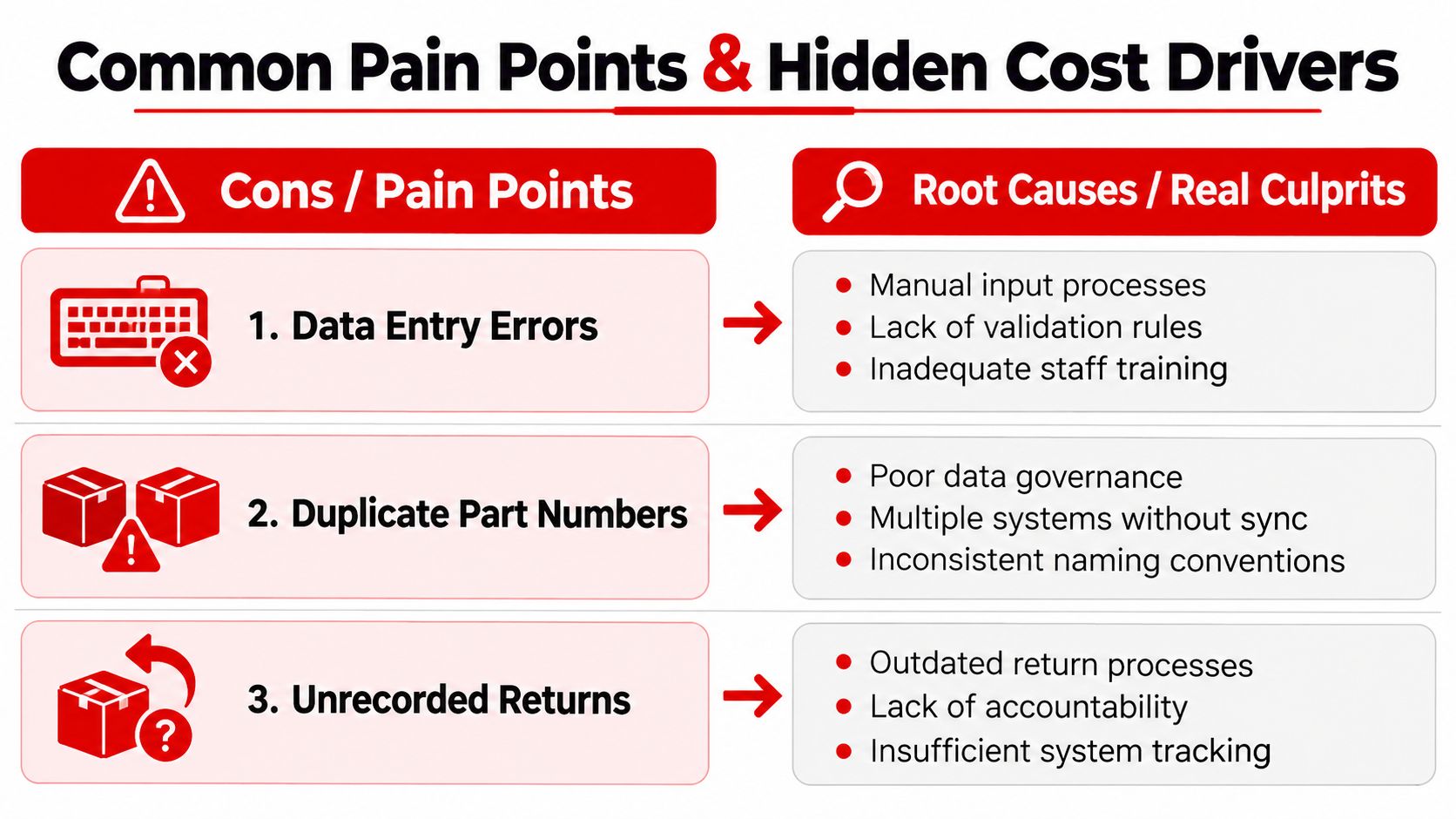
Common Pain Points and Hidden Cost Drivers
Many owners blame shrinkage when the count in the system doesn't match the shelf. Physical loss happens, but spare-parts research points to procurement delays, pricing issues, demand changes, and data entry errors as major contributors to variance, while shrinkage percentage showed no significant relationship with inventory variance. shifts the management focus toward process quality, purchase timing, and master data.
Phantom stockouts begin with bad records
A technician pulls a part without scanning it out. A service writer creates a second record because the existing description is hard to find. A returned core goes into a corner, but the vendor credit never reaches the purchase record. Each event leaves the system less trustworthy.
Duplicate records are especially damaging in multi-location operations. One shop may list a component by manufacturer part number, another by an internal description, and a third by an older catalog reference. Staff can't confidently search for available stock, so purchasing defaults to a new order.
A system that can't identify the part, its location, and its status will make an expensive decision look reasonable.
The hidden cost isn't limited to the part itself. Incorrect records can trigger emergency sourcing, duplicate freight, rushed approvals, and unnecessary customer updates. They can also distort job costing when the system assigns the wrong cost or fails to deduct the used item.
Location transparency controls purchasing
A large industrial inventory whitepaper describes the problem as a lack of transparent data showing which spare parts are available at which location. It reports common-parts rates of 15% to 25%, sometimes above 40%, and says up to two-thirds of ERP records can be incorrect because of missing information, inconsistent spelling, duplicates, and recoded records. is industrial rather than shop-specific, but the operational lesson applies directly to growing repair groups.
A multi-location parts inventory management process should therefore show:
- One standardized identity: Manufacturer number, internal SKU, description, brand, and unit of measure should resolve to one usable record.
- One location view: Staff should see on-hand, allocated, and on-order quantities by shop.
- One exception queue: Unmatched receipts, duplicate records, missing credits, and unexplained adjustments need ownership.
Overstock creates the opposite problem. Slow-moving parts occupy shelf space, tie up cash, and make active items harder to find. Managers should review aging stock for transfer, supplier return, alternate use, or controlled disposal instead of allowing it to remain invisible.
Best Practices and Daily Workflows That Actually Work
The most reliable inventory routines fit between normal repair activity. They don't require the shop to close the parts room for a major annual count or expect technicians to complete lengthy forms while a customer waits.
Organize shelves around movement
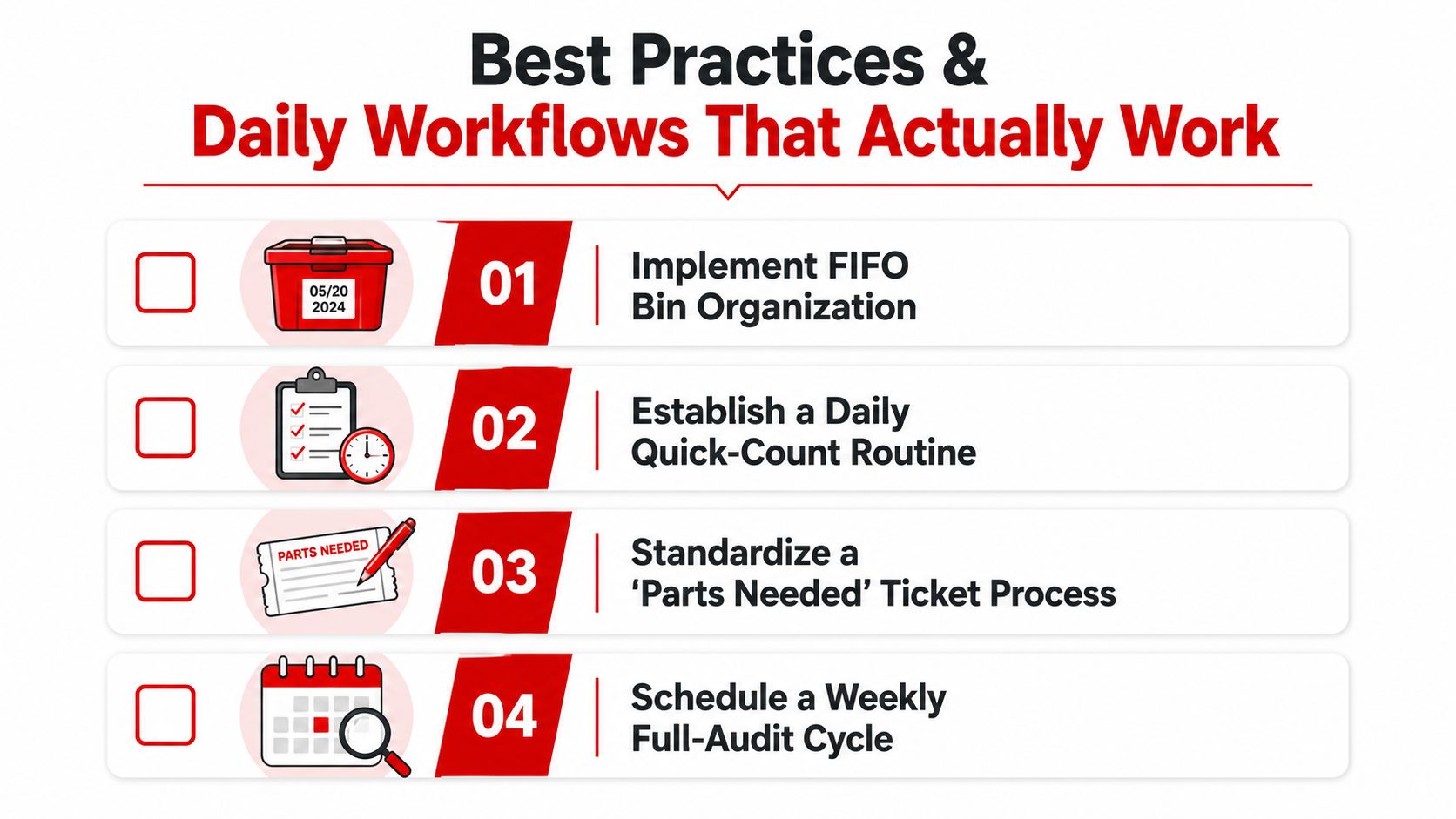
Fast-moving brake pads, filters, bulbs, and common hardware should sit where staff can reach and identify them quickly. Slow-turn items can move to less accessible shelves, provided the location remains accurate and visible. recommends categorizing by usage frequency, keeping high-turn items available, avoiding unnecessary slow movers, and using FIFO, first in, first out, so older parts leave the shelf before newer receipts.
FIFO needs a physical habit. Staff should place new stock behind older stock and use date stickers where shelf life matters, particularly for adhesives, sealants, and similar materials. A date label turns an invisible aging problem into something a technician can act on.
Count by risk, not convenience
A practical cycle-count program gives the most attention to items that move quickly, cost more, or create major repair delays when missing. A shop can assign weekly checks to A-velocity items, monthly checks to B items, and quarterly checks to C items, then adjust those categories based on actual variance.
The count is only useful when discrepancies receive a reason code. “Short” isn't a root cause. The employee should record whether the issue came from an unposted issue, receiving error, incorrect unit of measure, return problem, duplicate record, or location transfer.
Tie every issue to the repair order
The parts room shouldn't function as a black hole. A service advisor can reserve a part when the estimate is approved, the technician can confirm usage at installation, and the system can return unused items to available stock when the job closes.
Purchase orders deserve the same discipline. The receiver should reconcile ordered, shipped, received, backordered, damaged, and returned quantities before the order is closed. Core parts should have their own status, due date, vendor, and credit confirmation so rebuildable components don't disappear into an unclaimed value category.
Software Features That Transform Parts Management
A spreadsheet can document a list, but it struggles to represent a living repair operation. The weakness appears when staff need to reserve a component, compare supplier availability, transfer stock between locations, or connect actual usage to job profitability.
Compare the workflow, not the feature count
| Feature Category | Spreadsheet/Basic Tools | Integrated Shop Management |
|---|---|---|
| Part search | Depends on consistent manual naming | Searches by part number, brand, name, or bin number |
| Job allocation | Staff update cells manually | Parts connect directly to estimates, repair orders, and invoices |
| Purchase status | Separate notes or tabs | Shows received, allocated, on order, and returned status |
| Cost tracking | Manual price updates | Connects part cost with job costing and replenishment |
| Supplier sourcing | Manual website and phone checks | Supports supplier ordering and availability comparison |
| Multi-location visibility | Separate files or delayed updates | Shared view of stock and transfer opportunities |
| Reorder control | Formula maintenance by staff | Thresholds and alerts based on configured usage rules |
| Audit trail | Depends on user discipline | Records inventory movements and adjustments in the workflow |
The useful capabilities are specific. describes search by part number, brand, name, or bin number, while connected inventory workflows can show what is in stock, what is on order, and what each item costs. That connection supports both replenishment and accurate job costing.
A platform such as RedAppy combines parts tracking with estimates, invoices, scheduling, customer history, and supplier ordering. Its stated product capabilities include inventory records for parts, fluids, and supplies, automatic deduction when items are used on estimates or invoices, low-stock alerts, and visibility across multiple suppliers. Shops evaluating the purchasing side can also review how to when supplier communication is creating unnecessary manual work.
The integration test
A shop should ask what happens at the exact moment a part moves. Does the system reserve it when the estimate is approved? Does it deduct the item when the invoice is issued? Can a service advisor see that another location has the part? Can the manager identify a cost mismatch without opening several files?
If the answer requires duplicate entry, the software may be moving the same problem into a digital format. The strongest system is the one staff can use during a busy repair, not just the one that produces a polished report afterward.
Your Implementation Roadmap for Independent and Multi-Location Shops
A parts reset shouldn't begin with a large purchase or a full-room shutdown. It should begin with a controlled cleanup that gives the team a reliable foundation.
Phase one establishes trustworthy records
The first phase audits active records, removes duplicates, standardizes descriptions, confirms part numbers, and assigns physical locations. Managers should also establish baseline measures for turnover, days' supply, service level, emergency purchases, lost sales, and aging stock.
For a single-bay shop, a focused implementation can be organized across 90 days. The early work should prioritize the parts that affect current repair orders, not every historical record that has never moved.
Phase two connects people and transactions
Receiving must connect to purchase orders. Parts issuing must connect to repair orders. Service writers and technicians need a short, enforced process for reserving, installing, returning, and adjusting items.
The training should use real shop examples. A brake job, a fluid service, a returned alternator core, and a backordered sensor will expose more workflow problems than a generic software demonstration.
Phase three adds optimization
Once records and transactions are stable, managers can activate reorder thresholds, formalize cycle counts, review supplier performance, and segment inventory by velocity and criticality. Forecasting should account for changing vehicle mix and supplier uncertainty rather than rely only on an old average.
A market analysis reported U.S. new-vehicle inventory of 2.73 million units in May 2025, with hybrid inventory up 76.5% year over year and EV inventory up 5.6%, while tariff expectations contributed to sharp brand-level swings. illustrates why stable historical demand may not remain a safe assumption for every parts category.
Multi-location control needs its own phase
A three-location group may use a six-month rollout to standardize records, centralize reporting, enable inter-shop transfers, and align vendor agreements. Each location should retain operational accountability, but purchasing decisions need a shared view of stock, demand, and supplier performance.
The most common mistake is trying to change everything during peak season. Managers should start with one workflow, prove that staff can follow it under pressure, then expand. A clean part record and a dependable repair-order transaction will deliver more value than a long list of unused settings.
Explore RedAppy's features to see how integrated inventory, parts ordering, repair orders, invoicing, and shop workflow tools can fit together, or contact the RedAppy team to map a parts inventory management roadmap around the shop's locations, suppliers, and daily repair process.
Ready to Transform Your Shop?
RedAppy helps auto repair shops create professional digital estimates with photos and videos, send them instantly via text or email, and get customer approvals in seconds. No credit card required to start.