
Parts Order Tracking: Manage Your Shop's Flow
A vehicle is on the lift, the customer is waiting, and the technician can't finish because one part is still missing. The service advisor calls a supplier, checks a portal, searches an email thread, and discovers that the order was split across two deliveries. Nobody can say with confidence whether the part is confirmed, back-ordered, or sitting at a counter under the wrong repair order.
That daily uncertainty costs more than time. It ties up bays, delays customer updates, creates duplicate purchases, and makes completed work harder to invoice accurately. Effective parts order tracking gives the service advisor, technician, and manager one reliable view of what was ordered, where it is, and what needs to happen next.
Table of Contents
- Why Missing Parts Are Your Biggest Revenue Leak
- Core Features That Make Tracking Work
- Common Shop Workflows Explained
- Pain Points Solved by Integrated Systems
- How to Choose the Right Tracking Solution
- Best Practices for Implementation
Why Missing Parts Are Your Biggest Revenue Leak
The most expensive parts problem isn't always the part itself. It's the vehicle that stays on a lift while the team waits for an answer.
A service advisor may have approved a repair, selected a supplier, and received a verbal promise for delivery. Then the supplier changes the availability, ships only part of the order, or substitutes a component without the front desk noticing. The technician moves to another job, the customer calls for an update, and the shop spends more time reconstructing the order than progressing the repair.

The scale of the parts network explains why a simple status note isn't enough. The recorded $116.7 billion in motor-vehicle and motor-vehicle-parts merchant-wholesaler inventory in 2022, compared with $96.6 billion in 2021. The parts-and-supplies merchant-wholesaler group rose from $30.3 billion to $34.6 billion over the same period. Those figures describe merchandise held for sale, not a repair shop's own stock, but they show the size and complexity of the network behind an ordinary parts request.
The hidden cost of uncertainty
An unmanaged order creates several connected risks:
- Bay capacity: A vehicle can occupy a working position while the technician has no usable part.
- Customer confidence: Vague updates make the shop appear disorganized, even when the supplier caused the delay.
- Cash flow: The business may have approval for the job but can't complete, invoice, and collect payment.
- Purchasing accuracy: A second employee may order the same component after failing to find the first order.
- Scheduling: The front desk can't allocate technician time confidently without a verified arrival.
The problem becomes more visible during supply disruptions. The Texas Comptroller reported that average semiconductor order wait times reached 18 weeks in May 2021, while manufacturers were expected to produce 1.5 million to 5 million fewer vehicles than planned because of component shortages. Repair shops don't face the same manufacturing workflow, but the lesson applies: a delay can travel through multiple businesses before it reaches the customer.
Practical rule: A part order isn't complete when someone clicks “buy.” It's complete when the correct quantity has been received, checked, assigned to the repair order, and made available to the technician.
For unusual commercial-vehicle repairs, a specialist such as a can be a useful resource when the required component needs a more focused source. The same tracking discipline still applies, regardless of the supplier: record the request, confirmation, promised arrival, exceptions, and receipt against the right vehicle.
Core Features That Make Tracking Work
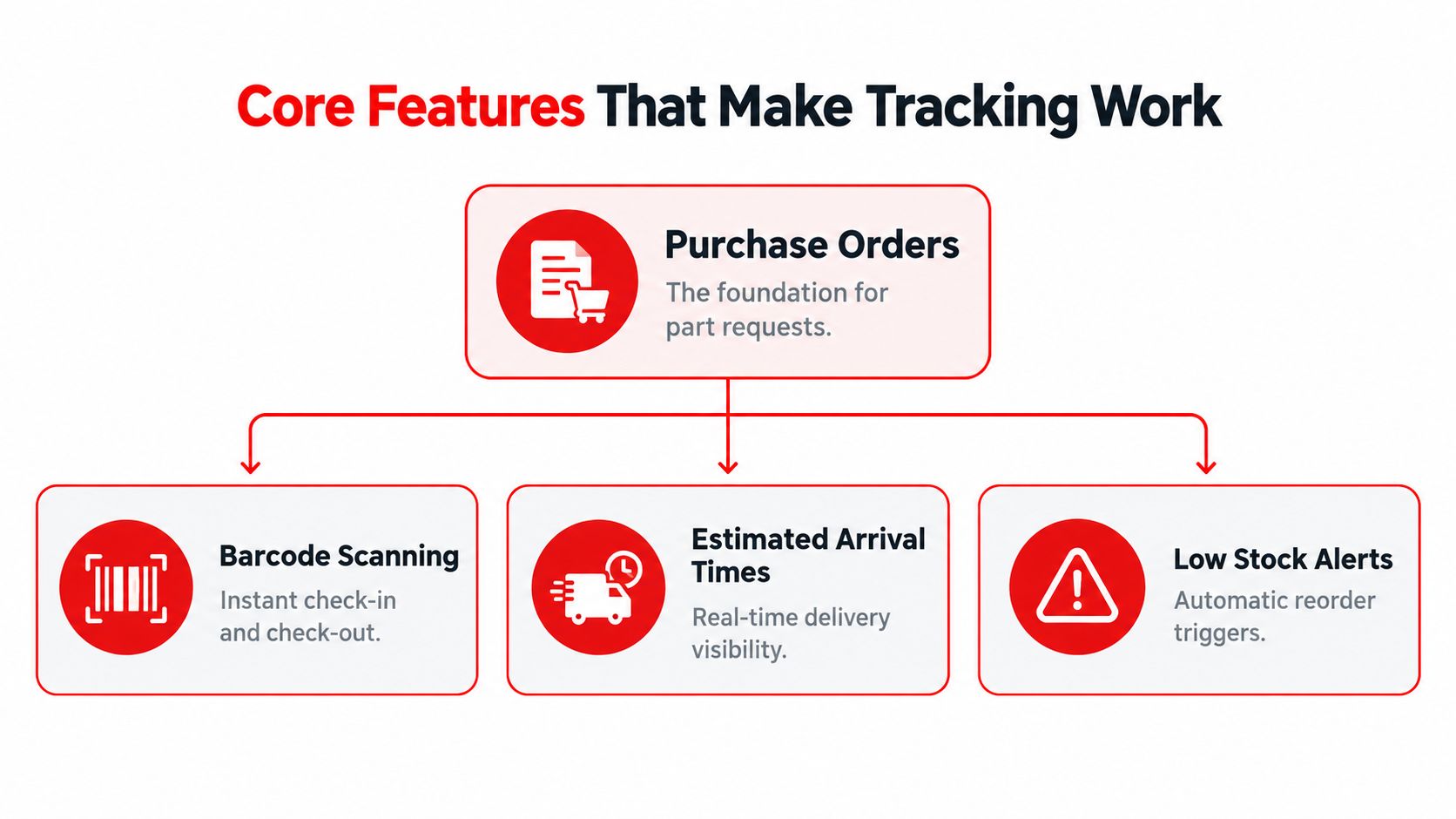
A useful tracking system turns a purchase into a visible workflow. It should show the purchase order, the specific vehicle or job, the supplier, the requested quantity, the expected arrival, and every meaningful status change.
Research into automotive component supply chains identifies mismatched order quantities, variable lot sizes, unreliable lead times, and inaccurate system data as causes of stockouts and excess inventory. One analyzed original-equipment-manufacturer context accumulated as much as 18 months of supply, according to the. An independent repair shop doesn't need a complex manufacturing system, but it does need accurate, item-level records.
Purchase orders establish responsibility
The purchase order should connect the part to the repair order before the supplier receives the request. It needs the part number, description, quantity, supplier, agreed cost, vehicle, and customer job.
That connection prevents a common front-desk failure: a delivery arrives with a packing slip, but nobody knows which vehicle needs it. It also gives managers a record to compare against the supplier invoice and the final customer invoice.
ETAs need context
An estimated arrival time is useful only when the system distinguishes between a supplier promise and a verified event. “Available” may mean the supplier sees stock in a catalogue. It may not mean that the part has been reserved, picked, or dispatched.
A dependable record should distinguish:
- Requested: The shop has identified the need but hasn't received confirmation.
- Confirmed: The supplier has accepted the order and stated an expected arrival.
- In transit: The shipment has a recorded dispatch event.
- Back-ordered: The supplier can't fulfill the request immediately.
- Received: The shop has checked the quantity and condition.
- Exception: The line is late, short, substituted, damaged, or otherwise blocked.
Shipment visibility works best when a shop understands the difference between a carrier scan and a usable arrival. The practical principles behind apply here too: a status should help the team decide what to do, not merely display movement.
Scanning closes the loop
Barcode or RFID scanning at receiving creates an event history from order creation through installation or return. Automotive logistics research found that RFID-enabled visibility can support responsive operations, share inventory information, prevent sequencing errors, reduce manual work, and avoid shortages or incorrect deliveries, as described in this.
A scan can confirm the supplier quantity against the purchase-order line and vehicle demand. If a line is short or substituted, the system should keep the exception open rather than marking the entire order received.
Common Shop Workflows Explained
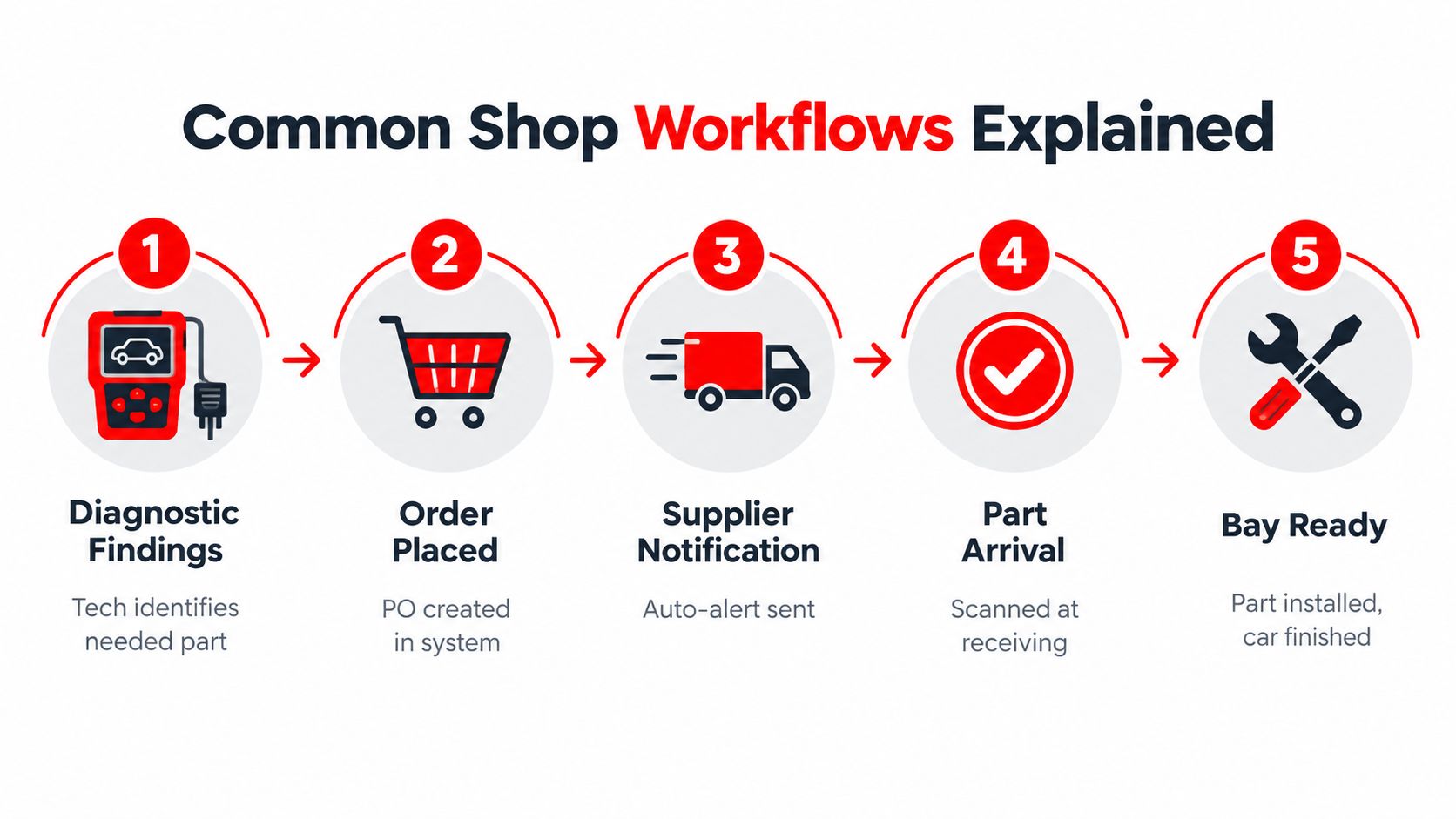
The cleanest workflow begins with the repair order, not the supplier website. When a technician identifies a failed component, the part request should be created inside the job record while the vehicle, customer, diagnosis, and approval are still visible.
Step one starts with verified demand
The technician records the required component, including the part number where available, quantity, notes about compatibility, and any related hardware. The service advisor checks the request before placing the order. This small pause prevents a fast but incorrect purchase based on an incomplete diagnosis.
The system should preserve the link between the part and the vehicle. A loose note saying “order sensor” doesn't tell the receiving team which car needs it, whether the order is approved, or whether another supplier has already been contacted.
Supplier selection should reflect the job
The service advisor compares availability, expected arrival, price, return terms, and confidence in the supplier record. Price matters, but it isn't the only consideration. A lower quoted price becomes expensive if the part arrives late, fails inspection, or requires another call to confirm its location.
The parts request then becomes a purchase-order line. That line should remain visible even if the shop changes suppliers, splits the quantity, or accepts an approved substitution.
Receiving must be an active step
When the delivery arrives, the receiver scans or enters the part, checks the quantity and condition, and assigns it to the correct repair order. A delivery that sits unopened on a counter isn't operationally received. The system should also record damaged packaging, an incorrect part number, missing hardware, or a replacement that doesn't match the approved specification.
The final step is installation. The technician sees that the correct part is available, completes the repair, and records any return or unused quantity. The service advisor can then move the vehicle toward inspection, invoicing, and collection without searching through supplier messages.
The useful question isn't “Was the order delivered?” It's “Can the assigned technician use the correct part on this vehicle now?”
This workflow also supports clear communication. If the supplier changes the promised date, the advisor can update the customer and move the job in the schedule before the vehicle blocks a bay without explanation.
Pain Points Solved by Integrated Systems
Disconnected tools create small gaps that become operational problems. A spreadsheet may contain the order number, a supplier portal may contain the shipment status, an email may contain the revised ETA, and the repair order may contain none of those details. The employee who needs the answer has to join the pieces manually.
Independent repairers commonly work with multiple suppliers and dealers. Survey data from the OEC U.S. General Auto Repair Shop Survey/Reports%20Mockups/The%20OEC%20US%20General%20Auto%20Repair%20Shop%20Survey%20Report.pdf?hsLang=en) found that U.S. repair shops work with an average of 5.8 suppliers and dealers, while parts availability was the leading ordering criterion for 34% of respondents. That makes a single shipped or delivered label too shallow for daily operations.
One order can have several realities
A single repair may involve one supplier for the primary component, another for a gasket, and a local distributor for a fastener or fitting. One line can be confirmed, another back-ordered, and a third delivered to the wrong location.
An integrated view should show the status of each line against the vehicle:
| Status | Operational question |
|---|---|
| Confirmed | Has the supplier accepted the exact part request? |
| Reserved | Is the part actually held for this shop? |
| In transit | Has the shipment left the supplier? |
| Delayed | What new action or customer update is required? |
| Partially received | Which quantity is still missing? |
| Inspected | Can the technician install it? |
This distinction matters because supplier-reported availability isn't the same as reserved stock or delivered stock. A supply-chain visibility study found that multi-tier visibility was available for only 10% to 20% of critical commodities when companies assessed supplier capacity and stock-on-hand information in advance, as reported in this.
Exceptions need owners
A system should assign an action when an order changes. A late line can trigger a supplier follow-up, a back-order can prompt an alternative search, and a failed delivery can alert the front desk before the customer calls.
The automotive aftermarket still faces separate risks in availability and delivery. Industry benchmark data reported that only 64% of top automotive-parts logistics providers achieved on-time delivery performance of at least 95%, while 35% of aftermarket professionals identified stock-outs as a significant challenge, according to the. A shipment can therefore arrive on time but incomplete, or complete but late. The system needs both fields.
Manual work doesn't disappear just because a shop owns software. The improvement comes from keeping the repair order, supplier record, receipt, exception, and customer communication connected.
How to Choose the Right Tracking Solution
A fragmented setup can look inexpensive because each tool solves one narrow problem. The actual cost appears when staff copy information between systems, sign in to several supplier portals, or ask the same question twice because the first answer isn't attached to the repair order.
An integrated platform should be judged by the decisions it helps staff make. Can the service advisor see every open line for a vehicle? Can the receiver identify the correct job without calling the front desk? Can the manager compare promised and actual delivery performance? If the answer is no, a carrier link alone won't solve the shop's problem.
Fragmented tools versus one operational record
| Fragmented approach | Integrated approach |
|---|---|
| Supplier portals hold separate status records | Orders appear against the relevant repair order |
| Staff retype part numbers and quantities | Purchase-order data carries into receiving and invoicing |
| Delays are discovered during follow-up calls | Exceptions can create internal actions |
| Delivery confirms movement only | The record shows confirmation, receipt, inspection, and installation |
| Supplier performance is hard to compare | Promised dates can be measured against actual events |
A shop doesn't need every advanced feature immediately. It does need a reliable foundation: accurate parts data, supplier connections, repair-order links, receiving controls, and role-based visibility.
Predictive tools have a place
Digital technologies such as the Internet of Things, blockchain, and AI-based predictive analytics are being studied for component tracking, inventory monitoring, forecasting, and inventory optimization, as described in this automotive supply-chain technology research. For a repair business, the practical value is simpler than the terminology suggests. The system should capture events consistently so it can identify recurring late suppliers, common shortages, and jobs that are repeatedly blocked.
RedAppy is one example of an all-in-one shop platform that connects parts ordering across multiple suppliers with repair orders, real-time availability, order status, supplier details, cost, receiving, and invoice pricing. It also combines job scheduling, digital inspections, payments, analytics, and a visual shop board, so parts status can sit within the wider repair workflow rather than in a separate purchasing tool.
A good evaluation includes a live workflow test. Ask the vendor to demonstrate a split shipment, a back-order, a substitution, a quantity mismatch, a return, and a late delivery. If the system handles only a clean delivered order, it hasn't been tested against the work that consumes the most staff attention.
Best Practices for Implementation
A tracking system works when the shop agrees on what each status means and who owns the next action. Technology can flag an exception, but a team member must still contact the supplier, update the customer, reschedule the bay, or approve an alternative. That ownership matters even more when independent shops buy from several suppliers with different ordering and delivery processes.
Start with a controlled process
Define the minimum information required for every parts request:
- Repair order: Link each line to the correct vehicle and customer job.
- Part identity: Record the part number, description, quantity, and compatibility notes.
- Supplier record: Capture the selected supplier, confirmation, cost, and promised arrival.
- Event history: Preserve order creation, acknowledgement, shipment, receipt, inspection, installation, and return.
- Exception state: Keep late, partial, substituted, damaged, and back-ordered lines visible until resolved.
Use one naming convention for statuses. “Ordered,” “confirmed,” and “in transit” should mean the same thing to every employee. A shared definition prevents one supplier call or manual note from hiding an unresolved line.
Treat receiving as a required step
The receiver should check each delivery against the purchase-order line before putting parts away. A barcode scan is preferable to retyping when the available equipment supports it, but a disciplined manual check is better than an unrecorded delivery.
The receiving process should answer four questions:
- Is this the correct part?
- Is the quantity complete?
- Is the part in usable condition?
- Which repair order receives it?
If any answer is no, keep the line in an exception state. This prevents a partial delivery from appearing complete and stops the shop from installing an unverified substitute.
Create escalation rules
Set an internal response for each common problem. A missed ETA should notify the service advisor. A back-order should prompt an alternative search or customer update. A damaged part should stop installation and start a return process. A split shipment should show the remaining quantity clearly.
Review supplier performance using operational measures rather than price alone. Useful measures include promised-versus-actual delivery variance, first-pass fill rate, shortage frequency, return rate, and the time between order placement and technician availability. These measures show which suppliers support dependable throughput and which repeatedly force staff into manual recovery work.
Train around real jobs
Use the shop's own workflow for training instead of a generic demonstration. Staff should practice creating a parts request, changing suppliers, recording a back-order, receiving a partial shipment, documenting a substitution, and returning an incorrect component.
Managers should review open exceptions during the daily planning conversation. Use that discussion to decide which vehicles need a customer update, which technicians need a revised plan, and which supplier calls require escalation. A report has value only when it leads to a clear decision and assigned action.
Adoption rule: If a status change doesn't trigger a clear action, the team will eventually stop maintaining the status.
RedAppy's parts-ordering and inventory features can be explored through its parts and shop management features, where shops can assess how a connected workflow fits their existing process.
RedAppy connects parts ordering across suppliers with repair orders, availability, order status, receiving, invoice pricing, scheduling, inspections, and shop analytics. Visit RedAppy to see how the platform can help your team replace scattered vendor checks with a shared parts timeline and clearer daily decisions.
Ready to Transform Your Shop?
RedAppy helps auto repair shops create professional digital estimates with photos and videos, send them instantly via text or email, and get customer approvals in seconds. No credit card required to start.