
8 Quality Control Checklist Templates for Auto Repair Shops
A vehicle leaves the shop, and the comeback starts before the customer reaches home. A pre-existing dent becomes a dispute, a replacement part doesn't match the vehicle, or a final verification step was skipped because the bay was busy. The repair may be technically sound, but the shop lacks the evidence and ownership needed to prove it.
A useful quality control checklist isn't one generic form. It's a connected set of checkpoints covering intake, readiness, parts, workmanship, safety, communication, and management review. Each checkpoint needs a responsible person, clear acceptance criteria, recorded evidence, and a decision such as pass, fail, or hold. Shops can use printable forms, digital inspections, or a combination while building toward the traceability described in.
The best checklist catches preventable problems before the next team or the customer encounters them.
The templates below follow the vehicle's complete journey through an auto repair shop. They show what to verify, who owns the step, what evidence to capture, and which KPI can reveal whether the process is working. Platforms such as RedAppy can connect inspections, estimates, vehicle history, parts, job status, and customer approvals without forcing staff to enter the same information repeatedly.
Table of Contents
- 1. Digital Vehicle Inspection Checklist Template
- 2. Pre-Service Quality Verification Checklist
- 3. Post-Repair Quality Assurance Checklist
- 4. Parts Ordering and Inventory Quality Checklist
- 5. Customer Communication and Documentation Checklist
- 6. Technician Performance and Competency Checklist
- 7. Safety and Compliance Verification Checklist
- 8. Multi-Location Shop Standardization Audit Checklist
- 8-Point Quality Checklist Comparison
- Turn the Checklist Into a Closed-Loop Workflow
1. Digital Vehicle Inspection Checklist Template
The first quality decision happens before a technician touches a tool. An intake inspection should establish the vehicle's identity, condition, customer concerns, and visible damage in a record that can be reviewed later.
A practical form starts with the VIN and license plate, odometer reading in and out, customer-reported concerns, fuel level at drop-off, and open safety recalls associated with the VIN. It can then move through tires, brakes, fluids, lights, body condition, and safety equipment. Tire pressure should be recorded for all four tires and the spare, while tread depth should be measured rather than described with a vague note. These intake elements create a baseline for comparing the vehicle before and after service, as shown in this auto repair completion and inspection workflow.
Make evidence part of the inspection
The service advisor or assigned technician owns the intake record. Photos should show the full vehicle, each relevant panel, the odometer, warning lights, and close views of existing damage. Notes should distinguish customer concern, observed condition, and recommended action. A verbal complaint, such as an intermittent noise, belongs in the record even when the technician can't reproduce it immediately.
Clear photography standards matter. The shop should define suitable lighting, useful angles, and minimum photo quality so one technician's documentation doesn't look completely different from another's. A digital inspection can attach photos and videos to the vehicle record, then send selected findings to the customer for approval.
A paper form still works for a small garage, but it creates more work when staff must scan pages, locate old records, or prove when a photo was taken. RedAppy's digital inspections can keep the inspection record connected to the vehicle history and estimate workflow. The KPI to watch is inspection-to-estimate conversion quality, especially how often approved work later requires an estimate revision because the original condition record was incomplete.

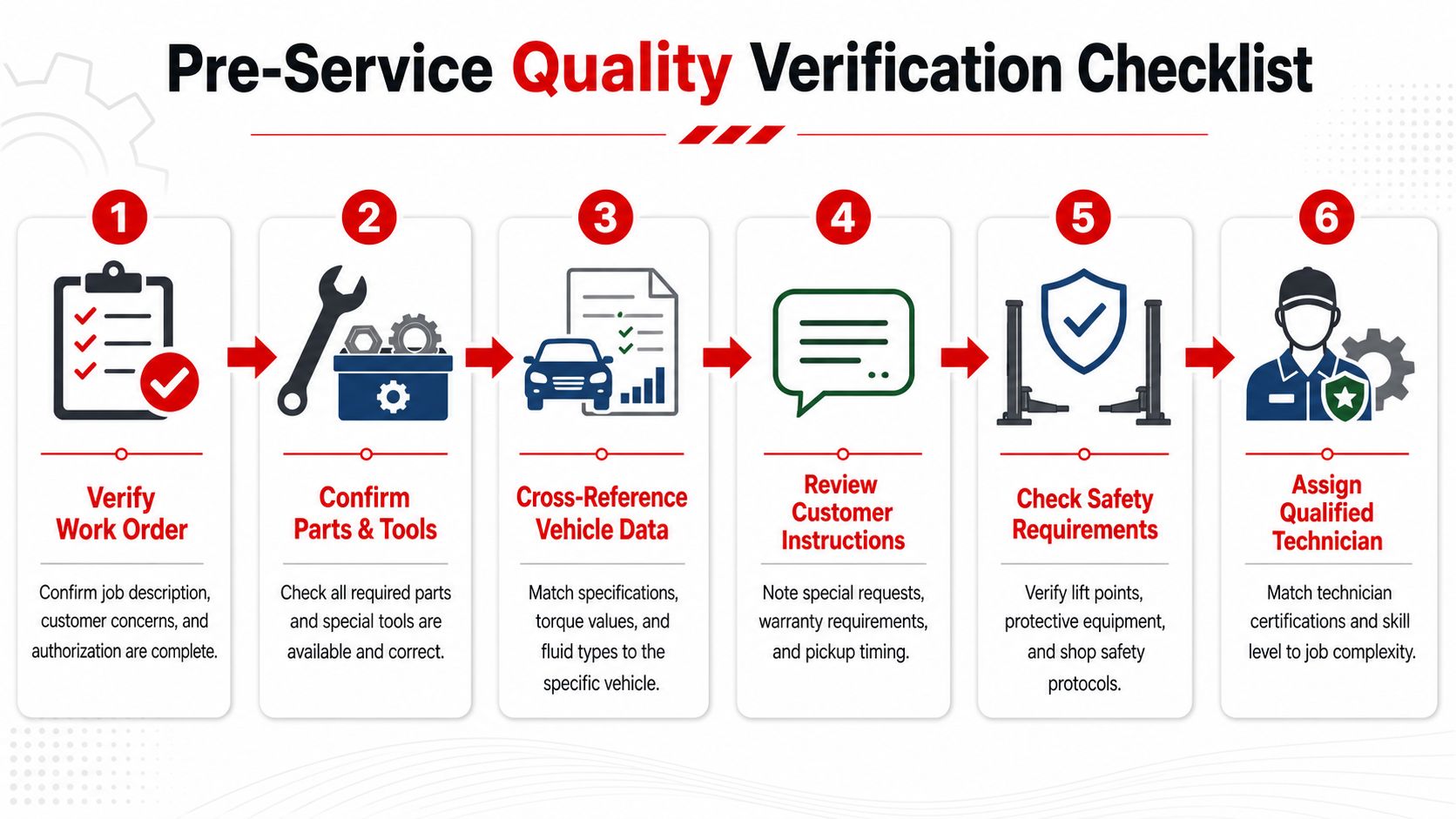
2. Pre-Service Quality Verification Checklist
A repair can fail before the vehicle enters the bay. The work order may lack a required specification, the correct part may not be available, or a customer request may sit in an email that the technician never sees.
The pre-service owner is usually the service advisor, with the technician confirming technical readiness before work begins. The checklist should require a review of the complaint, diagnostic findings, approved operations, labor notes, parts status, vehicle history, and special instructions. Warranty requirements and customer-requested limitations also belong here.
A transmission shop, for example, can verify the correct fluid specification, rebuild instructions, and torque requirements before disassembly. A collision center can confirm the paint code, repair method, and applicable manufacturer specifications before bodywork starts. The point isn't to add paperwork. It's to stop a technician from discovering a missing requirement after the repair has already begun.
Use a readiness decision
The form needs a visible ready, not ready, or hold decision. “Parts ordered” isn't the same as “parts received and verified.” “Customer approved” isn't enough if the authorization doesn't identify the actual work.
Useful fields include:
- Work order clarity: Match the written operation to the customer's concern and approved estimate.
- Parts readiness: Confirm availability, correct specification, condition, and any required core or return process.
- Technical requirements: Attach service information, special tools, torque values, fluid requirements, and manufacturer instructions.
- Customer conditions: Record timing promises, warranty terms, declined work, and requests that affect the repair.
A paper checklist can be clipped to the repair order, but a digital version can surface missing fields before the job moves to production. RedAppy's vehicle history and customer lookup by name, plate, or VIN help staff find prior information instead of relying on memory. The KPI is first-time fix rate. If comebacks repeatedly trace back to unclear work orders or missing parts, the readiness checklist needs another required field, not another paragraph of instructions.
3. Post-Repair Quality Assurance Checklist
The final inspection is the release gate. It should be completed after the approved work is finished and before the vehicle reaches the customer, preferably by someone who can evaluate the whole repair rather than only the last task performed.
A strong post-repair sequence has four phases. The initial visual review checks panel straightness, gap uniformity, and obvious flaws. Mechanical and functional evaluation verifies fasteners, hardware, fluid levels, and system operation. Cosmetic inspection checks paint match, overspray, trim reinstallation, and surface quality. Road-test validation looks for abnormal noises, warning lights, and handling issues. This sequence is described in the.
The technician should mark completed work and record measurements, photos, test results, or notes where evidence matters. A manager, foreman, or designated quality reviewer should then confirm the release decision. Using both technician and manager review roles turns the form into an accountability tool rather than a final walkaround that everyone assumes someone else completed. also frames inspection checklists as tools for technicians and managers to monitor and document repair quality on each vehicle.
Don't hide failures inside pass or fail
A failed item needs a severity, explanation, owner, corrective action, and due date. If a road test reveals a noise, the vehicle should move to hold status, not delivery. After correction, the failed item needs secondary verification and fresh evidence.
That closed-loop detail matters because a static checklist can record a defect without ensuring anyone resolves it. A useful KPI is comeback rate, segmented by repair type and failure category. A rising cosmetic comeback rate points to a different action than repeated warning-light failures. The review should identify whether the cause involves workmanship, parts, training, communication, or workflow timing.
4. Parts Ordering and Inventory Quality Checklist
A correct repair depends on a correct part. Procurement quality begins when the part is selected, continues through receiving and storage, and ends only when the installed component is matched to the work order.
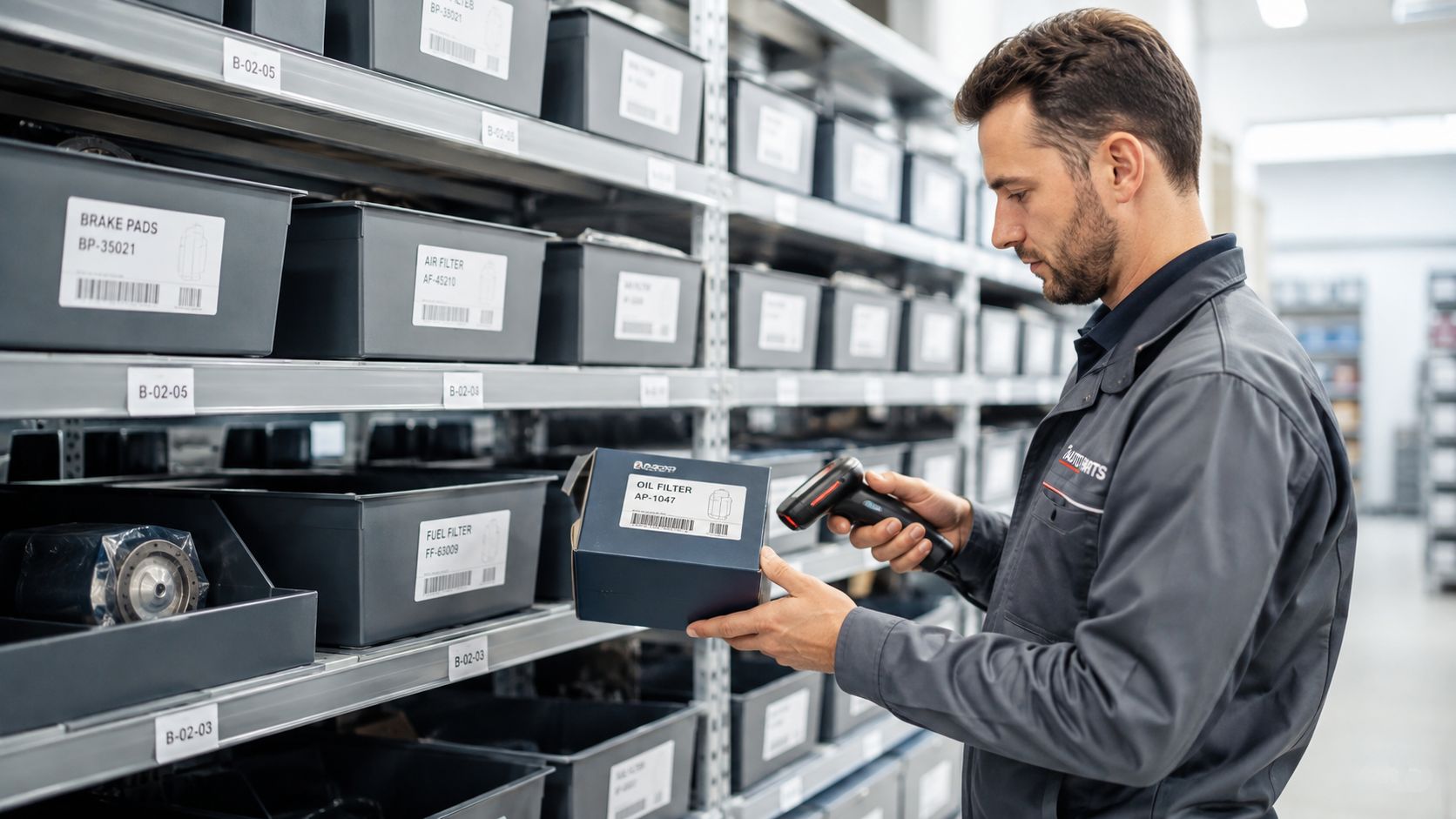
The parts coordinator owns ordering and receiving, while the technician confirms fit and condition before installation. The checklist should compare the selected part against vehicle information, VIN data where available, supplier details, specification, quantity, and expected delivery. On arrival, staff should inspect packaging, part numbers, visible damage, seals, connectors, finish, and any included hardware.
Keep the part traceable
A shop ordering through several suppliers needs one receiving routine. Otherwise, one vendor's delivery may receive a detailed inspection while another goes straight to the shelf. A part identification guide for frequently ordered components can help newer staff spot differences in filters, sensors, brackets, lighting assemblies, and body panels.
Barcode tracking can connect receipt, storage location, issue to a job, installation, and return. The technology isn't the control by itself. The control is the required match between the physical part and the repair order before installation.
The evidence can be a receiving photo, supplier invoice, part number, damage note, or return authorization. If a component is damaged, the status should be hold, not placed beside the vehicle. RedAppy's parts ordering across multiple suppliers and real-time inventory can support a more connected process, especially when the Digital Shop Board needs to show that a job is waiting on a verified part rather than waiting.
The KPI is parts-related complaints, reviewed by supplier, part category, and reason. A shop that sees repeated mismatches should change its ordering rule or supplier review process. A shop that sees transit damage should improve receiving evidence and packaging escalation. Marking every part “received” without recording exceptions doesn't create quality control. It creates false confidence.
5. Customer Communication and Documentation Checklist
Customers judge repair quality partly through the work itself and partly through how clearly the shop explains it. A technically correct job can still create a complaint if the estimate, authorization, progress update, or invoice doesn't match what the customer understood.
The service advisor owns communication, with the technician supplying clear findings and supporting evidence. The checklist should confirm that the estimate explains the concern, recommended operation, parts, labor, limitations, and declined work. Approval should be recorded before unauthorized work begins, using a signature or digital authorization tied to the vehicle and repair order.
Make the record easy to audit
Photo-rich inspections help the advisor explain why a recommendation exists. The customer doesn't need a technical lecture, but the record should show the observed condition, likely consequence, and decision requested. Progress messages should identify what has been completed, what is delayed, and what decision remains open. A final invoice should reflect the authorized work and document any approved change.
A useful communication checklist includes:
- Intake confirmation: Record the customer's concern in the customer's own practical terms, then confirm the requested outcome.
- Approval evidence: Store the approved estimate, declined items, and authorization history with the work order.
- Progress control: Notify the customer when parts delays, added findings, or completion timing changes affect the plan.
- Delivery record: Confirm invoice accuracy, warranty terms, payment, and any follow-up recommendation.
Automated text or email can reduce missed updates, but automation shouldn't replace judgment. A serious safety finding needs a direct conversation, not only a system notification. RedAppy's digital inspections can send photos and videos for approval, while estimates, invoicing, and online payments keep the customer record connected to the work.
The KPI is approval rate, read alongside estimate revision frequency. A high approval rate with frequent corrections may indicate persuasive communication but weak inspection quality. The best process improves understanding without hiding uncertainty.
6. Technician Performance and Competency Checklist
Quality control shouldn't begin by blaming the last technician who touched a failed repair. A fair process first checks whether the assigned technician had the training, tools, information, and time required for the operation.
The foreman or shop manager owns the competency record. Before assignment, the work order should identify the repair complexity and any required specialty. The manager then matches the job to documented skills, certifications, manufacturer training, and demonstrated capability. A small garage may keep this in a printed skills matrix. A larger operation needs a searchable record that can be updated when training or authorization changes.
Measure quality and capability together
A technician can be fast and still create avoidable comebacks. Another can produce excellent work but need support on workflow or documentation. The checklist should therefore separate technical quality, documentation quality, safety compliance, and productivity rather than reduce performance to one score.
For each technician, track:
- Authorized work types: Record systems and repair categories the technician can handle independently.
- Training needs: Note gaps in diagnostics, manufacturer procedures, equipment use, or documentation.
- Review triggers: Flag recurring comebacks, warranty claims, missed checklist fields, or repeated failed inspections.
- Development actions: Assign coaching, shadowing, reference material, or supervised work with a completion date.
The shop manager should review the data with the technician, not use an unexplained number as a disciplinary shortcut. A recurring failure may result from a parts issue, unclear estimate, poor scheduling, or missing service information. A technician efficiency KPI becomes useful when read with comeback rate, rework time, and job mix.
A logistics dashboard can help managers think about assigning people and resources against workload, capacity, and process performance. The offers relevant background for that operational view, although an auto repair shop still needs vehicle-specific quality measures.
7. Safety and Compliance Verification Checklist
Safety checks deserve their own release path. They shouldn't disappear inside a general workmanship form where a technician can mark every item complete without distinguishing a customer comfort issue from a brake, steering, restraint, emissions, or fluid-handling concern.
The shop manager or designated compliance owner maintains the requirements, while technicians complete job-specific controls. The checklist should reference applicable workplace safety procedures, environmental handling rules, emissions requirements, warranty obligations, manufacturer service bulletins, and required documentation. It should also identify who has authority to approve a deviation.
Use hold points for serious risks
A vehicle with an unresolved safety issue should not move to delivery because the customer is waiting or the bay is needed. The checklist should require a hold status, escalation to the manager, documented customer communication, and a final release decision after correction or written acceptance of a permitted limitation.
Practical fields include:
- Workplace controls: Confirm personal protective equipment, lift use, battery isolation, chemical handling, and workstation requirements.
- Vehicle safety: Verify warning lights, braking, steering, restraints, tires, lights, and other systems affected by the repair.
- Environmental handling: Record the required containment, storage, and disposal process for fluids, refrigerants, batteries, and contaminated materials.
- Manufacturer requirements: Check service bulletins, warranty conditions, calibration needs, and post-repair system procedures.
- Deviation authorization: Document any customer-requested departure from the shop's normal safety or repair standard.
The compliance owner should maintain a compliance calendar and update reference guides when requirements change. Staff training records should show who received instruction and when, without relying on a manager's memory.
The key KPI is safety-related failed inspection count, paired with closure time. A falling count can mean better work, but it can also mean weaker reporting. Managers should verify that technicians still record findings rather than rewarding a zero that reflects blank fields.
8. Multi-Location Shop Standardization Audit Checklist
A multi-location operation can have excellent technicians and still deliver inconsistent quality. One branch photographs every pre-existing mark, another relies on handwritten notes, and a third releases vehicles without a documented road test. Customers experience those differences as brand inconsistency.
The regional manager or quality lead owns the audit program, while each location manager owns corrective action. The audit should compare intake, work-order readiness, parts receiving, repair verification, communication, safety, documentation, and release practices against one approved standard.
Audit the process, not just the score
A scorecard can help compare locations, but a single total can hide a critical failure. A branch may perform well on communication while missing required safety evidence. Critical categories should therefore have mandatory pass conditions, and an audit should record the finding, responsible owner, corrective action, due date, and verification result.
A useful multi-location audit includes:
- Record sampling: Review completed vehicle files for photos, authorizations, parts records, inspection results, and release approval.
- Floor observation: Watch intake, parts receiving, technician handoff, final inspection, and delivery at different operating conditions.
- Customer validation: Use follow-up calls or satisfaction feedback to check whether the documented experience matches the customer's experience.
- Corrective-action review: Confirm that previous findings were resolved rather than copied into a new audit.
- Best-practice sharing: Give high-performing locations a way to demonstrate procedures that other branches can adopt.
The KPI is location variance across first-time fix rate, comeback rate, approval rate, technician efficiency, and documentation completion. Variance doesn't automatically identify the cause, but it tells regional leadership where to investigate.
A shared Digital Shop Board can make job status visible across locations, while centralized vehicle history, estimates, invoices, and analytics reduce differences created by disconnected systems. The checklist should standardize the required outcome without preventing a branch from improving the method.
8-Point Quality Checklist Comparison
| Item | 🔄 Implementation complexity | ⚡ Speed / resource efficiency | 📊 Expected outcomes | ⭐ Key advantages | 💡 Ideal use cases / tips |
|---|---|---|---|---|---|
| Digital Vehicle Inspection Checklist Template | Moderate, mobile + cloud setup, staff training required | ⚡ High for estimates and approvals; upfront inspection time | 📊 Fewer disputes, faster estimate turnaround, higher approval rates | ⭐ Photo-backed evidence, integrated estimates, customer trust | 💡 Customer-facing intake; set lighting standards, train techs, integrate with shop management |
| Pre-Service Quality Verification Checklist | Low–Moderate, process changes and access to vehicle data | ⚡ Moderate, adds startup steps but reduces rework time later | 📊 Higher first-time-fix rate; fewer comebacks and material waste | ⭐ Prevents incomplete starts, improves safety and efficiency | 💡 Use digital checklists tied to parts inventory; create role-based flows |
| Post-Repair Quality Assurance Checklist | Moderate, needs QC role, test protocols and documentation | ⚡ Moderate, prevents costly callbacks though may delay delivery if issues found | 📊 Fewer warranty claims, improved customer satisfaction and liability protection | ⭐ Final quality gate with documented verification and photos | 💡 Assign experienced QC techs, document with photos, require re-inspection when needed |
| Parts Ordering and Inventory Quality Checklist | Moderate–High, supplier integrations, receiving processes | ⚡ Moderate, adds receiving steps but speeds correct installs and recall response | 📊 Fewer wrong/counterfeit parts, improved traceability, reduced waste | ⭐ Prevents incorrect installs, enables recall tracking and supplier QA | 💡 Implement barcode/RFID, maintain vetted suppliers, cross-reference VINs |
| Customer Communication and Documentation Checklist | Low, templates and communication workflows; training for consistency | ⚡ High impact on approvals and reduced disputes; modest time investment | 📊 Higher approval rates, better customer satisfaction, clearer billing records | ⭐ Transparent estimates, documented authorizations, automated updates | 💡 Use photo-rich estimates, automated status notifications, digital signatures |
| Technician Performance and Competency Checklist | Moderate–High, tracking certifications, analytics and ongoing updates | ⚡ Moderate, improves job assignment efficiency but requires admin overhead | 📊 Reduced errors, targeted training insights, accountable performance metrics | ⭐ Ensures qualified technicians, identifies training needs, supports staffing decisions | 💡 Build a skills matrix, tie assignments to job complexity, monitor comeback rates |
| Safety and Compliance Verification Checklist | Moderate, continuous regulatory monitoring and documentation | ⚡ Necessary compliance overhead; may add time/cost but reduces legal risk | 📊 Lower regulatory fines/claims, safer workplace, maintained warranty eligibility | ⭐ Protects against liability, ensures regulatory and OEM compliance | 💡 Keep a compliance calendar, provide annual training, document deviations with authorization |
| Multi-Location Shop Standardization Audit Checklist | High, cross-site audits, data aggregation, enforcement mechanisms | ⚡ Improves centralized efficiency long-term; resource-intensive to run audits | 📊 Consistent customer experience, identifies location variances, supports best-practice rollout | ⭐ Enables benchmarking, centralized reporting, brand consistency | 💡 Use weighted scorecards, schedule varied-time audits, share results and recognize high performers |
Turn the Checklist Into a Closed-Loop Workflow
Eight forms can improve quality, but eight disconnected forms can create duplicate entry and checklist fatigue. The shop needs one workflow in which the vehicle, customer, work order, parts, evidence, and decision remain connected from check-in to checkout.
Each checkpoint should have a named owner. The intake record belongs to the advisor or assigned inspector. Readiness belongs to the advisor and technician together. Parts receiving belongs to the parts coordinator. Final release belongs to the assigned quality reviewer or manager. A checklist that says “manager review” without naming the role or person makes accountability difficult.
Required fields should be reserved for decisions that protect safety, authorization, traceability, and release quality. Optional notes can capture context, but a required field should block progression when the missing information could cause a dispute, unsafe release, incorrect part installation, or undocumented work.
Capture evidence where it changes the decision
Photos are valuable for pre-existing damage, cosmetic repairs, part condition, and final finish. Signatures matter for work authorization, customer-requested deviations, and release approval. Measurements matter when a pass or fail decision depends on a tolerance, such as tire tread, pressure, fluid level, alignment, or a manufacturer-specified repair condition.
A digital checklist should also capture severity, root cause, corrective action, owner, and due date when an item fails. That turns a defect into a manageable task. Without closure data, the same problem can recur and management won't know whether the fix worked.
Review the right KPIs together
No single KPI proves that quality control is working. Management should review a connected set of measures:
- First-time fix rate: Shows whether repairs solve the original concern without another visit.
- Comeback rate: Reveals defects or unresolved concerns after release.
- Parts-related complaints: Points toward ordering, receiving, supplier, or fitment problems.
- Approval rate: Shows whether customers understand and accept recommendations.
- Technician efficiency: Helps compare capacity and output with quality results.
- Average repair order: Adds context to the work mix and recommendation process.
- Repeat business: Indicates whether the complete service experience earns another visit.
RedAppy can connect digital inspections, vehicle history, parts ordering, estimates, invoicing, online payments, and the Kanban-style Digital Shop Board. Its analytics can track revenue, technician efficiency, average repair order, and repeat business, giving managers a shared view of the workflow. A shop can start with intake and post-repair verification, then add parts, communication, competency, compliance, and location audits as the process matures.
The best rollout is practical. Build the paper version first, test every field on real jobs, remove anything nobody uses, and define the evidence required for every critical decision. Then digitize the stable workflow so staff aren't typing the same vehicle and customer information into multiple systems.
Explore the RedAppy features page to see how the platform can support connected inspections and shop operations, or contact the RedAppy team to discuss the workflow with a shop-management specialist.
RedAppy connects digital inspections, photo and video evidence, estimates, vehicle history, parts ordering, invoicing, payments, and the Digital Shop Board in one shop-management workflow. Visit RedAppy to see how a repair shop can turn a quality control checklist into accountable checkpoints from intake through final delivery.
Ready to Transform Your Shop?
RedAppy helps auto repair shops create professional digital estimates with photos and videos, send them instantly via text or email, and get customer approvals in seconds. No credit card required to start.