
Recurring Payment Setup for Auto Repair Shops That Works
A shop owner sells a monthly maintenance plan in the morning, approves a larger repair after an inspection in the afternoon, and then discovers the card on file can't legally or practically cover both charges. That gap is where most autopay projects start to unravel. The customer says yes, the advisor assumes the stored card can be used again, and the office finds out later that the consent on file covered a flat plan, not a variable invoice with parts, labor, and extra work found in the bay.
A good recurring payment setup closes that gap before the first charge runs. It defines who agreed to what, which amounts can change, when a fresh approval is required, how failed charges get recovered, and how cancellation stops future billing. Shops that treat those choices as one workflow get predictable collections without turning every billing question into a dispute.
Table of Contents
- What Recurring Payment Setup Actually Means for a Repair Shop
- Picking the Right Processor and Payment Methods
- Subscription Plans and Customer Consent You Can Defend
- Technical Integration Without Burning the Weekend
- Handling Declines, Retries, and Customer Notifications
- Accounting, Refunds, and Reporting That Hold Up in an Audit
- Troubleshooting, Cancellations, and a Rollout Checklist
What Recurring Payment Setup Actually Means for a Repair Shop
A recurring payment setup isn't a single toggle inside shop software. It's seven linked decisions that determine whether charges run cleanly or create callbacks, refunds, and awkward conversations at the counter. Skipping any one of them doesn't remove the work. It pushes the work to the service advisor, the bookkeeper, or the customer.
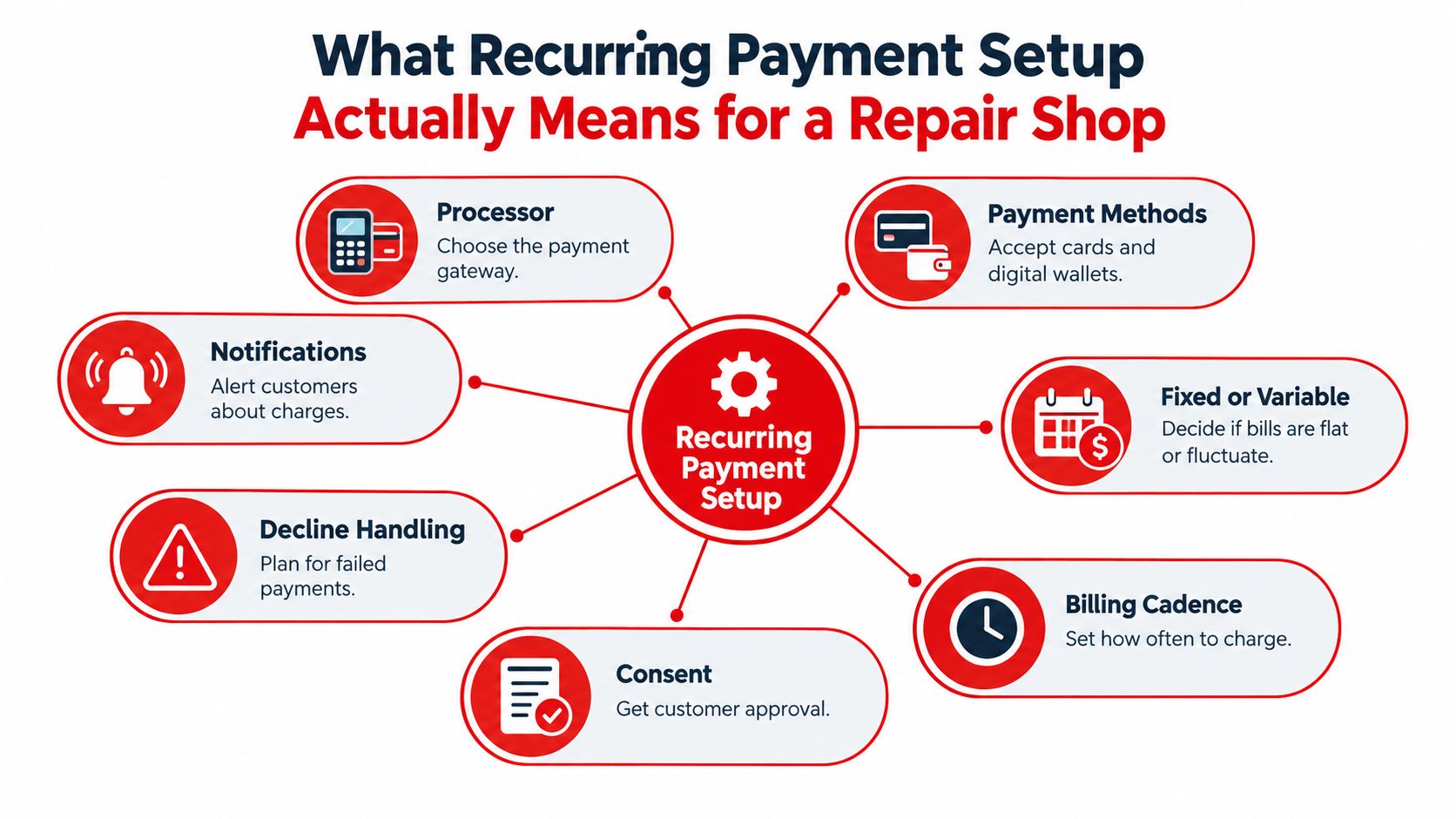
The Seven Decisions Behind the Toggle
- Processor choice: The gateway that stores credentials, runs charges, and reports decline reasons.
- Payment methods: Cards, bank debits, or both, based on ticket size and customer type.
- Fixed or variable billing: A flat maintenance plan works differently from an invoice that changes after inspection.
- Consent ownership: One named role checks that authorization language, records, and revocation steps stay current.
- Decline handling: Retries, customer notices, grace periods, and service pauses follow a written rule.
- Refund handling: Staff know how to reverse a charge without also creating a duplicate credit during a dispute.
- Reconciliation: Every scheduled charge ties to an invoice, a deposit, and an authorization record.
Shops need to separate predictable recurring billing from recurring authorization for variable work. A maintenance plan, storage fee, warranty installment, or fleet agreement can bill the same amount on a known cadence. A repair invoice doesn't behave that way because diagnostics can change the estimate after teardown begins. Both can sit on the same customer account, but they shouldn't share one vague permission.
Bank based autopay isn't new or experimental. notes that ACH payments are used primarily for recurring obligations such as payroll and monthly consumer bills, and commercial ACH volume at the Federal Reserve climbed from roughly 600 million transactions in 1988 to 18.5 billion in 2022, an increase of about 85% from the 10 billion level recorded in 2008.
A recurring payment setup is really a workflow for authorization, scheduling, recovery, and reporting. The processor sits in the middle, not at the top.
That mental model also explains why recovery planning belongs in setup, not after the first failure. Shops that want the mechanics of retries in plain language can use as background before writing shop rules. The shop still needs its own policy for grace periods, vehicle release, and plan suspension.
Picking the Right Processor and Payment Methods
Processor demos tend to lead with checkout screens. Shops should lead with four harder questions about fee shape, card on file architecture, ACH support, and reporting clarity. A platform that looks simple during signup can become expensive or opaque once declines, refunds, and variable invoices enter the picture.
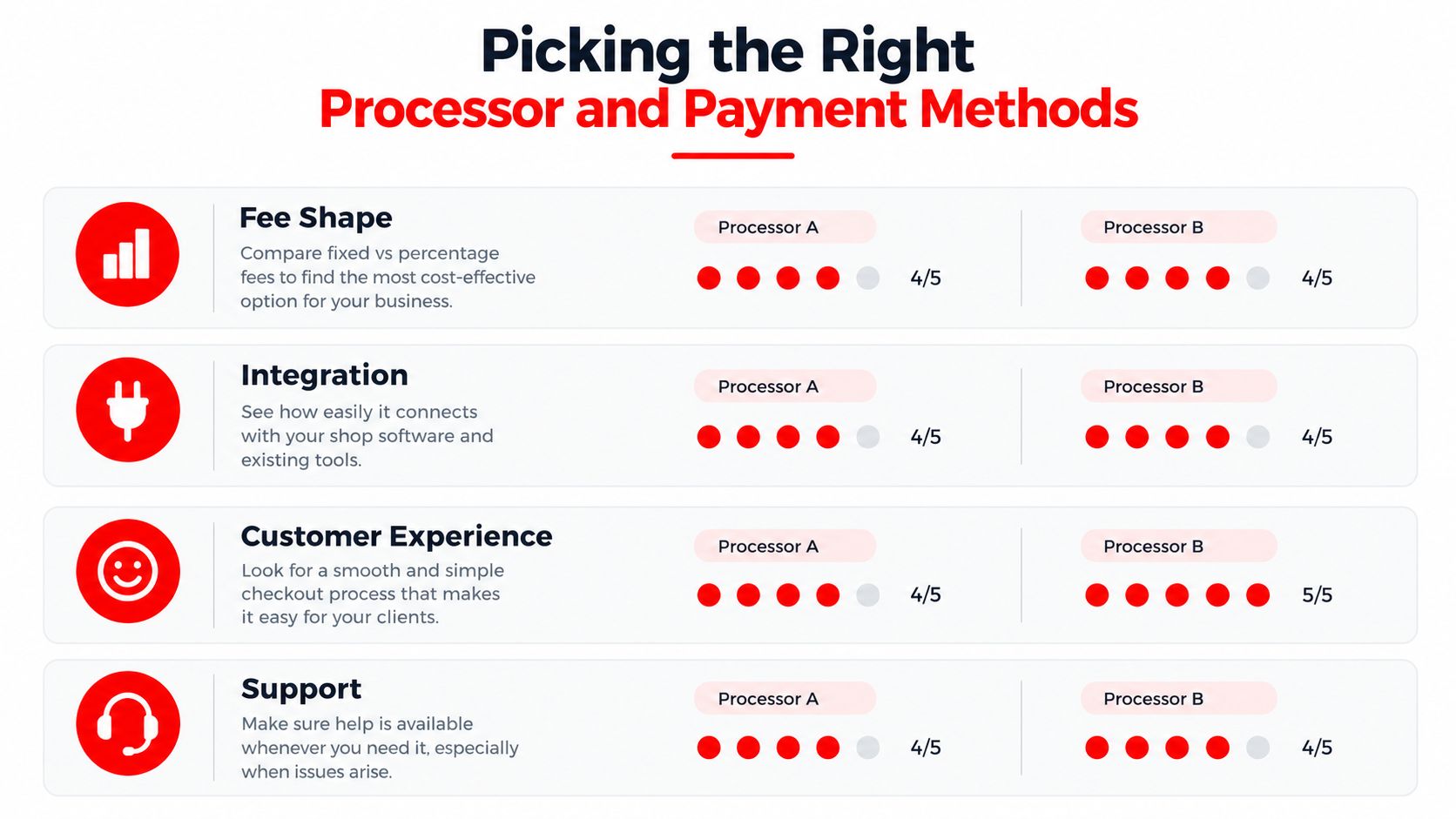
Fee Shape Matters on Small Recurring Tickets
Flat plus percentage pricing hits low value recurring charges hardest because the fixed part is charged again on every cycle. A plan that looks profitable at a larger ticket can thin out quickly when the shop bills small monthly amounts across many customers. Owners should model the fee on the shop's actual smallest recurring ticket, not on an average repair order. Deposit timing, ACH return fees, dispute fees, and refund fee policies belong in the same comparison.
Processor Selection Criteria for Shop Recurring Billing
| Criterion | What Good Looks Like | Red Flag to Avoid |
|---|---|---|
| Fee shape | Pricing is modeled clearly for small recurring tickets and larger fleet invoices | Sales quotes use one blended rate and hide ACH or dispute fees |
| Card on file model | Hosted capture, network or gateway tokens, stored credential flags, account updater support | Staff can view, export, or retype full card numbers |
| ACH support | Authorization records, revocation handling, return codes, and clear settlement timing | Bank debits are offered without proof of authorization tools |
| Reporting | Decline categories, retry status, refunds, disputes, and mandate links appear on one customer record | Reports show only success or failure with no reason code |
| Shop workflow fit | Estimates, approvals, invoices, and payment status stay connected | Advisors must copy totals between disconnected systems |
Cards, ACH, or Both
Cards fit consumer maintenance plans because customers understand them and can update details through a secure link. ACH often fits fleet accounts, storage arrangements, and repeat commercial work where bank debit is already normal. Many shops need both, but each method needs its own authorization record and failure process. A saved card doesn't authorize a bank debit, and a bank mandate doesn't authorize card charges.
Failure capacity should influence the shortlist from the start. estimates that 7% of recurring charges fail on the first attempt, while separate Visa and Mastercard data suggest as many as 15% of recurring payments may be declined, with insufficient funds alone accounting for more than 30% of failed subscription payments. A processor that can't classify those failures leaves the front desk guessing.
Red flags include vague language about automatic recovery, no exportable authorization log, and support that can't explain stored credential rules. Strong candidates answer direct questions about token portability, webhook events, updater coverage, retry controls, and how a cancellation suppresses the next charge. Shops should keep the shortlist to two or three processors and test each one against the same maintenance plan, fleet debit, failed card, refund, and disputed invoice scenarios. The winner is the option staff can explain clearly to a customer without reading from a help page.
Subscription Plans and Customer Consent You Can Defend
Consent is the part shops most often rush. A customer taps approve on a tablet, the card is saved, and nobody checks whether the words on screen cover the next charge. That shortcut works until an amount changes, a cardholder disputes the charge, or a customer says the plan was never explained.
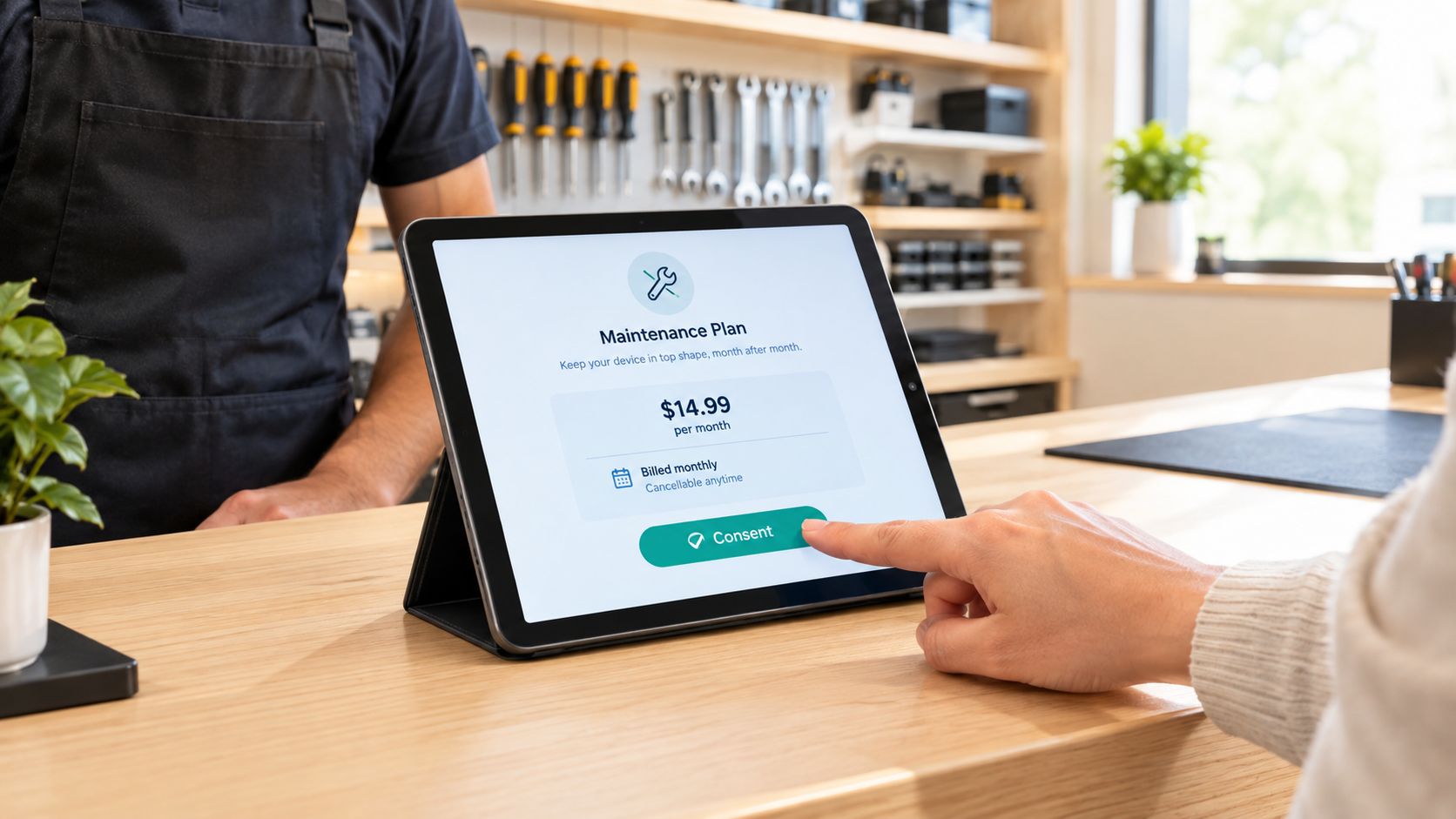
Fixed Plan Language Customers Can Understand
A maintenance plan authorization should state the amount, frequency, start timing, receipt method, and cancellation path in short sentences. It should also name the payment method being stored and explain that later charges will run without the customer returning to checkout. A practical fixed plan template reads like this in substance, adapted with qualified legal review for the shop's market.
Fixed plan consent: Customer authorizes the named shop to charge the saved payment method for the stated plan amount on the stated schedule until cancellation. Receipts will be sent by the selected method, and cancellation stops future charges after confirmation.
That wording still needs the shop's actual amount, schedule, terms version, and contact details attached to the customer record. Staff should store the mandate ID, timestamp, accepted terms version, payment token reference, and transaction identifiers together. Those fields let support prove approval without exposing card numbers.
Bank debits need the same discipline. explains that recurring bank debits generally require written or electronically authenticated consumer authorization identifying the payee, amount or an acceptable range, frequency, and withdrawal date, and consumers can typically ask their bank to stop a scheduled transfer at least three business days before it occurs.
Variable Repair Charges Need a Fresh Checkpoint
A fixed plan mandate shouldn't automatically authorize an unrelated repair invoice. When inspection finds worn brakes during a planned service, the shop should request approval for the added work, the revised total or range, and the payment method to be charged. Phone, text, and online approvals should all land in the same repair order record with the estimate version the customer accepted.
The approval script can stay short. It should identify the vehicle, the newly approved work, the amount or not to exceed range, taxes or fees if applicable, and whether the saved payment method may be charged when the work is complete. If the final amount moves outside the approved range, the shop asks again.
That checkpoint adds a little friction, and that's the point. Clear approval before a variable charge reduces disputes, chargebacks, and claims of unauthorized billing more reliably than silent convenience. Frictionless setup isn't better when the customer can't recognize the amount that appears on a statement.
Technical Integration Without Burning the Weekend
Integration sounds technical, but the shop owner only needs to verify a short sequence. Payment details enter through a secure hosted form, the processor returns a token, the shop system stores the token and mandate details, and later charges reference that token. Raw card numbers shouldn't pass through advisor screens, spreadsheets, text messages, or paper intake forms.
The Core Build Sequence
- Hosted capture: The customer enters card or bank details in a PCI compliant form controlled by the gateway.
- First successful payment: The initial transaction establishes the credential on file relationship.
- Token storage: The shop database stores only the token, last display details allowed by the processor, and billing metadata.
- Mandate record: Consent text, timestamp, channel, and terms version attach to the customer and vehicle record.
- Webhook confirmation: The processor sends machine to machine status updates that mark invoices paid, failed, refunded, or disputed.
- Access control: Roles limit who can charge, refund, export, or change a saved payment method.
The distinction between the first charge and later charges matters. distinguishes the initial customer initiated transaction from subsequent merchant initiated recurring transactions, and the first payment must succeed before later merchant initiated charges are submitted. PCI Security Standards Council guidance also prohibits retaining card verification codes after authorization, even when encrypted and even when the customer consents.
Controls That Prevent Expensive Mistakes
Webhooks should drive invoice status because a browser redirect can be closed, duplicated, or abandoned after payment succeeds. Idempotency keys, which are unique identifiers attached to each charge request, help prevent the same invoice from being charged twice during a retry or network hiccup. One open invoice per billing period keeps plan charges from stacking.
Role based access deserves the same attention as encryption. A service advisor may need to send a secure update link, but that role shouldn't be able to export payment credentials or alter mandate history. Managers should review who can issue refunds, who can pause billing, and who can delete a stored payment method.
Before launch, the shop should hand its software partner a test checklist covering successful signup, failed first payment, updated card, cancelled mandate, refund, dispute, and variable invoice approval. Each test should end with the correct invoice state and a readable audit trail. If staff can't trace a charge from consent to deposit during testing, the integration isn't ready for customers.
Handling Declines, Retries, and Customer Notifications
A failed recurring charge isn't one problem. It can mean a temporarily empty account, a replaced card, a fraud control, stale details, or a customer who intended to cancel but never completed the request. Treating every decline the same wastes retries and annoys customers who need a different fix.
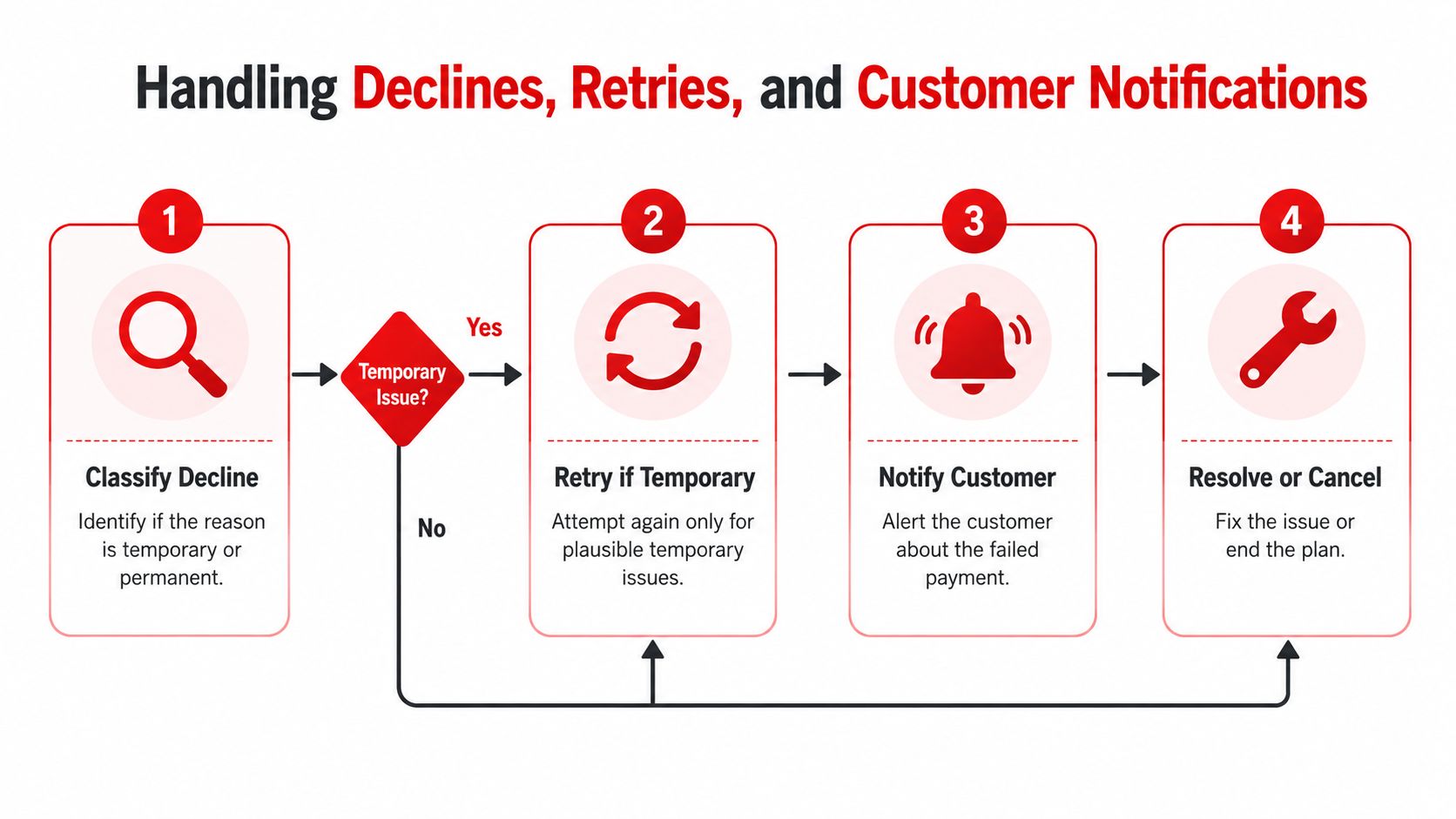
Classify Before Retrying
- Insufficient funds: Retry on a later day where processor rules allow it, and send a calm notice that the scheduled payment didn't clear.
- Expired or reissued card: Use an account updater when available, then send a secure update link if the credential can't refresh automatically.
- Outdated account details: Ask the customer to replace the payment method through the hosted form, never by phone notes or email.
- Fraud or do not honor signals: Pause automatic attempts and use human follow up because repeated charges can increase issuer suspicion.
- Customer revocation or cancellation: Stop future attempts immediately and document confirmation.
A controlled ladder works better than rapid blind retries. The shop attempts the scheduled charge, records the gateway category, retries only when the reason looks temporary, and spaces later attempts across different days. Notices get clearer as the grace period runs down, and service pauses only after the stated deadline passes.
The stakes are retention, not just collections. states that nearly one quarter of churn is involuntary and that its Smart Retries recover 57% of recurring payments that originally failed. Those are vendor reported benchmarks, so a shop should still measure its own recovery rate by decline code, payment method, and customer segment.
Customer Messages That Solve the Problem
The first notice should say what failed, which plan or invoice it affects, and how to update payment details securely. A later notice should state the grace period end, what service changes after that point, and how to reach a person. The message shouldn't threaten consequences the shop won't apply.
A good failed payment notice gives the customer one secure action, one deadline, and one human contact path. Anything else creates noise.
Front desk staff need an internal rule for vehicle related services. A maintenance plan can pause after the grace period, while a completed safety repair needs a separate payment conversation governed by the repair order and local rules. Keeping those paths distinct prevents a billing automation from making operational promises the shop can't defend.
Accounting, Refunds, and Reporting That Hold Up in an Audit
Recurring billing creates a finance trail that must survive staff turnover. A bookkeeper should be able to open a customer record and see the authorization, schedule, invoice, charge attempts, processor deposit, refund, and dispute status without asking who set it up. If that chain breaks, month end becomes detective work.
Daily Reconciliation in Plain Terms
The daily check compares five buckets against processor activity. Successful charges should match paid invoices, recovered charges should close previously failed invoices, and charges still in retry should remain open without being counted as revenue collected. Refunded charges need a linked credit, and disputed charges need a status that prevents staff from refunding the same amount twice.
One open invoice per billing period keeps that review manageable. When a retry succeeds, it settles the existing invoice rather than creating a second one. When a customer cancels, future invoices stop and the final invoice state follows the plan terms.
Data retention belongs in the same routine. requires stored payment card data to be protected and limited to what business, legal, or regulatory needs require, which means a recurring payment workflow should rely on tokenization rather than treating raw card storage as a routine shortcut.
Metrics Worth Reviewing
- Initial authorization rate: Shows whether saved credentials work at the first scheduled attempt.
- Failed payment recovery rate: Shows whether retries and update links rescue revenue.
- Days to recovery: Reveals whether notices arrive early enough for customers to act.
- Involuntary churn: Separates customers lost through payment failure from customers who chose to leave.
- Dispute rate: Flags consent, descriptor, or communication problems.
- Accounts in grace period: Gives advisors a manageable follow up list before plans lapse.
Refund rules should be written beside those metrics. Staff need to know whether a refund goes to the original payment method, how partial refunds appear on the invoice, and who approves credits for disputed variable work. Clear reporting turns billing from a monthly surprise into an early warning system for customer experience problems.
Troubleshooting, Cancellations, and a Rollout Checklist
Cancellation is where trust is either kept or lost. A customer who cancels a maintenance plan shouldn't see another charge because a retry queue kept running, and staff shouldn't confuse a replaced card with a decision to leave. Recent enforcement themes around unexpected charges, unclear enrollment, and difficult cancellation point to the same operational rule. Make stopping as clear as starting.
Customers notice that difference across local services, too, which is why advice to resonates beyond car wash memberships. Repair shops selling plans should expect the same scrutiny and provide an accessible cancellation path, immediate confirmation, and suppression of future charges. A cancelled mandate should block new invoices, pending retries, and saved credential use for that plan.
ACH records need particular care because proof may be requested later. requires the originator of recurring ACH debits to obtain authorization that explains how the customer can revoke permission, to provide proof of authorization within 10 days of a request, and to retain that record for two years after it ends or is revoked.
Rollout Checklist for the First Launch
- Processor tested: Card, ACH, refund, dispute, and updater flows pass shop scenarios.
- Consent ready: Fixed plan and variable repair language are separate and stored with mandate IDs.
- Tokenization verified: Staff screens never expose full card numbers or verification codes.
- Recovery policy set: Retry timing, notices, grace period, and human follow up are documented.
- Cancellation tested: Confirmation, charge suppression, and record retention work end to end.
- Dashboard live: Authorization, recovery, disputes, and grace accounts are reviewed routinely.
Shops evaluating connected estimate, inspection, invoicing, and online payment workflows can review the available features and use the contact page to discuss rollout fit. Consent captured at the estimate step gives the later invoice a cleaner approval trail than consent collected after work is finished. RedAppy is one platform option that connects digital inspections, estimates, invoicing, and online payments in that sequence.
Pairing photo rich digital inspections and clear estimate approvals with a disciplined recurring payment setup helps shops collect plan revenue and approved repair invoices without relying on vague card on file habits. RedAppy brings inspections, estimates, invoicing, online payments, scheduling, and shop analytics into one workflow built for auto repair businesses. Visit the site to see how consent, billing, and customer communication can stay connected from check in to final payment.
Ready to Transform Your Shop?
RedAppy helps auto repair shops create professional digital estimates with photos and videos, send them instantly via text or email, and get customer approvals in seconds. No credit card required to start.