
Sample Car Repair Estimate Guide for Accurate Quotes
A customer is waiting for a repair total, the technician has inspection photos ready, and the parts supplier needs confirmation before releasing an order. The service advisor has enough information to propose some work, but not enough to promise that every possible problem has been found.
A useful sample car repair estimate makes those limits visible. It separates what the shop knows, what the technician recommends, and what still needs investigation, then records exactly what the customer has authorized.
Table of Contents
- Why Repair Estimates Need Clear Authorization
- Anatomy of a Sample Car Repair Estimate
- Build an Accurate Estimate from Inspection to Approval
- Price Parts Labor Fees and Taxes Clearly
- Avoid Pricing and Estimate Mistakes
- Manage Margins Validity and Legal Notes
- Use RedAppy for Digital Estimate Approvals
Why Repair Estimates Need Clear Authorization
At the counter, a customer sees a large total covering a confirmed repair, recommended maintenance, and possible additional work. Without clear categories, that customer may assume every line is equally urgent. The advisor then has to explain a pricing document that should already explain itself.
The financial pressure is real. An found that one in three U.S. vehicle owners couldn't pay out of pocket for an unexpected repair costing $500 to $600. An advisor should therefore present a decision, not announce a balance.
Separate findings from permission
A practical estimate distinguishes between categories before combining their prices:
- Confirmed repair: Inspection or testing supports the proposed corrective operation.
- Recommended maintenance: The shop recommends service, but it isn't presented as the confirmed cause of the customer's complaint.
- Diagnostic contingency: Further investigation or disassembly is necessary before the shop can establish the repair scope.
Consider an illustrative brake complaint. The technician may document a confirmed defect while identifying another condition that needs inspection after disassembly. The advisor shouldn't present that unresolved condition as an established failure or include permission to repair it.
Authorization rule: Approval of an inspection isn't blanket approval of every repair that inspection might uncover.
The estimate should connect the customer concern, evidence, proposed operation, and spending boundary. That connection matters to everyone handling the job: the technician knows the permitted scope, the advisor can explain the recommendation, and the owner can review the financial commitment.
A clear authorization record also makes handoffs less dependent on memory. Another advisor should be able to open the job and distinguish approved work from declined recommendations without asking what someone remembers from a phone call.
Anatomy of a Sample Car Repair Estimate
A useful sample document starts with identification and ends with permission. Between those points, it should show enough detail for a customer to understand the work and for the shop to reconstruct how the quote was built.
For an illustrative brake-noise complaint, the document shouldn't begin and end with “brake repair.” It should preserve the customer's description, identify the inspected location, describe the finding, and list the proposed operation separately from any unresolved condition.
Sample Estimate Field Checklist
provides a useful completeness benchmark, including vehicle identification, odometer reading, labor basis, charges, warranty terms, and customer preferences. Its requirements are jurisdiction-specific, not a universal legal checklist.
| Estimate area | What to include | Why it matters |
|---|---|---|
| Shop and customer | Business identity, customer name, contact information | Identifies the parties and communication route |
| Vehicle | Model year, make, model, VIN or registration identifier, odometer | Connects the estimate to the correct vehicle |
| Customer concern | Reported symptom and circumstances | Preserves the reason for the visit |
| Findings | Inspection results, supporting photos, evidence status | Explains the basis for the recommendation |
| Proposed operations | Diagnostic work and corrective repairs on separate lines | Defines the work being offered |
| Parts | Description, part number, quantity, condition, applicable brand | Makes the supplied component identifiable |
| Labor | Operation, quoted hours, rate, flat-rate or actual-time basis | Explains the labor charge |
| Additional charges | Supplies, disposal, hazardous-waste charges, estimate fee, applicable taxes | Prevents an incomplete subtotal from appearing final |
| Timing and terms | Proposed completion, payment method, warranty, storage terms | Sets expectations beyond price |
| Customer preferences | Returned-parts preference and selected parts option | Records choices that affect job handling |
| Authorization | Selected work, approved limit, approval record, revision reference | Defines permission to proceed |
Annotate the sample rather than filling gaps with guesses
For the brake example, the customer concern might describe noise during braking. The finding should record the actual inspection result, not repeat the complaint as though it proves a component has failed.
The corrective operation should then identify the affected location and proposed work. A separate conditional entry can identify an area that remains inaccessible, with pricing pending inspection rather than a fabricated allowance.
Warranty wording deserves its own space. “Warranty included” doesn't tell the customer whether coverage includes parts, installation labor, or both. Likewise, the completion field should distinguish an expected turnaround from a commitment dependent on parts availability.
The sample should leave unknown information marked pending confirmation. Empty fields invite assumptions, but invented specificity is worse: it gives the appearance of a complete estimate without the evidence needed to support it.
Build an Accurate Estimate from Inspection to Approval
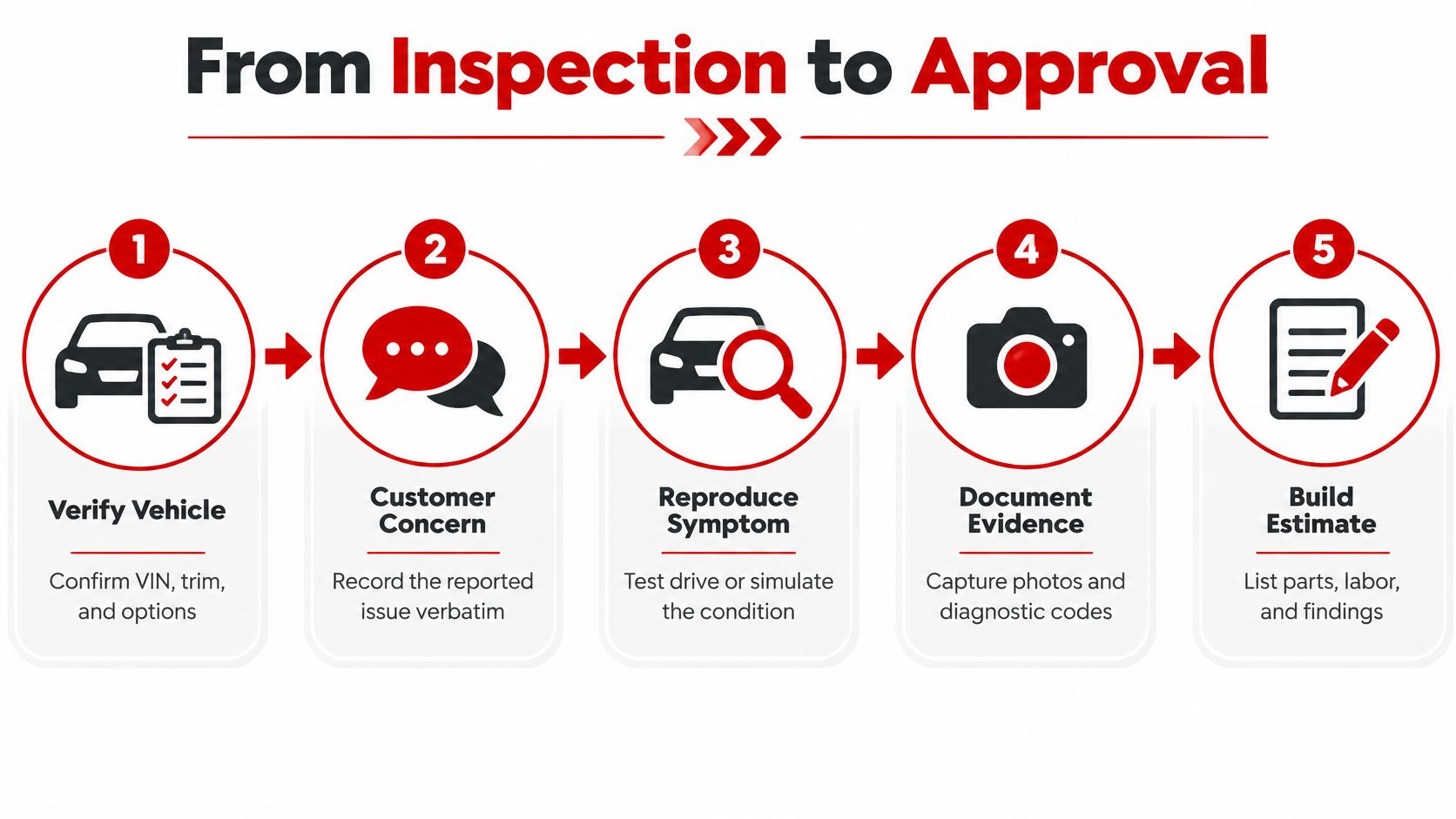
An accurate estimate begins before parts are priced. The advisor and technician need a shared account of the vehicle, the complaint, and the evidence supporting each proposed operation.
Establish the vehicle and the concern
Verify the VIN, configuration, and relevant equipment before selecting parts or labor operations. A description based only on the vehicle's general model can leave important fitment or procedure questions unresolved.
Record the customer's concern without translating it prematurely into a diagnosis. A customer reporting a vibration has described a symptom, not authorized replacement of whichever component first appears plausible.
The technician should reproduce the condition when practical and document the circumstances. If the symptom can't be reproduced, the estimate should acknowledge that limitation rather than present an unverified explanation as settled.
Use the diagnostic work needed to support a root-cause hypothesis. Photos can document visible conditions, while measurements and test results support findings that a photograph alone can't establish.
Turn evidence into priced operations
Before pricing corrective work, assign each finding a status:
- Confirmed: The available evidence supports the stated failure.
- Probable: The evidence supports a working explanation, but a decision point remains.
- Inspection-required: Access, disassembly, or additional testing is necessary before a repair recommendation can be finalized.
Keep diagnostic labor separate from repair labor. The shop can charge for an authorized investigation without implying that the investigation guarantees a particular repair outcome.
Price parts using current supplier information, checking the quoted component against the verified vehicle. Record the labor source and its revision information internally, or use recorded technician time where that is the agreed billing method.
Add operations because the job requires them, not because a template contains a convenient line. Access work, fluids, programming, calibration, sublet services, disposal, and post-repair verification need a clear relationship to the proposed repair. Check for overlapping operations before presenting the total.
Close the authorization loop
The recommends written estimates identifying the condition, required parts, and anticipated labor, with customer approval required before exceeding a stated amount or time.
Present the evidence alongside the proposed work and record the customer's selection. The approval record should identify the estimate revision, authorized scope, spending boundary, and communication method.
A revised estimate should explain what changed and why, not merely display a larger total.
When new findings change the scope, pause the affected work, document the evidence, and request revised permission. Preserve the earlier estimate so the shop can distinguish the original commitment from the later decision.
Price Parts Labor Fees and Taxes Clearly
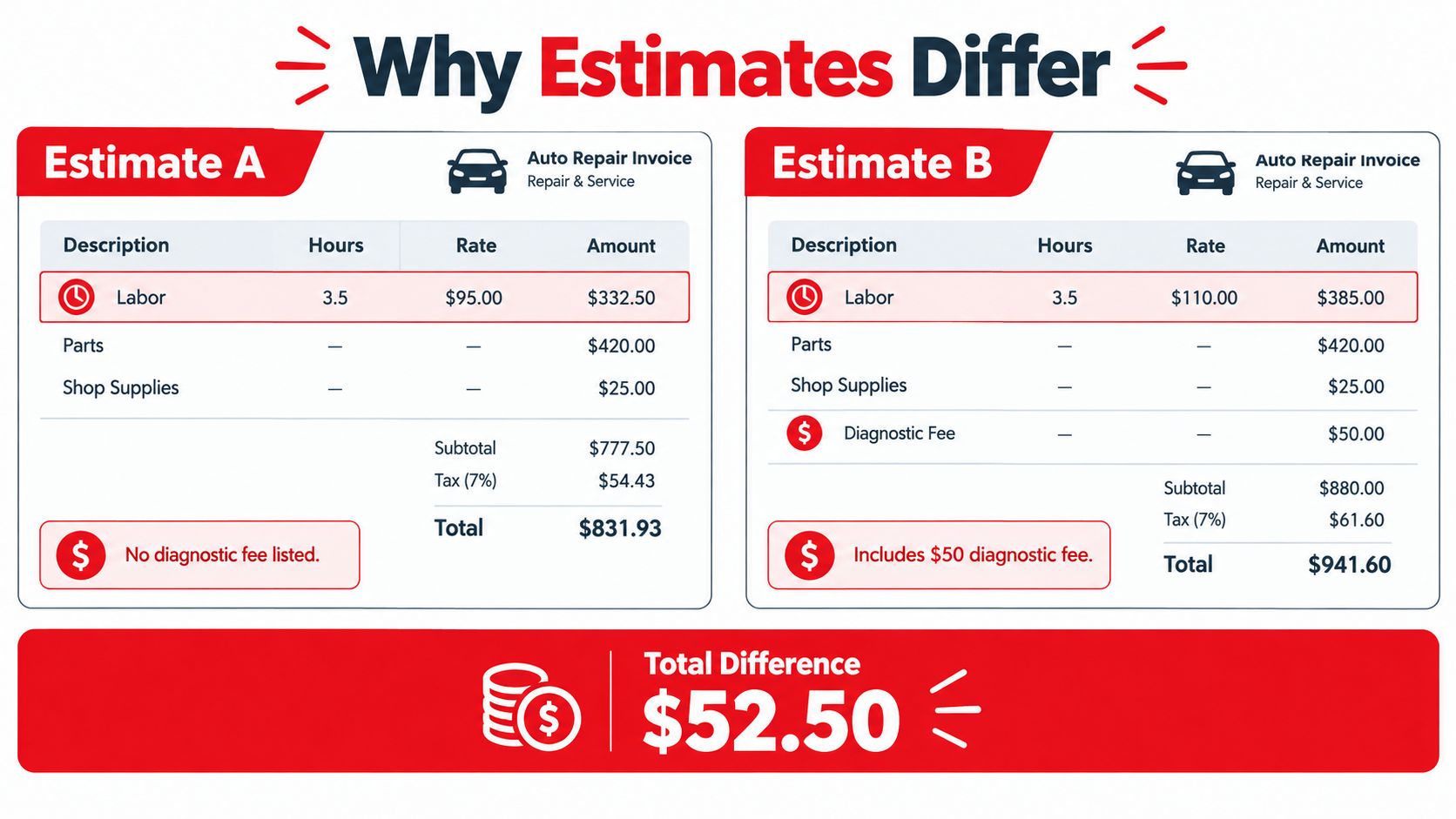
Similar-looking estimates aren't necessarily quotes for the same job. A lower labor subtotal may omit diagnosis, while a higher parts price may refer to a different component condition or brand.
Compare the labor basis before the total
The describes flat-rate estimating and gives a typical labor-rate range of $50 to $150 per hour. As an arithmetic illustration, 2.5 quoted labor hours multiplied by $140 per hour equals $350, before parts, taxes, supplies, or disposal charges.
That calculation still needs a label. If those hours come from a flat-rate guide, the estimate should identify them as book time and retain the supporting labor source. If the shop bills actual technician time, the document should state that method and the authorized boundary.
Consider contrasting approaches to a diagnostic complaint:
- A defined corrective operation: The shop uses documented flat-rate time for an established repair, with diagnosis shown separately.
- An unresolved intermittent symptom: The shop proposes an authorized diagnostic allowance, with corrective work pending findings.
Neither approach is automatically cheaper or more appropriate. The problem starts when an estimate presents them as interchangeable.
Make parts and additional charges comparable
identifies vehicle make and model, brand, quality, location, and availability as pricing factors. The document should distinguish new, used, rebuilt, or remanufactured condition from original-equipment or aftermarket sourcing.
Those descriptions answer different questions. “Aftermarket” alone doesn't fully describe the component being offered, and “replacement part” provides even less useful information.
List supplies, disposal charges, estimate fees, and applicable taxes where the customer can see their effect on the total. Avoid adding an unexplained miscellaneous charge at invoicing.
For a cross-trade comparison exercise, provide a separate reference outside automotive repair. Such comparisons are useful for examining presentation, not for setting automotive prices or repair procedures.
The advisor's comparison question should remain concrete: Do both estimates include the same diagnosis, component, operations, verification, and charges? A headline price alone can't answer that.
Avoid Pricing and Estimate Mistakes
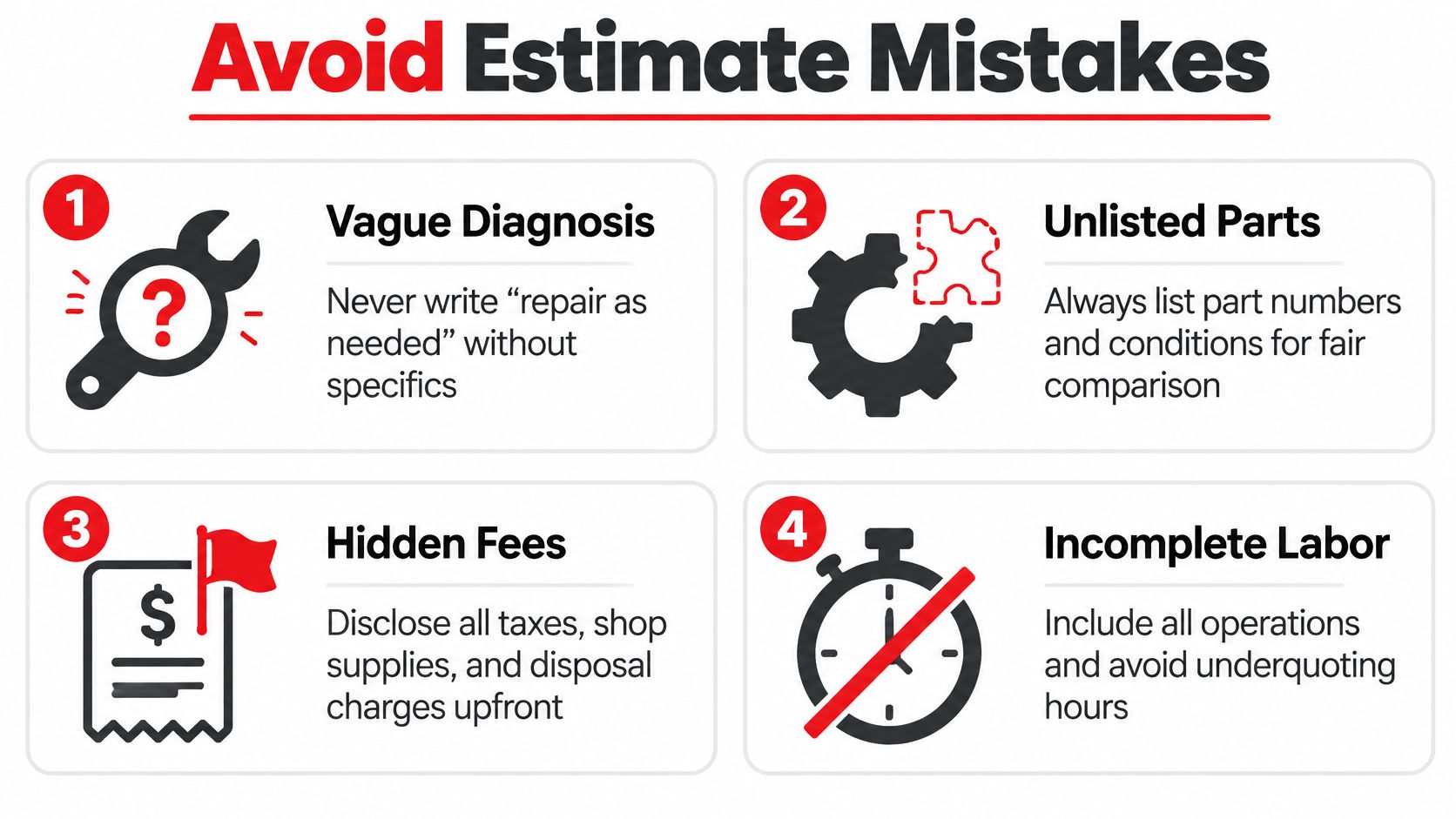
A tidy total can still rest on a weak estimate. The most troublesome documents often look complete because the uncertain work has been compressed into vague descriptions.
Challenge false precision
“Diagnose and repair concern” combines different commitments. It doesn't explain what testing is included, what finding supports the repair, or whether additional investigation requires permission.
A guaranteed total can also be inappropriate when the shop hasn't resolved access or condition questions. Hidden corrosion, seized fasteners, prior modifications, and diagnostic branching can change the work required. The estimate should describe the uncertainty specifically instead of attaching a broad disclaimer to every job.
Technology-related operations deserve the same discipline. The addresses scanning, calibration, and additional procedures associated with modern vehicles. Advisors should identify applicable conditional operations rather than assume a familiar-looking repair has a familiar scope.
An omitted operation isn't a customer benefit if the shop later needs to add it. Equally, a possible operation shouldn't be presented as a confirmed requirement without support.
Use a correction checklist
When an estimate appears incomplete or the proposed total changes unexpectedly, review the job in a consistent order:
- Match the concern: Compare the proposed work with the customer's reported symptom.
- Check the evidence: Reconcile each repair line with the inspection or diagnostic record.
- Recalculate labor: Confirm the billing basis, included access work, and overlapping operations.
- Verify components: Check part identity, condition, availability, and selected option.
- Resolve contingencies: Identify which unanswered questions affect scope or price.
- Document the correction: Explain the revision and obtain any necessary renewed authorization.
Correction standard: A price change needs a reason that another advisor can understand from the record.
Verbal conversations may still be part of service advising. The avoidable mistake is leaving those conversations undocumented, especially when a customer changes the approved scope or declines a recommendation.
Manage Margins Validity and Legal Notes
A sample car repair estimate should support pricing discipline without exposing the customer to unexplained charges. The owner needs to understand the cost of delivering the job, while the customer needs to understand the agreed selling price and scope.
Margin review belongs behind the estimate, not in a vague fee added after approval. Owners should assess parts acquisition cost, labor assumptions, supplier terms, and required outside services before deciding whether a quoted job is commercially sound.
Review why estimates change
Compare estimates with final invoices by job type, technician, vehicle age, and cause of change. Separate customer-added work from diagnostic discoveries, parts substitutions, omitted operations, and pricing errors.
That distinction prevents misleading conclusions. An increased invoice caused by newly authorized maintenance isn't the same estimating problem as repeated omissions of required access labor.
A practical margin review should examine:
- Parts decisions: Whether substitutions change cost, coverage, or the customer's selected specification.
- Labor assumptions: Whether the quoted operations match the actual job scope.
- Supplier exposure: Whether availability or purchasing terms changed before acceptance.
- Revision discipline: Whether additional work received authorization before costs were committed.
Set a usable validity rule
An estimate's validity should reflect the supplier quote and the shop's ability to hold the proposed scope and price. If availability or inspection findings change, issue a clearly identified revision instead of silently replacing the earlier document.
Recommended maintenance should remain distinct from urgent safety work. A customer's limited budget doesn't justify exaggerating urgency, and a conditional line shouldn't imply that an incomplete diagnosis is complete.
The also warns that repair warranties aren't standardized and may cover parts without installation labor. State coverage, exclusions, and the process for seeking assistance in plain language.
Local requirements can differ, so a reusable template still needs jurisdiction-specific review. Digital evidence and approval records support that review, but software doesn't replace appropriate legal guidance or a shop's responsibility to describe its terms accurately.
Use RedAppy for Digital Estimate Approvals
Digital tools are useful when they preserve the connection between inspection, proposed work, and the customer's decision. A PDF template, a structured estimating system, and an all-in-one shop platform are different options; the right choice depends on how the shop manages handoffs and records.
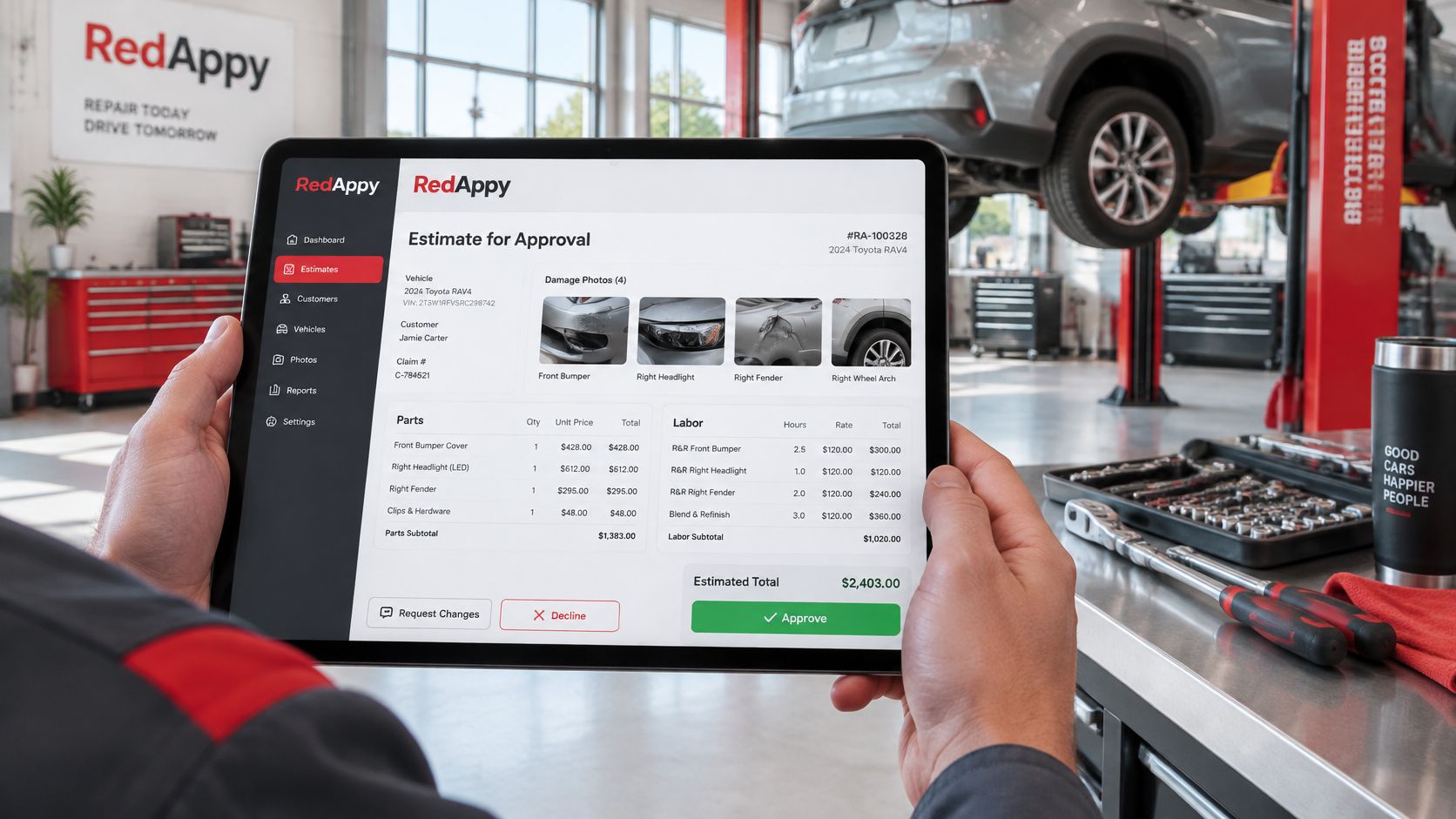
RedAppy provides digital inspections, instant estimates, parts ordering across suppliers, one-click invoicing, online payments, analytics, and a Kanban-style Digital Shop Board. Those functions place estimating within the wider shop workflow rather than treating the quote as an isolated document.
Keep inspection evidence close to the decision
The practical starting point is the digital inspection. The technician documents findings, and the advisor uses those findings to build understandable parts and labor lines rather than forwarding unexplained technical shorthand.
Photos should show the condition the recommendation addresses. A clear image with a specific explanation is more useful than a collection of pictures that leaves the customer guessing which repair each image supports.
Vehicle history can provide context for prior work, but the current recommendation still needs current evidence. An earlier repair record shouldn't substitute for inspecting the present concern.
A workable digital process assigns clear responsibilities:
- Technician: Records findings and identifies unresolved inspection questions.
- Advisor: Builds the customer-facing estimate and explains the proposed choices.
- Customer: Selects the work and provides authorization through the available approval process.
- Manager: Reviews exceptions, revisions, and differences between estimated and invoiced scope.
Preserve the distinction between approval and invoicing
One-click invoicing isn't the same as one-click authorization. Before adopting an approval workflow, the manager should confirm how the system records selected work, revised estimates, and the customer's decision.
The Digital Shop Board can support job visibility, while parts ordering and online payments handle other stages of the visit. Analytics are most useful when staff consistently record why a job changed rather than leaving managers to infer the reason from totals alone.
The platform features overview offers a place to assess those functions against an existing shop process. For a more specific discussion, the shop can contact the team about its estimating workflow and ask how inspection evidence, approval history, and revisions are handled.
A useful evaluation should follow an ordinary job from check-in through a changed finding and final invoice. That reveals whether the system supports the shop's authorization rules under practical conditions, not just whether it can produce an attractive estimate.
RedAppy offers digital inspections, instant estimates, parts ordering, and invoicing within a shared shop management platform. Shop owners can visit RedAppy to discuss turning their sample car repair estimate into a repeatable workflow with clearer evidence, itemized pricing, and documented customer decisions.
Ready to Transform Your Shop?
RedAppy helps auto repair shops create professional digital estimates with photos and videos, send them instantly via text or email, and get customer approvals in seconds. No credit card required to start.