
Shop Keys: What They Are, Why They Matter, and How Auto Repair Shops Manage Them
Every auto repair shop runs on trust — and nothing tests that trust like a set of shop keys. When a customer hands over their vehicle, they're giving you access to one of their most valuable possessions. How your shop handles, tracks, and returns those keys says a lot about your professionalism and your systems.
Poor key management is more common than most shop owners admit. Keys get misplaced, mixed up, or left in the wrong vehicle — and a single incident can cost you a customer for life. According to industry surveys, customer trust and communication are among the top reasons people switch repair shops.
This guide covers everything from how shop keys are physically organized to how modern shop management software ties key tracking into your broader workflow. You'll learn best practices, common mistakes, and how digitizing your process can eliminate the chaos that costs shops time, money, and reputation.
Table of Contents
- What Are Shop Keys?
- The Real Cost of Poor Key Management in Auto Shops
- How Auto Repair Shops Traditionally Handle Shop Keys
- Modern Key Management: Systems, Tools, and Best Practices
- How Shop Management Software Connects Key Tracking to the Full Repair Workflow
- Conclusion
What Are Shop Keys?
In an auto repair shop, shop keys are the physical vehicle keys that customers leave behind when dropping off their car for service. They're handed over at check-in and held by the shop until the job is done and the vehicle is picked up.
That simple exchange is at the heart of a much bigger operational concern. From the moment a key is handed over, the shop is responsible for it — and for the vehicle it controls. Key management refers to the entire process of tracking, storing, securing, and returning those keys without error.
Why Shop Keys Matter More Than They Seem
A vehicle key isn't just a piece of metal. It's access to a customer's property, often worth tens of thousands of dollars. When a shop takes a key, they're accepting a duty of care that carries both practical and legal weight.
In a slow shop with two or three cars a day, keeping track of keys is simple. But the average independent auto repair shop handles. At that volume, an informal system breaks down fast.
A single misplaced key can delay a repair by hours, tie up a bay, and leave a customer without their vehicle longer than necessary.
The Three Components of Shop Key Management
Key management in a repair shop involves three distinct responsibilities:
- Physical handling — Where the key is stored between check-in and pickup, and who has access to it
- Workflow tracking — Connecting the key to the correct repair order, technician, and vehicle status
- Security and accountability — Ensuring keys are only handled by authorized staff and returned to the right customer
Most shops have some version of a system for each of these. The problem is that manual systems rarely connect all three in a reliable way. Keys end up on the wrong hook, logged in the wrong place, or handed to the wrong person — often with no way to trace what went wrong.
What "Key Management" Looks Like in Practice
In practice, key management starts the moment a customer walks in. The service advisor takes the key, links it to a job number or repair order, and stores it in a designated location. From that point, the key may change hands several times — from the advisor to a technician, back to the service desk, and finally to the customer at checkout.
Each handoff is a point where something can go wrong. A key left on a workbench, placed in the wrong slot, or forgotten in a jacket pocket creates a chain reaction: delayed repairs, frustrated customers, and wasted staff time tracking it down.
Managing shop keys well is really about managing accountability — knowing who has the key, where it is, and what job it belongs to at every stage of the repair process.
This is why key management has become a recognized workflow concern, not just a front-desk chore. Shops that treat it as a real process — with defined steps, tools, and responsibilities — run more smoothly and avoid the costly mistakes that come from treating it as an afterthought.
The Real Cost of Poor Key Management in Auto Shops
Poor key management isn't just an inconvenience — it's a direct cost to your shop in time, money, and reputation.
Lost or misplaced keys are more common than most shop owners admit. According to the, operational inefficiencies — including poor physical organization — are among the top causes of customer complaints at independent repair shops. A technician spending 10 minutes searching for a key set doesn't sound like much, but across a busy shop handling 20+ vehicles a day, that adds up fast.
Lost Keys: The Obvious Problem
When a key goes missing, everything stops. The vehicle can't be moved, the job can't be completed, and someone has to retrace every step since check-in. In the worst cases, a lost key means replacing the key, the fob, or even the ignition — costs that typically fall on the shop.
A replacement key fob for a modern vehicle can cost anywhere from $150 to $600, depending on the make and model. If the shop is at fault, that expense comes straight off the bottom line. And that's before factoring in the labor time lost and the customer who's now waiting longer than promised.
Liability Exposure
When a customer hands over their keys, they're placing legal custody of their vehicle with your shop. That's called bailment — a legal relationship where the shop is responsible for the vehicle's safekeeping while it's in their possession.
If a vehicle is damaged, stolen, or broken into while in your care, and you can't demonstrate proper key security, your liability exposure increases significantly. Most shop insurance policies require documented key control practices. Sloppy key handling can complicate or even void a claim.
A shop that can't account for where a customer's keys were at any given moment has a much harder time defending itself if something goes wrong.
Customer Trust and Reputation Damage
Customers notice when a shop feels disorganized. Being told "we can't find your keys" — even briefly — creates immediate doubt. That doubt doesn't go away when the keys turn up. It follows the customer to their next Google review.
According to, 98% of consumers read online reviews for local businesses, and negative reviews about trust or professionalism carry disproportionate weight. One incident of key mismanagement, handled poorly, can generate a public complaint that costs far more than a replacement fob.
Delayed Repairs and Workflow Disruption
Keys aren't just a security issue — they're a workflow issue. When a technician finishes one job and can't immediately locate the next vehicle's keys, the gap in productivity compounds across the day.
In a shop running multiple bays, delays caused by key confusion can push jobs past promised completion times. That triggers customer calls, service advisor scrambling, and rescheduling — all of which consume time that should be going toward billable work. Shops that track technician efficiency often find that avoidable interruptions like key searches quietly erode productivity metrics.
The Volume Problem
Small shops with two or three bays might manage keys informally without major incidents. But as vehicle volume increases, informal systems break down. A shop handling 30 or 40 repair orders a week is managing dozens of key sets simultaneously — some vehicles checked in, some in progress, some waiting on parts, some ready for pickup.
Without a clear system, the probability of a mix-up scales with volume. A key placed on the wrong hook, tagged with the wrong number, or set down temporarily and forgotten becomes increasingly likely. The shops that experience the most key-related problems aren't careless — they're simply busy and relying on systems that weren't built for their volume.
How Auto Repair Shops Traditionally Handle Shop Keys
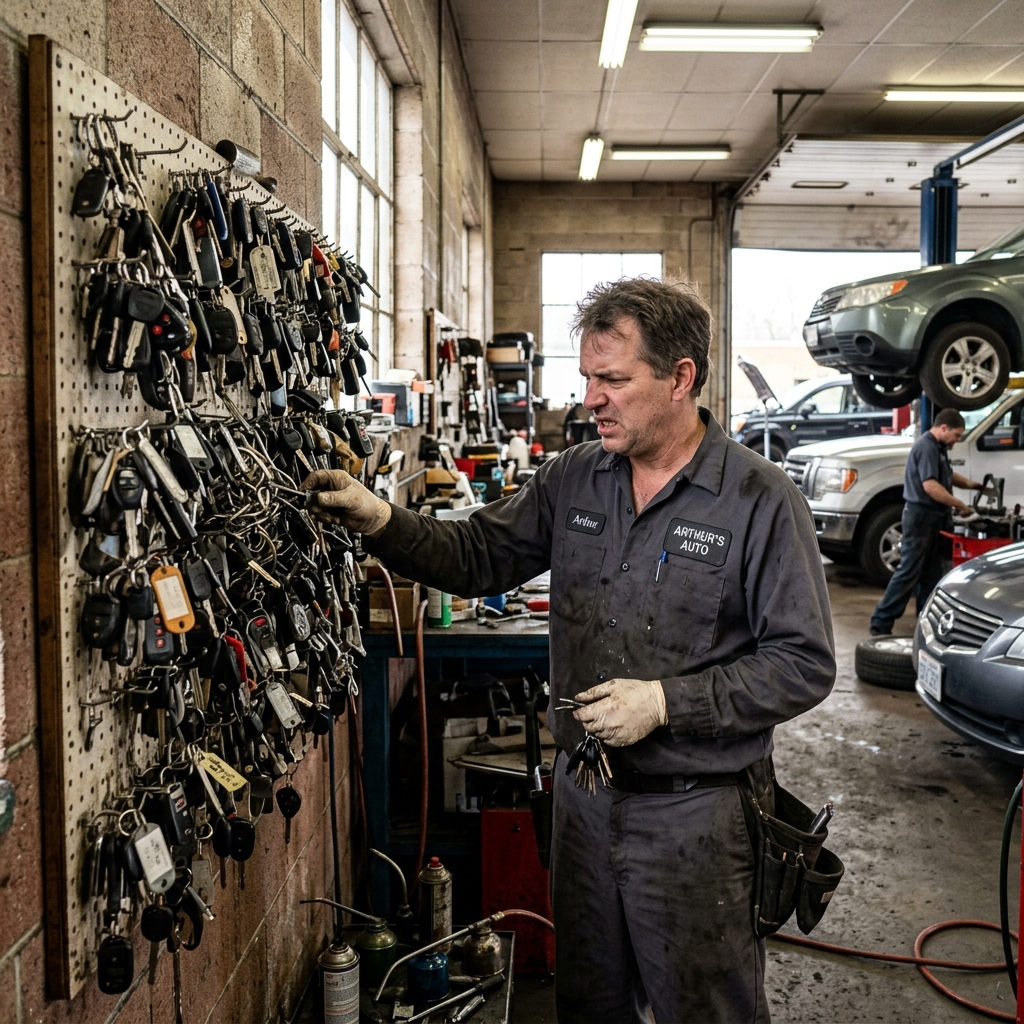
Most auto repair shops start with the same basic setup: a row of hooks on the wall, a pegboard near the service desk, or a drawer where keys get tossed at drop-off. These methods work fine when a shop handles five or six cars a day. They start to break down fast as volume grows.
The Pegboard and Hook System
The pegboard is the most common key management tool in independent shops. Keys hang on numbered hooks, and each hook corresponds to a bay, a job number, or a customer name written on a whiteboard nearby. It's cheap, visible, and requires no training.
The problem is that it relies entirely on habit. If a technician borrows a key and doesn't return it to the right hook, the system breaks. There's no record of who moved it or when. In a busy shop with multiple techs sharing the same space, this happens daily.
Key Tags and Numbered Labels
Most shops pair their hook system with key tags — small plastic or cardboard labels attached to the key ring. Tags typically show the customer's name, a job or repair order number, and sometimes the vehicle's make and model.
This is a meaningful improvement over blank hooks. It answers the question "whose key is this?" but not "where is this key right now?" Tags also get lost, fall off rings, or become unreadable after sitting in a greasy shop environment.
Paper Logbooks
Some shops maintain a written log — a notebook or clipboard where staff sign keys in and out. The idea is sound: create a paper trail of who has each key and when it moved.
In practice, logbooks are only as reliable as the people using them. Entries get skipped during busy periods. Handwriting becomes illegible. Finding a specific entry means flipping through pages. According to a, manual logs have error rates that climb significantly as transaction volume increases — a pattern that applies directly to key logbooks in high-traffic shops.
Lockboxes and Key Safes
For overnight security, many shops use a lockbox or small key safe bolted to a wall or stored in a back office. Keys get moved into the lockbox at close and retrieved in the morning. This solves the overnight theft risk but adds a handoff step that creates its own confusion.
A lockbox protects keys from theft but does nothing to track which technician has a key during shop hours — the period when most key mix-ups actually happen.
Comparison: Common Traditional Key Management Methods
| Method | Cost | Accountability | Scalability | Security |
|---|---|---|---|---|
| Pegboard + hooks | Very low | Low | Poor | None |
| Numbered key tags | Low | Moderate | Moderate | None |
| Paper logbook | Very low | Moderate | Poor | None |
| Lockbox / key safe | Low–moderate | Low (in/out only) | Moderate | Good (overnight) |
| Combined (hooks + tags + log) | Low | Moderate | Poor | Limited |
Where Traditional Systems Break Down
Manual methods share one fundamental weakness: they depend on consistent human behavior. In a shop processing 20 or more repair orders per day, that consistency is hard to maintain.
When a technician grabs a key to pull a car into a bay, checks something quickly, and sets it on a workbench instead of returning it to the hook, the system loses track. There's no alert, no record, and no easy way to find it without asking everyone on the floor.
Shops with three or more technicians and no formal check-out process report the most key-related delays — because accountability dilutes as team size grows.
Volume is the breaking point. A single-bay owner-operator can keep track of three keys in their head. A five-bay shop with two service writers and four technicians cannot run on memory and a pegboard alone.
Modern Key Management: Systems, Tools, and Best Practices
The upgrade from manual key handling to a structured system doesn't require a massive overhaul. It starts with small, deliberate changes that add accountability at every step.
The Four Levels of Key Management
Think of key management as a progression. Most shops sit somewhere in the middle and can move up with minimal investment.
| Level | Method | Best For |
|---|---|---|
| Basic | Hook board + handwritten tags | 1–3 bay shops, low volume |
| Structured | Numbered cabinet + paper logbook | Small to mid shops |
| Semi-digital | Barcode/QR tags + spreadsheet or app | Growing shops, 4–10 bays |
| Fully integrated | Key tags linked to shop management software | Multi-bay, high-volume shops |
Most shops can dramatically reduce key chaos by moving just one level up from where they are now.
Physical Key Cabinets
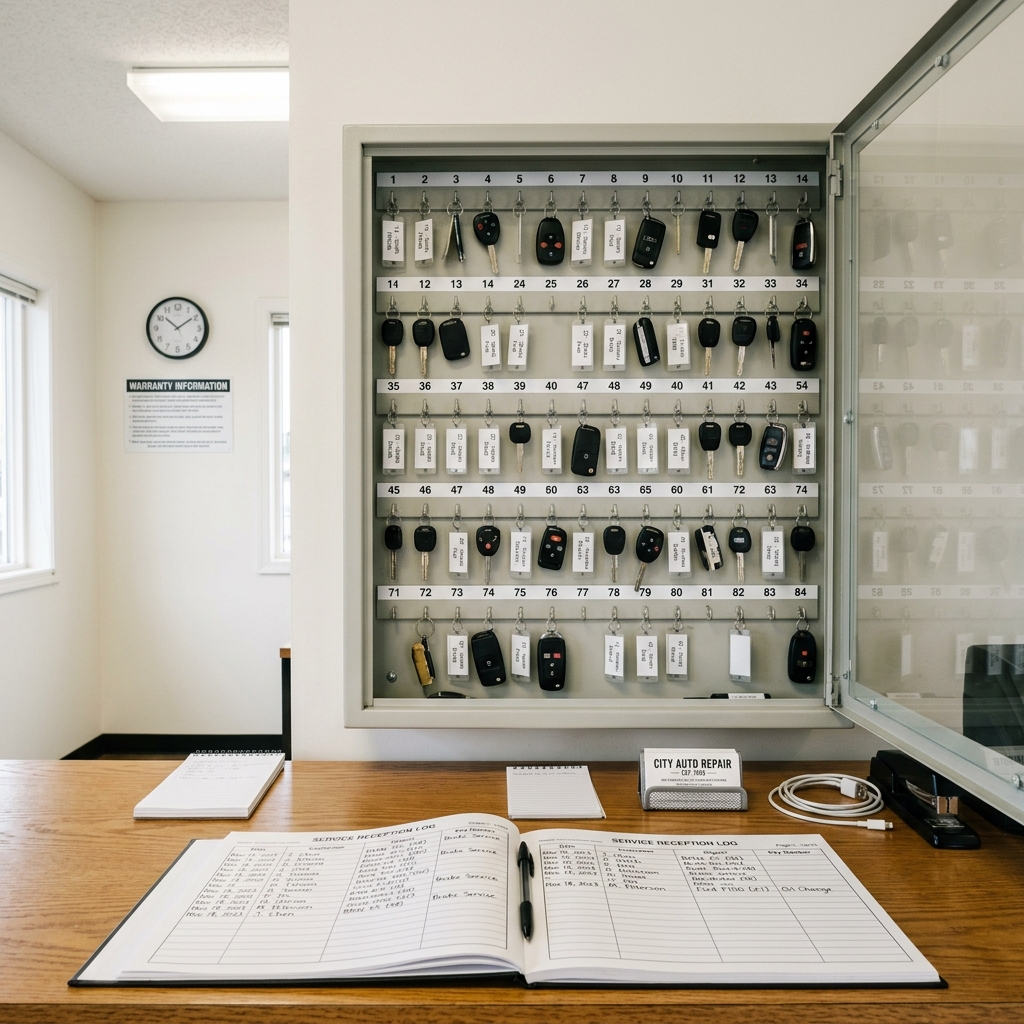
A lockable key cabinet is a significant upgrade from an open pegboard. Steel key cabinets with numbered hooks and a lock come in sizes ranging from 10 to 200+ key slots. The key detail: every hook gets a number, and every number maps to a vehicle or repair order.
In practice, numbered cabinets work best when the cabinet number appears on the job paperwork. That way, anyone in the shop can find the key in under 30 seconds — no searching, no asking around.
Look for cabinets that include a key log on the inside door. This creates a paper trail without requiring a separate logbook.
Key Tags with Barcodes or QR Codes
Barcode and QR code key tags are inexpensive and effective. Each tag gets scanned when a vehicle checks in and again when keys move — from service advisor to technician, from tech back to desk, and finally to the customer.
A scanned check-out timestamp is the most important record a shop can have if a customer later claims their car was taken out without permission.
QR tags can link directly to a digital repair order when scanned with a phone. This means a technician can pull up the full job details just by scanning the key fob tag — no paper, no chasing down the service advisor.
Best Practices for Check-In and Check-Out
A solid key process follows the same path every time. Consistency is what prevents keys from going missing.
At vehicle check-in:
- Tag the key immediately — before it leaves the service desk
- Record the tag number on the repair order
- Log the customer name, vehicle, and tag number in your system
- Hang the key in its designated cabinet slot
During the repair:
- Technicians sign out keys by name before moving the vehicle
- Keys return to the cabinet — not a pocket or workbench — when not in active use
- Any key movement gets logged (paper or digital)
At vehicle check-out:
- Confirm the key matches the repair order before bringing the vehicle around
- Hand the key directly to the customer — never leave it on the counter unattended
- Mark the key as returned in your log
Electronic Key Control Systems
For high-volume shops, electronic key control cabinets take accountability further. These systems require a PIN or employee card to access any key slot. Every access is time-stamped and logged automatically.
Electronic systems from manufacturers like or Morse Watchmans can hold hundreds of keys and generate full audit reports. The upfront cost runs from $1,500 to $5,000+ depending on capacity, but they eliminate the human error that cheaper systems rely on.
From experience, the ROI case is straightforward for shops doing 30+ repair orders per day — the time saved and liability avoided quickly offsets the equipment cost.
Connecting Physical Tags to Digital Records
The most effective shops don't treat key management as a separate process. They tie it into the same record as the repair order, the customer profile, and the vehicle history.
When a key tag number appears directly in your shop management software alongside the vehicle's status, any team member can answer "where are the keys to the blue Tacoma?" in seconds. No radio, no shouting across the shop floor.
This connection — between a physical tag and a digital job record — is what separates a structured system from a truly integrated one. The next section covers exactly how shop management platforms make that link work across the full repair workflow.
How Shop Management Software Connects Key Tracking to the Full Repair Workflow
The most organized key cabinet in the world still creates chaos if it's disconnected from everything else happening in your shop. Shop management software closes that gap by tying physical key location to the full digital workflow — repair orders, customer records, technician assignments, and job status — all in one place.
Linking Keys to Repair Orders
When a vehicle checks in, the key tag number should connect directly to the repair order (RO). This means anyone on your team can search the customer's name, license plate, or VIN and immediately see where that vehicle is in the queue — and by extension, where the keys should be.
In practice, this eliminates the most common key-hunting scenario: a service advisor needs to hand a car back to a customer, but nobody wrote down where the keys went. With a linked system, the RO tells the whole story.
A key without a connected repair order is just an anonymous piece of metal. The repair order gives it an owner, a status, and a home.
The Digital Shop Board and Job Visibility
Platforms like RedAppy use a Kanban-style Digital Shop Board that shows every active job as a card moving through stages — check-in, diagnosis, waiting for parts, in progress, quality check, ready for pickup. Each card represents a real vehicle, a real customer, and a real set of keys.
When a job moves to "ready for pickup," that's the signal for keys to move too — from the active hook to the outgoing drawer or secure cabinet. The board makes that handoff visible to everyone without a single phone call or sticky note.
This kind of visual workflow matters more than most shop owners expect. According to, visual job tracking reduces process errors and improves team coordination — benefits that apply directly to physical asset tracking like keys.
Customer Lookup and Key Accountability
A good shop management platform lets any staff member pull up a customer record by name, plate, or VIN in seconds. When that record includes check-in timestamps, assigned technician, and current job status, it also tells you exactly when the keys were received and who is responsible for the vehicle right now.
This accountability layer is what separates a connected system from a standalone key cabinet. The software doesn't just track keys — it tracks custody. That distinction matters when a customer disputes damage or questions when their car was touched.
Reducing the Chaos That Causes Lost Keys
Most lost keys aren't stolen — they're buried under paperwork, left on the wrong hook, or carried into a bay and forgotten. The underlying cause is usually the same: the key had no clear digital identity tying it to a specific job and a specific status.
When every vehicle in your shop has a live repair order with a current status visible on the shop board, the key always has a logical home. Shop workflow software removes the ambiguity that turns a misplaced key into a 20-minute search and an angry customer.
What to Look for in an Integrated System
Not all shop management platforms handle key-related workflow equally well. When evaluating options, prioritize these capabilities:
- Check-in logging that timestamps when a vehicle — and its keys — arrive
- RO-linked key tag tracking so tag numbers appear on the repair order
- Digital Shop Board with real-time job status visible to all staff
- Customer lookup by VIN, plate, or name for fast key-to-owner matching
- Technician assignment so there's always one accountable person per vehicle
- Ready-for-pickup notifications that trigger the key handoff process
RedAppy includes all of these features within its standard workflow, including vehicle history and customer records that give every key check-in a complete paper trail from the moment the customer walks in the door.
Shops that treat key tracking as part of the digital workflow — not a separate physical process — report fewer delays, fewer disputes, and faster vehicle turnaround.
The connection between key management and shop software isn't a luxury feature. It's the difference between a shop that reacts to key problems and one that prevents them entirely.
Conclusion
Shop keys are a small thing that can cause big problems. A lost key, a delayed repair, or a vehicle left overnight with no record of where the keys are — these aren't minor inconveniences. They're the kind of issues that damage customer relationships and expose your shop to real liability.
The good news is that fixing key management doesn't require an expensive overhaul. It requires treating it as a real process rather than an afterthought.
The Compounding Effect of Getting It Right
When key tracking works well, everything else moves faster. Technicians know exactly where to find a vehicle's keys. Service advisors can tell customers the status of their car without walking the floor. Managers have a clear record if a dispute ever arises.
Shops that tie key management into their overall workflow — rather than handling it as a separate task — spend less time searching, less time explaining, and less time recovering from mistakes.
That connection between keys and workflow is where modern shop management software makes the biggest difference. Platforms like RedAppy link each vehicle's keys directly to its repair order, customer record, and live job status on a digital shop board. Nothing falls through the cracks because everything is visible in one place.
What a Complete Key Management System Looks Like
In practice, the most effective setups combine physical organization with digital accountability:
- A dedicated key storage area — numbered hooks, a key cabinet, or a lockbox — with a fixed location everyone on the team uses
- Consistent tagging at check-in — every key gets a tag tied to the repair order number before it leaves the customer's hand
- A check-in/check-out log — whether that's a paper sheet, a digital entry, or an automated record inside your shop management software
- Integration with your shop board — so the status of the job and the location of the keys are always connected
This isn't complicated. But it does require consistency, and that consistency has to be built into the daily routine — not left to individual habit.
Protecting the Shop, the Customer, and the Bottom Line
Key management sits at the intersection of security, liability, and customer trust., vehicle theft remains one of the most common property crimes in the United States, and shops that leave keys unsecured overnight create unnecessary risk for themselves and their customers.
Beyond theft, the liability exposure from a lost key — replacement costs, towing, customer disputes — can far exceed whatever time it would have taken to build a proper system in the first place.
Customers notice how a shop handles their keys. A clear, documented process at drop-off signals that the shop is organized and trustworthy. That impression carries through the entire service experience and directly influences whether a customer comes back.
The shops that grow — and keep growing — are the ones that take the operational details seriously. Key management is one of those details. The right physical setup, backed by a shop management platform that connects keys to jobs, customers, and workflow, turns a common source of friction into a smooth, reliable part of how the shop runs every day.
Ready to Transform Your Shop?
RedAppy helps auto repair shops create professional digital estimates with photos and videos, send them instantly via text or email, and get customer approvals in seconds. No credit card required to start.