
SIC Code for Auto Body Repair: 7532 and NAICS Guide
The SIC code for auto body repair is 7532, formally titled Top, Body, and Upholstery Repair Shops and Paint Shops, and the current code that answers the same question is NAICS 811121, Automotive Body, Paint, and Interior Repair and Maintenance. One is a four-digit classification still printed on plenty of paperwork, the other is the six-digit standard that federal statistics, tax systems, and procurement portals run on, and a shop needs both on file.
So why does a supplier portal, an insurer's vendor application, and a state registration page each ask for a different number, and why does a filing get bounced after the owner types the six-digit label found in an online directory?
The usual answer stops at "7532" and leaves the reader to guess the rest. That guess is where mixed-service shops get into trouble. A body shop rarely does one thing. Collision repair, refinishing, upholstery work, restoration projects, and a little mechanical service can all sit under one roof, and each of those activities has a code that could plausibly describe it.
The SIC code for auto body repair is not a trivia answer. It's an identifier that follows a business into insurance underwriting, lender files, vendor onboarding, employment datasets, and the directories customers and suppliers search. Getting it right takes ten minutes. Getting it wrong takes years to unwind.
This guide gives the code up front, then works through the parts that trip people up: what 7532 covers, where it sits in the tree, which sibling codes steal business from it, and how to verify a classification against official references instead of a single directory page.
Table of Contents
- SIC 7532 and NAICS 811121 at a Glance
- What SIC 7532 Covers and Excludes
- Where 7532 Sits in the SIC Hierarchy
- Nearby SIC Codes in the Automotive Repair Group
- When New Services Change Your Classification
- Verify the Right Code for Your Shop
- Confirm a Code Against Official References
- Run Your Body Shop on One Platform
SIC 7532 and NAICS 811121 at a Glance
The official pair is short. SIC 7532 is the legacy four-digit code. NAICS 811121 is the six-digit code current forms expect. They describe the same kind of shop, and each form asks for only one of them.
7532 comes from the Standard Industrial Classification Manual, issued by the Office of Management and Budget. That manual places the industry in Division I (services), Major Group 75 (automotive repair, services, and parking), and Industry Group 753 (automotive repair shops). The hosts that listing under the title Top, Body, and Upholstery Repair Shops and Paint Shops.
NAICS 811121 is titled Automotive Body, Paint, and Interior Repair and Maintenance. Federal statistics, tax systems, and procurement portals run on NAICS. A field labeled NAICS wants 811121 even when older paperwork on the wall only shows 7532.
Directory publishers sometimes lengthen the SIC into 7532-01, Automobile Body Repairing & Painting. A six-digit extension like 7532-01 is a commercial directory label, not an official government code. When a tax registration, an insurance application, or a lender file asks for SIC, enter the four-digit 7532 from the OMB manual.
| System | Code | Official title | Use it for |
|---|---|---|---|
| SIC | 7532 | Top, Body, and Upholstery Repair Shops and Paint Shops | Any form or database that asks for a SIC code |
| NAICS | 811121 | Automotive Body, Paint, and Interior Repair and Maintenance | Current federal statistics, tax, procurement, and registration forms |
| Extended SIC | 7532-01 | Automobile Body Repairing & Painting | Commercial directory label only; file the four-digit 7532 on official forms |
Why Both Codes Stay on File
The two systems work like an old part number and the current catalog number for the same job. SIC 7532, in four digits, identifies an establishment whose principal activity is body, top, upholstery, or paint work. NAICS 811121 names that same kind of shop in the six-digit system newer workflows use. Swap them and the filing bounces. A SIC field will not take 811121. A NAICS field will not take 7532.
Read the label on the form, not the number that looks more precise. A supplier portal or an insurer's vendor application that still says SIC gets 7532. A state registration, a tax worksheet, or a procurement profile that says NAICS gets 811121. The directory extension stays in the directory. It does not go on either form.
Store both codes on the shop profile, each labeled with its system. When a lender or vendor asks, the front desk reads the label instead of guessing from a folder of old applications.
Scale is easier to check than the code, and the check uses Census tables rather than one directory page. The counts 35,029 employer establishments in the industry. Its puts sales, receipts, or revenue at roughly $52.9 billion.
Those figures describe the NAICS industry. They do not make 7532-01 a government code, and they do not replace reading the field name before you type.
What SIC 7532 Covers and Excludes
Say a shop runs two collision bays, one upholstery bay, and a slow-burn restoration project on a customer's classic truck in the back corner. To the owner that's one business with a few service lines. To a classifier it's also one business, provided the body and paint work drives the revenue.
The covered work is broader than most owners assume. SIC 7532 takes in repair of automotive tops, bodies, and interiors, automotive painting and refinishing, and customization of cars, trucks, and vans performed outside a factory setting. Antique and classic automobile restoration sits inside the code as well, which is why a restoration shop that never touches an insurance claim still belongs here rather than in some vague specialty category.
The One Boundary That Actually Excludes Work
Factory-based customization falls outside 7532 and belongs to Manufacturing, Industry Group 371. The line isn't about the task, it's about the kind of establishment performing it. A plant that builds or modifies vehicles as part of production is a manufacturer. A shop that takes in a customer's vehicle and hands it back repaired or refinished is a service business.
The test that settles most arguments: did the customer bring the vehicle to the shop, or did the shop build the vehicle for sale? Customer vehicles point to 7532. Production runs point to manufacturing.
Two quick reads on that rule. A collision shop that straightens a unibody, replaces a quarter panel, and refinishes the paint is squarely 7532. A restoration business that rebuilds a classic body, retrims the interior, and repaints it to a period-correct finish is also 7532, even though almost none of that work arrives through an insurance claim.
Where Mixed Shops Go Wrong
The mistake is treating 7532 as a badge of capability rather than a description of the business. A general repair shop that mounts a bumper or polishes a scratch a few times a month is still a mechanical shop, and its filings should say so. The code follows the activity that pays the bills, not the activity the owner would like to advertise.
Where 7532 Sits in the SIC Hierarchy
The SIC system builds from broad to narrow, and 7532 is the fourth and most specific step in a four-level chain. Each level answers a different question, which is why a survey occasionally asks for a group rather than a code.
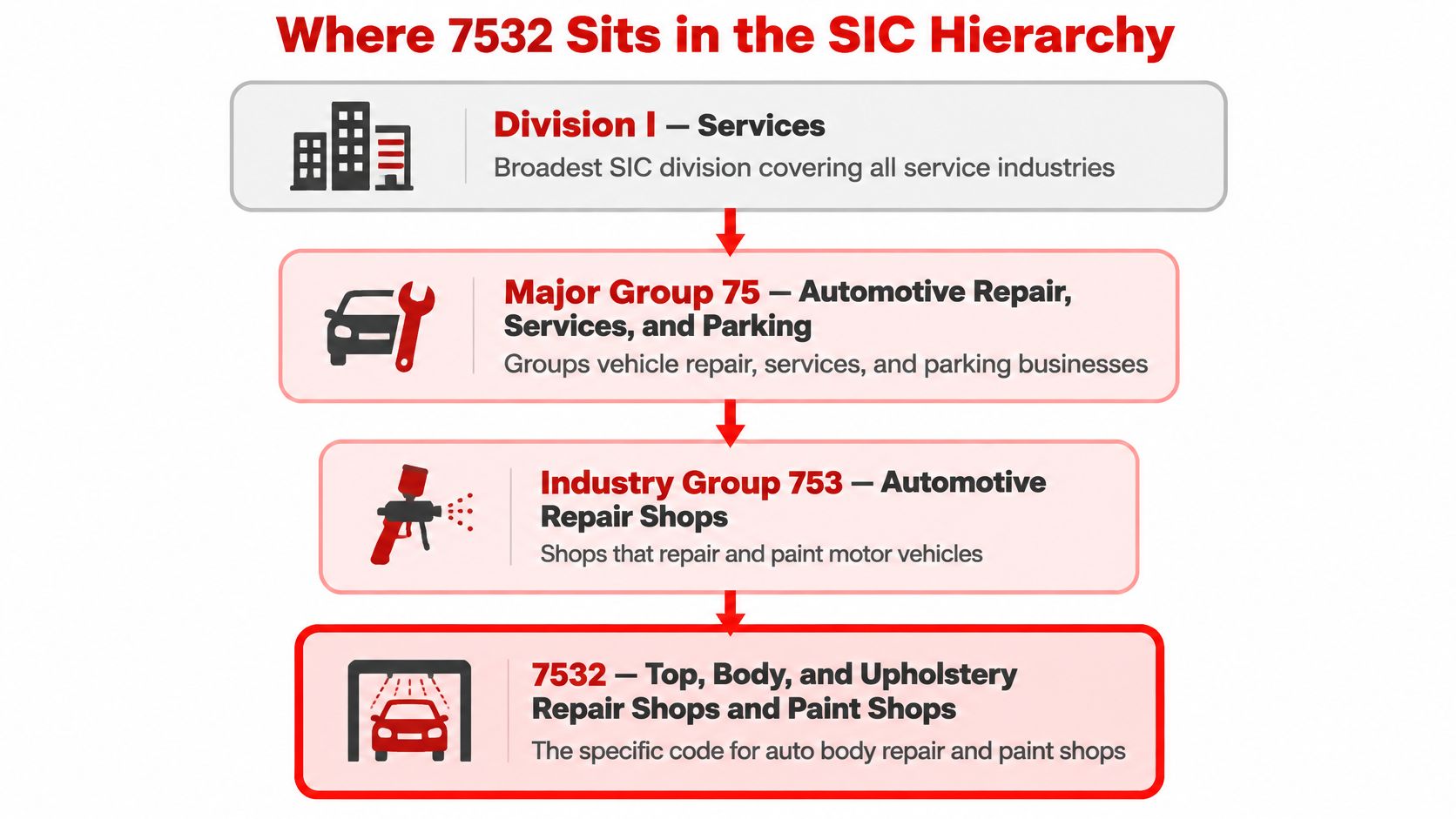
Division I covers service industries as a whole and shows up when a dataset wants to compare services against manufacturing or retail. Major Group 75 narrows that to establishments furnishing automotive repair, rental, leasing, and parking services to the general public.
Industry Group 753 trims the list to automotive repair shops, cutting out the rental counters and parking garages that share the major group. 7532 then pulls top, body, upholstery, and paint work away from the mechanical, glass, tire, exhaust, and transmission shops sitting beside it in the same group.
Some registrations collect a major group or industry group instead of a four-digit code. A shop that knows the chain can answer either one without guessing.
That tree also explains why 7532 can't serve as a universal automotive code. Every business in the trade sits somewhere on the same branch, and the level below 753 tells a reader exactly what kind of repair shop the business is. Picking a sibling number by accident is a small error that follows a shop through directories and databases for years, because nobody re-verifies a field that already looks filled in.
Nearby SIC Codes in the Automotive Repair Group
A body shop that also mounts tires and replaces a muffler still has one principal activity. Industry Group 753 splits automotive repair into seven four-digit codes. Picking by the job on the lift this afternoon, instead of the work that fills the schedule, is how shops land on the wrong sibling.
The classification manual lists them together: 7532 for top, body, upholstery, and paint shops; 7533 for exhaust systems; 7534 for tire retreading and repair; 7536 for automotive glass replacement; 7537 for transmissions; 7538 for general automotive repair shops; and 7539 for automotive repair shops not elsewhere classified. General mechanical repair is 7538, not a lower number in the same group.
| SIC code | Industry title | Primary focus | Choose it when |
|---|---|---|---|
| 7532 | Top, Body, and Upholstery Repair Shops and Paint Shops | Body, paint, interior, restoration, non-factory customization | Body repair or refinishing is the shop's main activity |
| 7533 | Automotive Exhaust System Repair Shops | Mufflers and exhaust systems | Exhaust work is the main activity |
| 7534 | Tire Retreading and Repair Shops | Tires | Tire work is the main activity |
| 7536 | Automotive Glass Replacement Shops | Windshields and automotive glass | Glass replacement is the main activity |
| 7537 | Automotive Transmission Repair Shops | Transmissions | Transmission work is the main activity |
| 7538 | General Automotive Repair Shops | Mechanical repair and maintenance | Mechanical work is the shop's main activity |
| 7539 | Automotive Repair Shops, Not Elsewhere Classified | Specialized repair outside the codes above | That specialized line is the shop's main activity |
Read the table as a set of alternatives, not a menu of add-ons. A collision shop that mounts a set of tires or swaps a muffler while the car is already on the lift does not become a tire shop or an exhaust shop. Those tasks are incidental to the work that fills the schedule. The sibling codes exist for establishments whose entire business is the narrower service.
A form that asks for SIC wants one four-digit code from this group. A form that asks for NAICS wants 811121 for a body and paint shop. The two numbers describe the same kind of establishment on different systems. They are not interchangeable, and neither one is a blend of every service on the invoice.
Where the Siblings Actually Matter
They matter most in labor and wage data, where occupations do not split the way industries do. The Bureau of Labor Statistics groups automotive body and glass repairers into a single occupation with a median annual wage of $52,530, even though 7532 and 7536 are separate industry codes. An owner reading wage benchmarks should know which population the number describes before using it to set pay.
Directories also publish six-digit extensions inside 7532, from automobile body repairing and painting to narrower labels for paint work, customizing, and restoration. Those labels work like aisle signs in a parts catalog: handy for filtering a search, not the number a government form prints in the SIC box. Government forms still want the four digits.
When New Services Change Your Classification
The question that follows every new piece of equipment is whether it changes the code. Adding EV structural repair, ADAS calibration, paintless dent repair, mobile work, or glass replacement usually doesn't, because classification follows the establishment's principal activity and the rules printed on the form in front of you, not the technology sitting in the bay.
The existing mapping already absorbs modern work. NAICS 811121 is mapped to SIC 7532 and explicitly covers repairing or customizing vehicle and trailer bodies and interiors as well as painting vehicles and trailers. A calibration bay bolted onto an existing body shop changes what the shop can bill, not what kind of establishment it is.
The Exceptions Worth Planning For
- A separately operated division. When calibration or mechanical work runs as its own location with its own revenue, it may need its own NAICS code, a different insurance classification, and licensing treatment the body shop's policy won't cover.
- Factory-based customization. Production work moves to Manufacturing, Industry Group 371, no matter how much body and paint labor it involves.
- A genuine shift in the revenue mix. A shop that drifts from mostly collision work to mostly mechanical service should reclassify, because the dominant activity has changed and the old code now misdescribes the business.
A code is a statistical label and it certifies nothing. Holding 7532 doesn't prove a shop owns an ADAS calibration rig, holds the welding certification an OEM structural procedure calls for, or meets the permitting rules for a spray booth. Insurers, OEM certification programs, and workplace-safety regulators each run their own checks, and those checks live entirely outside the SIC and NAICS systems.
For the mixed-shop case where nothing obviously dominates, the quick-reference table below maps common situations to the code to enter.
Verify the Right Code for Your Shop
A form that asks for an industry code wants one of two numbers, not a guess. SIC 7532 is the legacy code for auto body, paint, and interior repair shops. NAICS 811121 is the current counterpart for the same kind of establishment. Keep the pair in the shop's files, and put only the one the form names on that line.
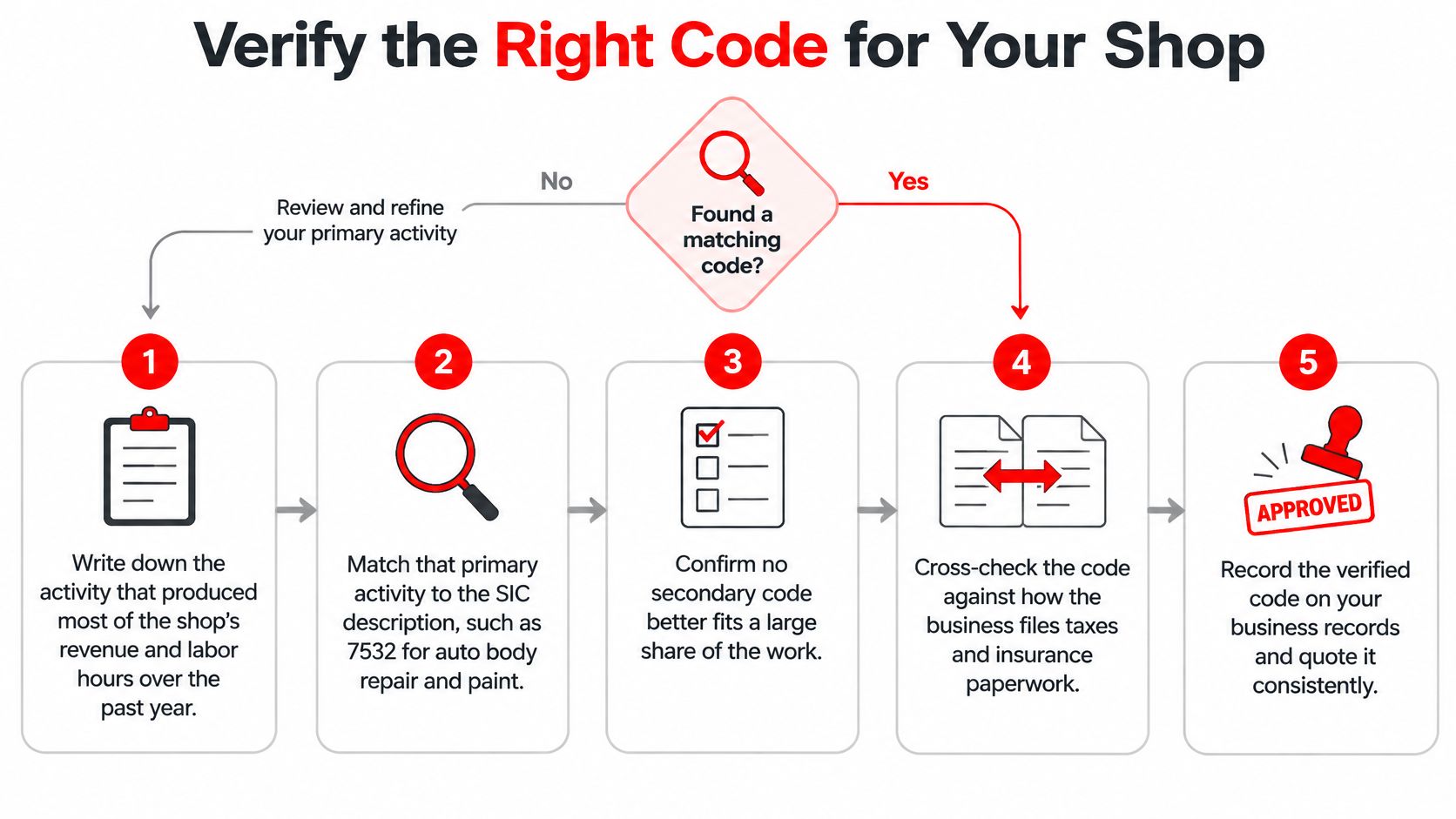
Filling the box works like writing a repair order: name the main job before you pick a labor line. Here the main job is the activity that produced most of the shop's revenue and labor hours over the past year. The code describes that business, not the service list on the website.
Match the activity to a description before you touch the form. Body, paint, interior, or non-factory restoration work points to 7532. Mechanical maintenance points to 7531. Glass replacement points to 7536. Factory production points to Manufacturing, Industry Group 371.
Then read the instruction line on the form itself. If it asks for SIC, enter 7532. If it asks for NAICS, enter 811121. Applications sometimes switch systems halfway through, so both numbers should already be on file.
A mixed shop ranks the top two or three services by revenue and by labor hours, then codes the leader. Secondary codes go on the form only where a field exists for them. Insurance policies, licenses, directory listings, and tax records should show that same classification. A mismatch tends to surface during underwriting, a loan review, or vendor onboarding.
Three habits cut down later corrections. Do not substitute a six-digit directory extension for 7532. Store 7532 and 811121 side by side rather than treating them as the same number. Revisit the classification when the service mix shifts and a different activity starts producing most of the revenue and hours.
The Compliance Layer Under the Code
The code also shows up in safety enforcement. OSHA identifies SIC 7532 shops as a potential focus for silica-related inspections when abrasive blasting creates crystalline-silica exposure, and its guidance limits those inspections to hazards associated with silica. A shop that strips coatings or blasts metal before refinishing should keep engineering controls, respiratory protection, housekeeping routines, exposure assessment, and worker training in a file it can produce on request.
Card networks run a separate numbering system, merchant category codes, which is not SIC and not NAICS. Cleaning up 7532 and 811121 does not tell a processor how to list the shop. A shop setting up card acceptance can walk through account setup and review in the.
| Your situation | Code to use | Why |
|---|---|---|
| A form asks for a SIC code | 7532 | Use the four-digit official code, not a directory extension |
| A form asks for a NAICS code | 811121 | Current counterpart mapped to SIC 7532 |
| Shop does mostly mechanical work | 7531 | Occasional dent or paint work does not make it 7532 |
| Shop only replaces automotive glass | 7536 | Glass specialists sit outside 7532 |
| Restoration or custom body and interior work | 7532 | Included when done on a non-factory basis |
| Factory-based vehicle customization | Manufacturing 371 | Production work is not a repair-shop code |
| Mixed services and unsure what dominates | 7532, 7531, or 7536 | Enter the code of the activity that leads in revenue and labor hours |
Confirm a Code Against Official References
A directory match proves somebody typed the same digits into another database. The key test is whether the code appears in an official reference with the same title and the same scope notes, and five checks settle it.
- The SIC manual itself. The four-digit code, its official title, and its industry description all appear there, along with the notes on restoration and non-factory customization. If a label doesn't appear in the manual, it isn't an official SIC code.
- The NAICS manual published by the U.S. Census Bureau. The body, paint, and interior repair definition and its correspondence to SIC 7532 are documented in the current manual, which is the reference behind anything asking for NAICS.
- SEC EDGAR filings. Publicly traded collision and automotive service companies carry SIC codes in their filings, so a search of comparable registrants shows how established businesses in the sector are coded.
- State registration and tax forms. Many states print an SIC or NAICS field and state which system they expect, which makes the form itself an authority on the number to enter.
- The party receiving the form. Insurers, lenders, and procurement portals build their own forms, so a short email to the underwriting or vendor-onboarding desk confirms the expected system before the application goes in.
If the number isn't in the manual, it isn't an official SIC code, no matter how many directories publish it.
Labels like 7532-01 fail that test every time, which is exactly why an official match is the deciding check. When a classification is disputed, the form issuer or a licensed accountant can confirm which code fits the shop's principal activity, and a short written record of that decision settles the question the next time it comes around.
Run Your Body Shop on One Platform
Which number belongs on the form, and which system runs the bays? Those are different jobs. SIC 7532 is the legacy code for body, paint, and interior repair. NAICS 811121 is its current counterpart. Older insurance and vendor forms often still ask for SIC. Newer registrations ask for NAICS. Keep both numbers in one clearly labeled spot in the shop's own records, a shared note or the front of the compliance folder, so the next form starts from that pair instead of a fresh guess.
A correct code files the business. It does not schedule the work. RedAppy is an all-in-one shop management platform for auto repair businesses, used by thousands of shops. It covers the operational layer: digital inspections, estimates with parts and labor, one-click invoicing, and analytics on revenue and technician efficiency. The included shop website is built to be search ready and to show the shop to people searching for auto repair nearby. That matters when a driver is comparing three body shops on a phone in the parking lot.
Directory visibility sits next to that site, not inside the classification codes. Owners who want the listing side tightened up can read about for the profile and map work that sits alongside it.
Review the RedAppy shop management features or reach the team through the RedAppy contact page. Visit RedAppy to see how it fits the way your body shop already works.
Ready to Transform Your Shop?
RedAppy helps auto repair shops create professional digital estimates with photos and videos, send them instantly via text or email, and get customer approvals in seconds. No credit card required to start.