
Social Media Marketing for Auto Repair Shops That Books Jobs
At the beginning of 2025, the world had approximately 5.24 billion active social-media user identities, representing about 63.9% of the global population, according to. For an auto repair shop, that scale changes the question from “Should the shop post on social media?” to “Can the shop respond effectively when a driver finds it there?”
Social Media Marketing for Auto Repair Shops works best when it connects directly to inspections, estimates, approvals, and completed repair orders. A post may create the first impression, but the response process determines whether that impression becomes a booked appointment. The strongest strategy balances social content with Google visibility, review management, and the shop's ability to follow up without losing customer information.
Table of Contents
- Why Social Media Matters for Your Shop Right Now
- Picking Platforms and Content Pillars That Fit Your Shop
- Creating Posts That Turn Scrollers Into Booked Jobs
- Turning Engagement Into Estimates and Repair Orders
- Where Social Fits Next to Google, Reviews, and Local Search
- Your 30-Day Social Plan With the Right Metrics
Why Social Media Matters for Your Shop Right Now
A driver may discover a repair shop through a short video, inspect its photos, read customer comments, and send a message before making a phone call. The journey often starts with a question such as “What does this warning light mean?” or “Is this brake noise serious?” The shop that explains the problem clearly has an opportunity to become the trusted option before the customer compares prices.
Social platforms support that early research. Instagram led brand and product research among active adult users at 62.3%, followed by Facebook at 52.5% and TikTok at 51.5%, according to the DataReportal research linked above. Those figures aren't a reason to publish everywhere. They show why platform choice should follow customer behavior in the shop's service area.
Where Car Owners Discover and Vet Auto Repair Shops
The figures below describe research behavior and platform use, not guaranteed bookings. They show where a shop can influence trust before a vehicle owner contacts the service desk.
| Research Step | Driver Share Using This Channel | Role in Booking Decision |
|---|---|---|
| Reviewing service providers on social media | 55%, | Helps a driver judge credibility, activity, and customer experience |
| Researching brands and products on Instagram | 62.3%, | Makes visual inspections, technician videos, and repair examples useful |
| Researching brands and products on Facebook | 52.5%, | Supports local discovery, reviews, messages, and appointment actions |
| Researching brands and products on TikTok | 51.5%, | Gives educational short-form videos a chance to reach new drivers |
A shop's social profile now carries signals that once lived mostly on its website or Google listing. Recent inspection photos, clear explanations, visible technicians, customer-approved testimonials, and prompt replies all answer the same concern: “Can this business handle my vehicle professionally?”
Practical rule: Social media should be managed as a trust-and-response system tied to the repair order, not as a content calendar measured by follower growth.
That distinction matters for independent garages and multi-location chains with limited staff time. A service advisor may be able to capture a photo during an inspection, but that doesn't mean the same person can monitor messages, qualify leads, update the schedule, and follow up on estimates. Every post needs an owner, a response path, and a measurable next action.
Picking Platforms and Content Pillars That Fit Your Shop
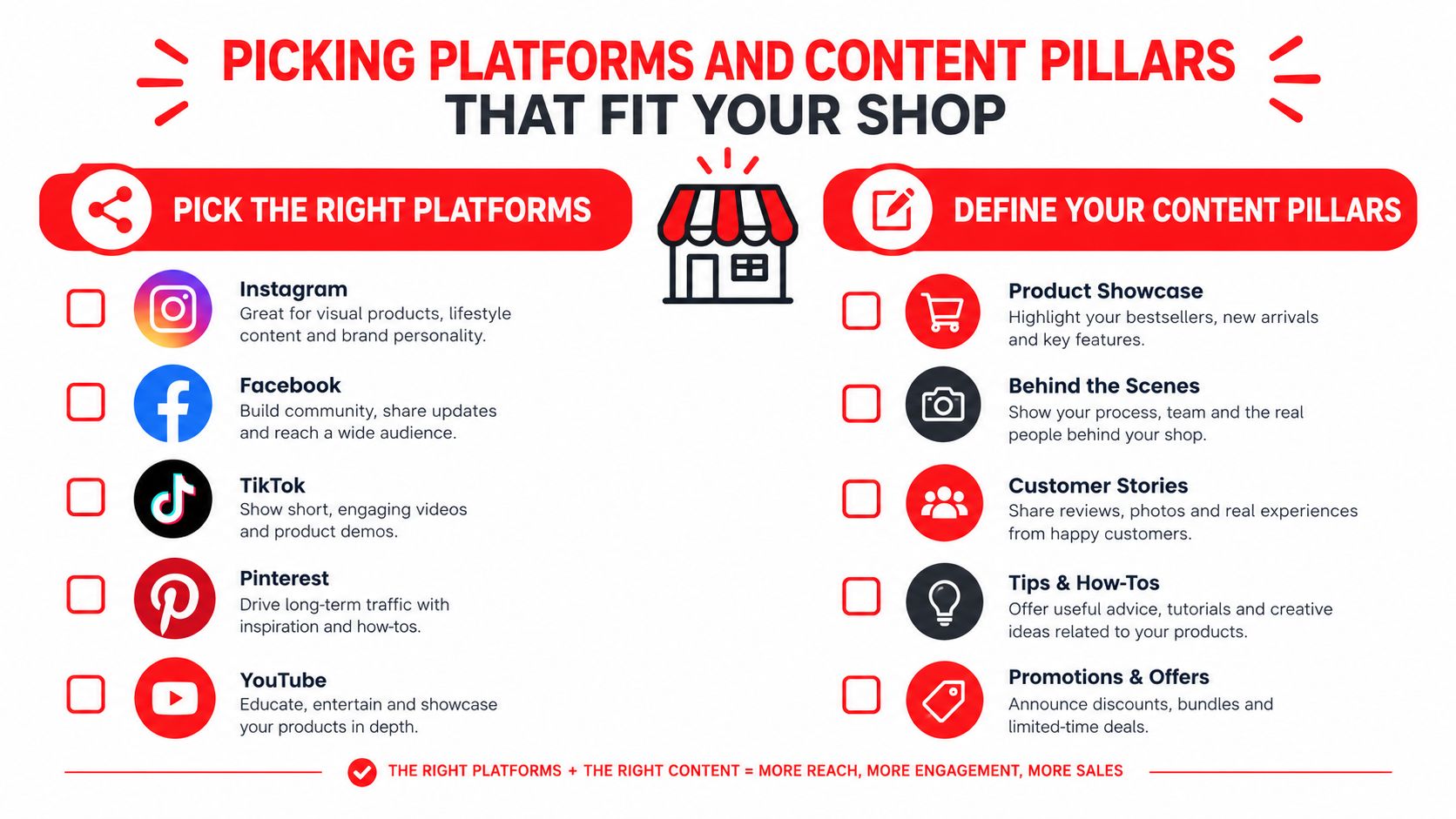
A small shop doesn't need an account on every platform. It needs a reliable presence where local drivers research businesses and where the team can publish without disrupting vehicle work.
Facebook is often the practical starting point for a local garage because it supports community interaction, reviews, business information, and direct contact. Instagram suits shops with strong visual material, such as brake inspections, tire wear, suspension repairs, technician demonstrations, and clean before-and-after images. TikTok can work when a technician enjoys appearing on camera and can explain a problem naturally. YouTube Shorts can extend the life of a useful how-to explanation, but production and channel management require additional discipline.
Start with two platforms
For most shops, a focused two-platform approach is more sustainable than spreading a thin team across several accounts. Facebook and Instagram make a sensible pair when the shop can reuse a repair image while adapting the caption and format. TikTok becomes a useful third channel only when someone has the time and interest to film consistently.
The content should come from ordinary shop activity:
- Inspection evidence: Show a worn component, explain the finding, and document the approved repair without exposing personal information.
- Technician expertise: Let technicians explain warning lights, noises, fluid leaks, tire wear, or maintenance decisions in plain language.
- Customer education: Answer questions drivers ask at the counter, such as whether a vehicle can be driven with a warning light on.
- Shop life: Introduce advisors, technicians, quality checks, tools, and clean handover procedures.
- Community proof: Share permitted reviews, local involvement, and customer stories without revealing vehicle or contact details.
A practical cadence is three to five posts and one or two short videos each week. That schedule gives the shop enough activity to look current while leaving room for inspections and customer communication. One weekly batch can produce the raw material, captions, and scheduled posts. Each repair moment should be repurposed carefully, not duplicated mechanically: an inspection image can become a carousel, a short video, a Google Business Profile update, and a service FAQ with different wording and purpose.
The shop should also complete basic profile information before chasing reach. Business name, phone number, opening hours, location, service categories, booking path, and current photographs must agree across platforms. A polished video cannot compensate for a profile that sends a customer to an outdated phone number.
Creating Posts That Turn Scrollers Into Booked Jobs
A brake inspection can become useful content without becoming a sales pitch. The technician photographs the worn pad and rotor, removes identifying details, and records a short explanation of what the inspection found. A second image shows the approved replacement, while the caption explains the symptom, the diagnostic step, and what evidence the customer received before authorizing the work.
That sequence gives the viewer more than a dramatic “before and after.” It shows a process. The customer sees that the shop identified a condition, explained it, obtained approval, and completed a defined repair.
Three shop-style scenarios
A technician selfie video can perform the same trust-building job with less production. The technician faces the camera and says what a dashboard light can indicate, what the light cannot prove by itself, and why a scan or inspection is the correct next step. The video should open with the customer symptom, use native captions, and end with a direct instruction such as “Send a message with the warning light you're seeing” or “Book an inspection through the profile.”
A permitted customer story adds a different kind of proof. After a completed repair, the advisor can ask whether the customer is comfortable sharing a short comment or allowing a review excerpt to be posted. The story should focus on the customer's concern, the explanation provided, and the completed service. Plates, VINs, invoices, names, and other identifying details should be removed unless explicit permission covers their use.
The strongest posts don't hide the technical work, but they also don't overwhelm drivers with jargon. A shop can use this reusable set of prompts:
- Symptom post: “Hearing grinding when braking? These are the inspection points that matter.”
- Inspection post: “This worn component was found during an approved inspection. Here's what the technician checked.”
- Technician video: “A check engine light gives a starting signal, not a complete diagnosis.”
- Process post: “Before delivery, the team verifies the repair, updates the invoice, and explains what happens next.”
- Review post: “The customer wanted clearer communication. The advisor documented the concern and provided updates through the repair.”
- Booking post: “Need an inspection for brakes, tires, diagnostics, or routine maintenance? Send a message or use the booking form.”
Branding should remain visible but restrained. A logo, consistent colors, and the shop name help recognition, while oversized promotional graphics can make technical education feel like an advertisement. The call to action should match the post. An urgent symptom post can direct a driver to call or message. A maintenance explanation can lead to an inspection request. A customer review can invite another driver to book the same service.
Turning Engagement Into Estimates and Repair Orders
A comment doesn't become revenue by itself. The shop needs a defined route from public engagement to private qualification, scheduling, inspection, estimate approval, and a repair order.
The six-step conversion path
- Qualify the inquiry in direct messages. Ask what the vehicle is doing, whether it is drivable, and what service the customer is seeking. Public comments aren't the place for detailed diagnosis.
- Capture vehicle and contact information securely. Move the conversation to a booking form, phone call, or approved customer system. Don't request VINs, plates, payment information, or detailed personal information in a public thread.
- Send the lead to the scheduler or shop-management system. The next employee should see the original concern, requested service, vehicle details, and contact information without asking the customer to repeat everything.
- Perform the inspection and generate the estimate. Social media should never replace diagnosis. The post creates interest, while the inspection produces evidence and a repair recommendation.
- Request a deposit when the shop's policy supports it. Clear terms can reduce avoidable no-shows for appointments requiring reserved time or ordered parts.
- Convert the approved estimate into a repair order. The approved work, parts, technician notes, customer updates, and final invoice should remain connected.
Response ownership matters as much as the funnel. A shop should decide who monitors comments and messages during business hours, which questions require a service advisor, and when a technician must review the issue. A simple script can acknowledge the concern, avoid a public diagnosis, collect the preferred contact route, and offer the next available inspection path.
A response-time standard should be realistic for staffing, but it must be explicit. One consumer-behavior summary reports that 75% of automotive customers expect real-time repair-status updates, while 60% prefer booking service online rather than calling, as reported in. Those figures support online scheduling and status communication, but they don't justify promising an immediate answer when nobody owns the inbox.
Paid testing without wasting the budget
The first paid test can use two distinct structures. A trust ad shows inspection photos or a technician explanation and asks the viewer to book an inspection. A promotional ad presents a specific seasonal service offer with a direct booking or message action. Meta's apply to paid placements across its services, so claims, images, offers, and landing pages must accurately match the service.
Test one meaningful creative variable at a time. A symptom-led video should not be compared with an inspection carousel while also changing the audience, offer, and booking destination. Stop or revise creative when qualified messages, booking rate, or approved work deteriorates, even if clicks remain inexpensive.
Automotive repair and service traffic on Meta averages roughly 0.80% click-through rate, while a separate benchmark reports approximately $0.81 average CPC, according to. These are reference points for testing, not booking promises. The shop should compare them with its own qualified appointment rate, show rate, approval rate, and completed-repair revenue.
For shops that need a deeper look at comment handling and missed opportunities, offers useful context on why unanswered public interactions can weaken the conversion path.
Where Social Fits Next to Google, Reviews, and Local Search
Social media isn't automatically the best channel for an auto repair shop. A driver with a vehicle that won't start may search Google Maps, compare opening hours, read reviews, and call the nearest credible shop. That driver has stronger immediate intent than someone watching a general maintenance video.
Local search deserves a deliberate share of the team's attention. One local-search survey reports that 68% of consumers use some form of Google search as their default for finding local businesses, 67% always or often examine reviews, and 85% consider contact information and opening hours the most important profile details, according to. Social posts can create demand and provide proof, but Google Business Profile and review management often capture demand closer to the booking decision.
A practical allocation model
A single-location shop should usually give its first attention to accurate Google Business Profile information, review responses, service pages, and a clear booking route. Social can receive the remaining capacity once those basics work. A multi-location chain can justify a more structured social program because content, creative testing, and response procedures can be shared across locations while each profile retains local information.
| Channel | Weekly Effort Share | Time to First Result | Best Fit Shop Type |
|---|---|---|---|
| Google Business Profile | High priority | Often immediate for profile actions and calls | Every location, especially urgent-service shops |
| Reviews and responses | High priority | Builds through repeated customer interactions | Every shop serving local drivers |
| Paid search | Priority for high-intent services | Can produce inquiries quickly when campaigns are aligned | Shops with clear service areas and tracking |
| Local SEO and service pages | Steady investment | Slower, with compounding visibility | Shops seeking durable local discovery |
| Organic social | Focused, consistent effort | Usually supports consideration before direct booking | Shops with useful repair evidence and active advisors |
| Paid social and retargeting | Controlled testing budget | Depends on creative, audience, and follow-up | Shops with a working booking and tracking process |
Reviews are not separate from social strategy. BrightLocal findings cited by report that 97% of consumers read reviews for local businesses, 68% require at least a four-star rating, 31% use only businesses rated 4.5 stars or higher, 47% avoid businesses with fewer than 20 reviews, and 74% look for reviews from the previous three months. A shop should request feedback after completed work, respond to positive and negative reviews, and share approved excerpts where they reinforce a real service experience.
Social can also feed local search by turning one repair into several useful assets. An inspection image can support a social post, a Google update, a website FAQ, and a review request. The wording should change for each channel, and the customer information must remain private.
The allocation decision becomes clearer when the shop asks what a channel is supposed to do. Google captures existing intent. Reviews reduce uncertainty. Local SEO builds durable discovery. Social creates familiarity and demonstrates process. Emergency repairs and highly specific specialty services may favor Google, while preventive maintenance and trust-sensitive decisions benefit from social evidence.
Your 30-Day Social Plan With the Right Metrics
A useful rollout starts with the shop's operating reality rather than a large content library. Each week should produce a small improvement in visibility, response handling, or attribution.
Week one, fix the foundation
Complete every profile with the correct shop name, service area, opening hours, phone number, services, photographs, and booking route. Select the content pillars that match the work performed, such as brakes, diagnostics, tires, inspections, fleet service, or maintenance.
Track reach, profile visits, and incoming messages. The first week isn't about proving revenue. It is about removing basic friction and establishing a baseline for later comparisons.
Week two, batch useful evidence
Capture inspection photos, technician explanations, shop-process clips, and approved customer proof during normal work. Prepare three to five posts and one or two short videos, then schedule them through a platform-native tool such as Meta Business Suite or another scheduling system the team can maintain.
Sync the strongest themes with the Google Business Profile and service pages, but don't copy the same caption everywhere. Track reach, profile visits, link clicks, and direct-message volume. Record which service category each inquiry mentions.
Week three, test the handoff
Run a controlled paid test only after the booking path works. One ad can focus on inspection evidence, while another promotes a specific seasonal service. Use separate links, landing pages, phone numbers, or campaign codes where possible.
Start or reinforce the review-request loop after completed work. Track DM response time, link clicks, booked appointments, show rate, and review requests sent. The service advisor should record the lead source at intake instead of relying on memory.
Week four, measure and document
Compare content categories by business outcome. Track estimate approval rate, completed repair value, revenue attributed to social, response time, and repeat visits. A post with modest reach but a qualified inspection may be more valuable than a widely viewed video that produces no identifiable inquiry.
Document the response script, escalation rules, privacy safeguards, booking steps, and source fields in a simple standard operating procedure. A centralized shop-management platform can help connect customer communication, vehicle history, estimates, repair orders, payments, and lead capture so the advisor doesn't have to rebuild the customer record at every stage.
Manager's review: Ask which content generated qualified conversations, which conversations became appointments, which appointments showed up, and which approved estimates became completed repairs.
A 60-minute weekly review is enough for an owner or manager to maintain control. Spend the first part checking response time and unresolved messages. Use the next portion to review booked appointments, show rate, approval rate, and attributed revenue. Reserve the final portion for selecting the next repair moments to document, refreshing weak creative, and assigning one person to each follow-up task.
RedAppy connects customer and vehicle records, digital inspections, estimates, repair orders, customer communication, and online lead capture in one shop-management workflow. Shops that want social inquiries to move cleanly from first message to approved work can contact the RedAppy team or visit RedAppy to review the platform and its features.
Ready to Transform Your Shop?
RedAppy helps auto repair shops create professional digital estimates with photos and videos, send them instantly via text or email, and get customer approvals in seconds. No credit card required to start.