
Best Software for Automotive Repair Shops in 2025: Tools That Actually Save Time
Running an auto shop in 2025 means juggling more than wrenches. The right software for automotive repair can mean the difference between a shop that runs smoothly and one buried in paperwork, missed appointments, and unpaid invoices. According to the Auto Care Association, the U.S. auto repair industry generates over $115 billion annually — yet many shops still rely on whiteboards, spreadsheets, and sticky notes to manage it all.
The pressure to do more with less is real. Technicians are harder to find, parts prices keep climbing, and customers expect faster turnaround and digital communication. Shops that adopt modern management tools report saving 10 or more admin hours per week — time that goes straight back into billable work.
This article covers the best shop management platforms available right now, what each one does well, where each falls short, and which type of shop each one fits best. Whether you're a solo mechanic or running multiple locations, there's a tool here built for your situation.
Table of Contents
- How We Compared Auto Repair Shop Software
- RedAppy — Best All-in-One Platform for Modern Auto Repair Shops
- Conclusion
- Frequently Asked Questions
How We Compared Auto Repair Shop Software
Picking the right shop management software comes down to matching features to your actual workflow. To compare fairly, we evaluated each platform across six criteria: ease of use, feature depth, pricing transparency, AI capabilities, scalability, and whether it includes built-in tools like a website or parts ordering.
What to Look for in Shop Management Software
Not every feature matters equally. Some are non-negotiable for running a smooth shop — others are useful add-ons once the basics are covered.
Must-have features:
- Digital inspections — Photo and video inspections increase customer approval rates. According to industry data, shops using digital inspections see up to 30% more approved work per RO (repair order).
- Estimates and invoicing — Fast, accurate estimates tied directly to invoicing cut admin time significantly.
- Online payments — Customers expect to pay digitally. Platforms without this create unnecessary friction.
- Parts ordering — Ordering from multiple suppliers inside the same platform eliminates tab-switching and reduces errors.
- VIN lookup — Pulling vehicle data by VIN, plate, or customer name speeds up check-in and reduces manual entry mistakes.
Nice-to-have features:
- AI repair assistant for labor times and diagnostics
- Technician performance analytics
- Multi-location dashboard
- Built-in branded website
- Kanban-style job tracking board
Shops that consolidate workflow into one platform — rather than patching together five separate tools — consistently report faster turnaround times and fewer dropped jobs.
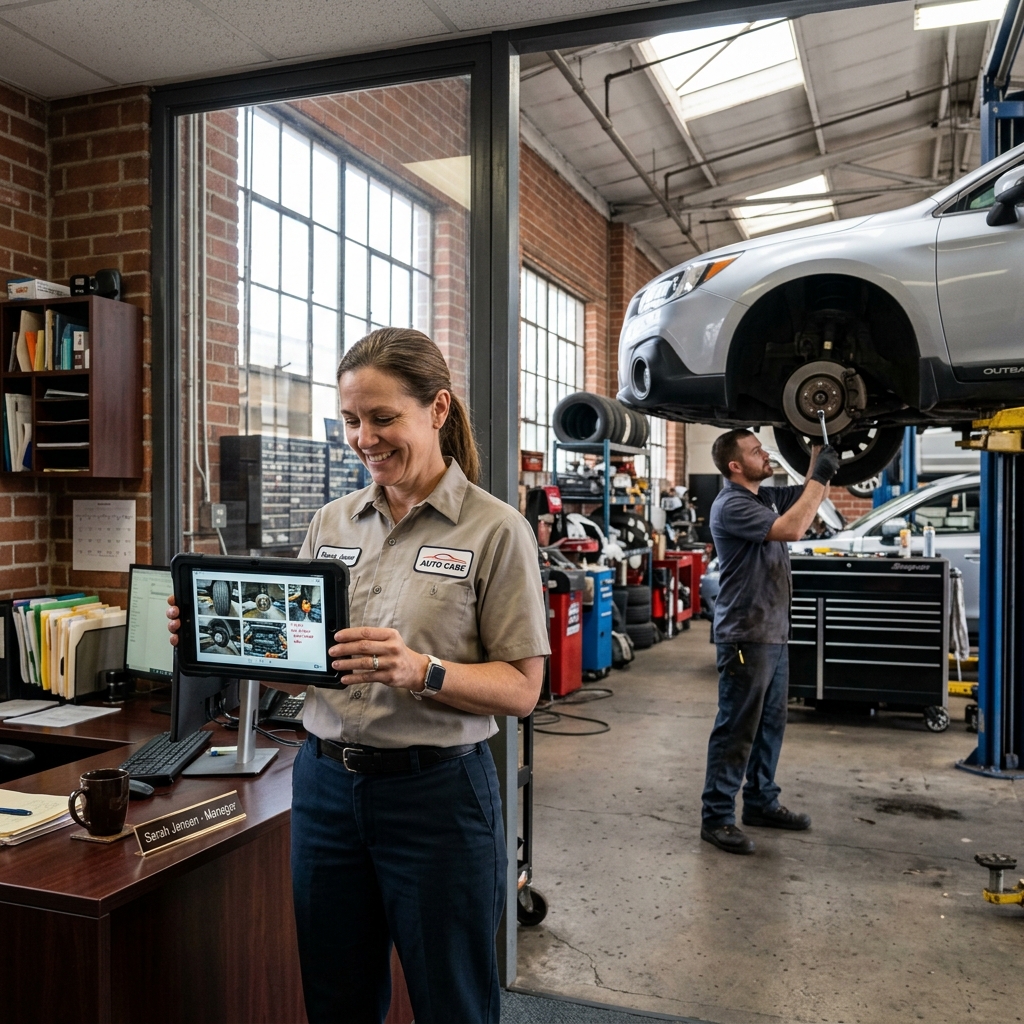
How digital inspections improve approval rates
Quick Comparison Table
| Feature | RedAppy | Mitchell 1 | Shop-Ware | Tekmetric | Alldata |
|---|---|---|---|---|---|
| Starting Price | Transparent, month-to-month | Subscription (quote-based) | Quote-based | Quote-based | From ~$149/mo |
| Free Trial | Yes | Limited | No | Yes | No |
| AI Features | ✅ Built-in AI Repair Assistant | ❌ | ❌ | ❌ | ❌ |
| Digital Inspections | ✅ | ✅ | ✅ | ✅ | ❌ |
| Multi-Supplier Parts Ordering | ✅ Real-time inventory | ✅ | Limited | ✅ | ❌ |
| Online Payments | ✅ | ✅ | ✅ | ✅ | ❌ |
| Analytics & Reporting | ✅ Real-time | ✅ | ✅ | ✅ Advanced | ❌ |
| Built-in Website | ✅ Branded, included | ❌ | ❌ | ❌ | ❌ |
| Scalability | Single-bay to multi-location | Single to mid-size | Small to mid-size | Multi-location focus | Add-on tool only |
| OEM Repair Data | Via AI Assistant | ✅ Deep integration | Limited | Limited | ✅ Factory-accurate |
Alldata is a repair information tool, not a shop management platform. Most shops use it alongside a management system rather than as a standalone solution.
Compare shop management platforms side by side
In practice, the platforms that score best across all six criteria are the ones built to handle the full job lifecycle — from first customer call to final payment — without requiring add-ons or workarounds. The sections below break down each tool in detail so you can match the right platform to your shop's specific pain points.
What to Look for in Shop Management Software
Not every feature on a vendor's sales page is worth paying for. These are the ones that actually move the needle for most shops.
Must-Have Features
- Digital inspections — Photo and video inspections sent directly to customers increase approval rates. Shops using photo-rich inspections report 20–40% higher upsell conversion compared to verbal recommendations.
- Estimates and invoicing — One-click estimate-to-invoice conversion eliminates double entry and speeds up the billing cycle.
- Online payments — Customers expect to pay by text or link. Shops that offer digital payment options collect faster and reduce front-desk friction.
- VIN and plate lookup — Pulls vehicle specs, service history, and parts compatibility automatically. Saves 5–10 minutes per repair order.
- Parts ordering — Built-in ordering across multiple suppliers with real-time inventory means fewer phone calls and faster turnaround.
- Basic analytics — Revenue tracking, technician efficiency, and average repair order value tell you where money is being made or lost.
Nice-to-Have Features
- AI repair assistant — Surfaces labor times, diagnostic steps, and shop insights without leaving the platform. Useful, but only if it's accurate and fast.
- Kanban-style job board — Visualizes every job from check-in to checkout. Reduces status calls and keeps the whole team aligned.
- Customer-facing website — A branded site with contact forms and service listings helps attract new customers without a separate marketing tool.
- Multi-location dashboard — Essential for shop groups, overkill for a single-bay operation.
- Team calendar — Centralizes scheduling so nothing falls through the cracks.
Shops that try to run five separate tools — one for invoicing, one for inspections, one for parts, one for customer messaging, one for their website — spend more time managing software than managing cars.
Questions to ask before you commit:
- Is pricing transparent, or do you need a sales call to get a number?
- Is it month-to-month, or are you locked into an annual contract?
- Does it include onboarding support, or are you figuring it out alone?
- Can it scale if you open a second location?
- Does it integrate with the parts suppliers you already use?
The goal is a platform that fits how your shop actually works — not one that forces you to change your workflow to fit the software.
Quick Comparison Table
| Feature | RedAppy | Mitchell 1 | Tekmetric | Shop-Ware | Alldata |
|---|---|---|---|---|---|
| Pricing | Transparent, month-to-month | Subscription, no public price | Starts ~$199/mo | Starts ~$299/mo | From ~$149/mo |
| Free Trial | ✅ Yes | ❌ No | ✅ Yes | ✅ Yes | ❌ No |
| AI Features | ✅ Built-in AI Repair Assistant | ❌ No | ❌ No | ❌ No | ❌ No |
| Digital Inspections | ✅ Photo-rich | ✅ Yes | ✅ Yes | ✅ Yes | ❌ No |
| Parts Ordering | ✅ Multi-supplier, real-time inventory | ✅ Limited | ✅ Yes | ⚠️ Limited | ❌ No |
| Branded Website Included | ✅ Yes | ❌ No | ❌ No | ❌ No | ❌ No |
| OEM Repair Data | ⚠️ Via AI assistant | ✅ Deep integration | ⚠️ Basic | ⚠️ Basic | ✅ Factory-accurate |
| Multi-Location Support | ✅ Yes | ⚠️ Limited | ✅ Strong | ⚠️ Limited | ❌ No |
| Online Payments | ✅ Yes | ⚠️ Add-on | ✅ Yes | ✅ Yes | ❌ No |
| Kanban Shop Board | ✅ Yes | ❌ No | ⚠️ Basic | ❌ No | ❌ No |
Most shops need more than repair data — they need a full workflow system. A platform that handles inspections, invoicing, parts, and customer communication in one place eliminates the hidden cost of switching between five different tools.
A few things stand out from this comparison. RedAppy is the only platform that includes a built-in branded website, an AI assistant, and multi-supplier parts ordering at a transparent month-to-month price. Mitchell 1 and Alldata lead on OEM repair data but function more as reference tools than workflow platforms. Tekmetric is the strongest option for reporting across multiple locations, while Shop-Ware stands out for customer-facing communication.
Use this table as your starting filter. If a platform is missing something your shop relies on daily — like online payments or digital inspections — it belongs lower on your list regardless of price.
RedAppy — Best All-in-One Platform for Modern Auto Repair Shops
RedAppy is an all-in-one shop management platform that handles every step of the repair workflow — from the first customer call to the final payment — inside a single system. Most shop owners piece together separate tools for inspections, invoicing, parts ordering, and customer follow-up. RedAppy replaces all of them.
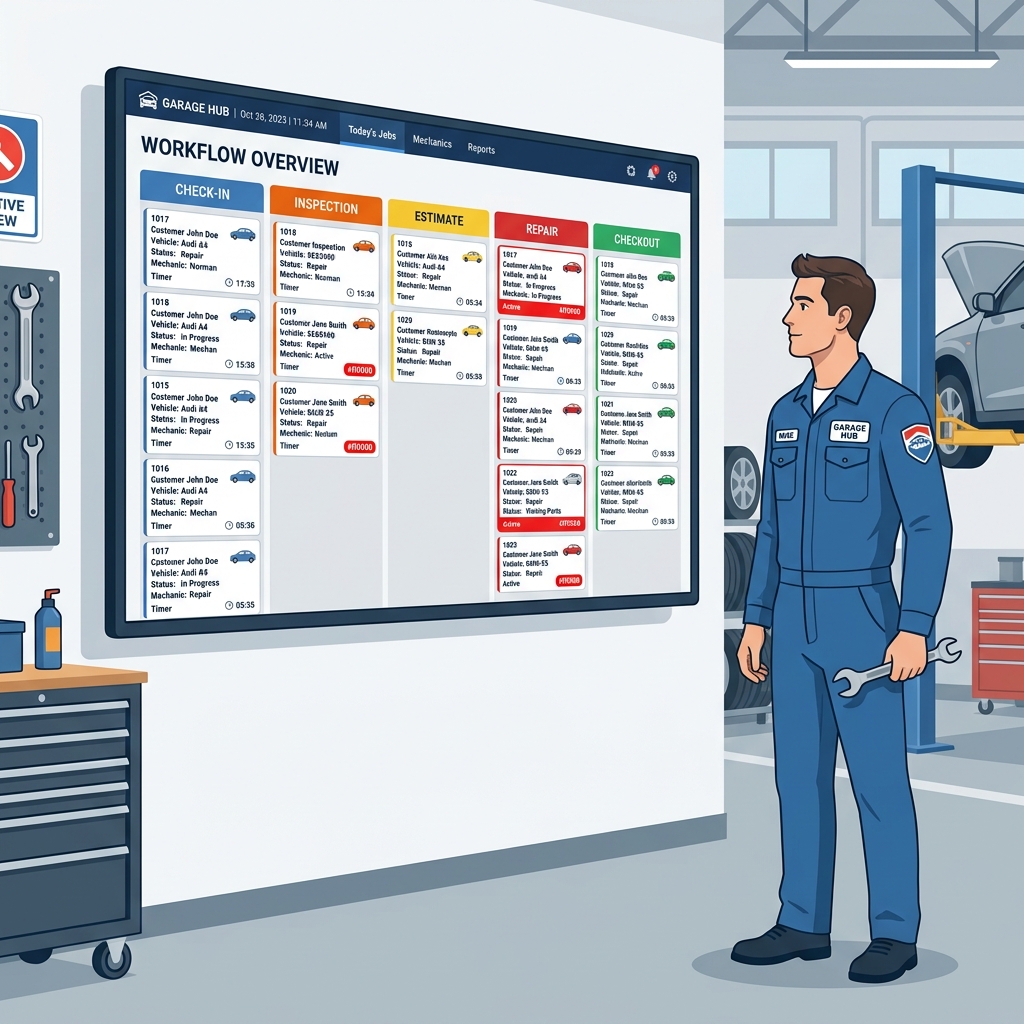
The platform's Digital Shop Board gives your whole team a live view of every job on the floor. Jobs move through stages visually — check-in, inspection, estimate approval, repair, and checkout — so nothing falls through the cracks. In practice, this alone cuts the "where's that car?" back-and-forth that eats up technician and service advisor time.
Digital inspections let technicians attach photos and notes directly to a job. Customers see the evidence, which makes approving work much easier. RedAppy reports that photo-rich inspections lead to stronger work approval rates compared to verbal walkarounds.
From an approved inspection, the platform generates an estimate instantly. One click converts it to an invoice. Online payments mean customers can pay from their phone before they even arrive at the counter. That chain — inspection → estimate → invoice → payment — runs without switching apps or re-entering data.
Parts ordering pulls real-time inventory and pricing from multiple suppliers simultaneously. You compare options and place orders without leaving the platform. The AI Repair Assistant layers on top of this by delivering labor times, diagnostic guidance, and shop performance insights on demand — something that previously required a separate repair information subscription.
Real-time analytics track revenue, technician efficiency, average repair order value, and repeat business. According to RedAppy, shops using the platform typically save 10+ admin hours per week and see strong first-year ROI.
Every subscription also includes a branded professional website with contact forms and optional used-car listings — a feature no other platform in this comparison provides by default.
Shops that currently pay separately for a website, a repair information tool, and a management system can often consolidate all three costs under one RedAppy subscription.
Pricing is transparent and month-to-month, with no long-term contracts. The platform scales from a single-bay independent garage up to multi-location operations.
Limitations to know: RedAppy is a newer platform compared to Mitchell 1 or Alldata, so shops that rely on deep OEM wiring diagrams or factory repair procedures may still want a dedicated repair information source alongside it. The AI Repair Assistant covers common diagnostic needs, but highly specialized repair data isn't its core focus.
Who RedAppy Is Best For
RedAppy fits three types of shops well:
- Solo shop owners and single-bay garages who are currently doing estimates by hand, invoicing in spreadsheets, or using three different apps to manage their day. One platform replaces the patchwork.
- Growing independent shops with 2–10 bays that are hiring technicians and service advisors and need a system that keeps the whole team on the same page without a long onboarding process.
- Multi-location operators who want consistent workflow, shared customer history, and performance analytics across locations without managing separate software setups at each site.
The included branded website also makes RedAppy a strong fit for shops that want to attract new customers online but don't have the budget or time to manage a separate web presence.
If your biggest pain points are admin time, slow invoicing, and scattered tools, RedAppy is built directly for that problem. If your primary need is deep OEM repair data and wiring diagrams, pair RedAppy with a dedicated repair information tool like Alldata — covered later in this guide.
Who RedAppy Is Best For
RedAppy fits a specific type of shop owner — one who's tired of juggling separate tools for invoicing, inspections, parts, and customer follow-up. If that's you, it's worth a close look.
Solo and small shops benefit most from the all-in-one setup. Instead of paying for three or four separate subscriptions, everything lives in one place. The Kanban-style Digital Shop Board gives a single technician or owner a clear view of every job at a glance — no whiteboards, no sticky notes.
Growing garages adding staff get real value from the analytics and team calendar. When you're managing two or three technicians, tracking who's doing what — and how efficiently — matters. RedAppy's technician efficiency reports and real-time revenue tracking make that visible without manual spreadsheets.
Multi-location owners can scale without switching platforms. RedAppy is built to handle more than one location, so you're not starting over when you open a second bay or a second shop.
Shops that feel the most immediate impact are typically those replacing paper estimates and phone-tag follow-ups with digital inspections and online payment links — that's where the reported 10+ admin hours per week savings come from.
RedAppy is also a strong fit for shops that want a professional online presence without hiring a web designer. Every subscription includes a branded website with contact forms and optional used-car listings — something most competitors don't offer at any price tier.
It may not be the best fit if:
- You primarily need deep OEM repair data and wiring diagrams (Mitchell 1 or Alldata serve that need better)
- You run a dealership-scale operation with complex multi-franchise reporting requirements
- You already have a website and parts system you're happy with and only need one piece of the workflow covered
In practice, RedAppy works best as a full replacement — not a supplement. Shops that get the most out of it are the ones willing to migrate their workflow into a single platform rather than bolt it onto an existing setup.
Conclusion
The right software depends on your shop's biggest bottleneck right now.
If you're losing hours to manual invoicing, missed follow-ups, and scattered parts orders, RedAppy gives you one platform to handle all of it — inspections, estimates, payments, parts, analytics, and a customer-facing website included. It's the strongest choice for shops that want a complete system without stitching together multiple tools.
If your technicians constantly need OEM repair data and wiring diagrams, Mitchell 1 Manager SE pairs deep repair information with shop management in a way few platforms match. It takes longer to learn, but shops that live inside repair documentation will get real value from it.
Tekmetric makes the most sense for shop groups and owners managing multiple locations. Its reporting depth and multi-shop dashboard give operators a clear picture of performance across every bay.
Shop-Ware is built for shops that compete on customer experience. Real-time photo sharing and transparent communication tools help win approvals on larger jobs — especially useful in markets where customers have plenty of options.
Alldata isn't a shop management system, but it's the gold standard for factory-accurate repair data. Most shops use it alongside a management platform rather than instead of one.
Match your software to the problem that's costing you the most time or money today. That's the one worth solving first.
A few practical questions to guide your decision:
- Do you need one platform for everything? → RedAppy
- Is repair data your primary gap? → Mitchell 1 or Alldata
- Are you managing multiple locations? → Tekmetric
- Is customer communication your biggest differentiator? → Shop-Ware
- Do you need OEM accuracy without a management system? → Alldata as a standalone add-on
Most shops find that starting with a free trial or demo is the fastest way to know if a platform fits their workflow. No comparison table replaces 20 minutes of hands-on use.
If you're evaluating auto repair shop software for the first time, RedAppy's month-to-month terms mean you're not locked in while you figure out what works. For shops already using a patchwork of tools, it's worth calculating how many hours per week each one is costing you — and whether a single platform could give that time back.
Frequently Asked Questions
What is the best free software for auto repair shops?
Shop-Ware and Tekmetric both offer free trials, but Mitchell 1 Manager SE and AutoFluent are among the most recommended free or low-cost options for basic shop management. Many shops also use Shopmonkey's free tier for estimates, invoicing, and scheduling without upfront costs.
How much does Identifix cost per month?
Identifix Direct-Hit subscriptions typically range from approximately $150 to $200 per month for a single user, though pricing varies based on shop size and contract terms. It's best to contact Identifix directly for current pricing, as they often offer bundled packages with additional diagnostic tools.
Can I use Alldata for free?
Alldata does not offer a free version, but it provides a limited free trial period for new users to evaluate the platform. Paid plans start at around $149 per month for a single vehicle make, with broader access plans available at higher price points.
What is the best app for auto repair services?
Tekmetric and Shop-Ware are consistently rated among the top apps for auto repair services, offering features like digital vehicle inspections, invoicing, and customer communication tools. For DIY mechanics, ALLDATA DIY and Identifix are top-rated for accessing professional repair data and wiring diagrams on mobile devices.
Ready to Transform Your Shop?
RedAppy helps auto repair shops create professional digital estimates with photos and videos, send them instantly via text or email, and get customer approvals in seconds. No credit card required to start.