
Best Software for Car Repair Shops in 2025: Tools That Actually Save Time
Running an auto repair shop without the right software is like diagnosing an engine without a scan tool — you're guessing, and it costs you. The demand for software for car repair shops has surged as owners realize that spreadsheets and paper invoices are quietly draining hours and revenue every week. According to the Auto Care Association, the U.S. auto repair industry generates over $115 billion annually — and the shops capturing the most of that are the ones running lean, digital operations.
The right platform can cut admin time, speed up approvals, and keep customers coming back. But with dozens of options on the market, it's hard to know which tools actually deliver and which ones just add another subscription to your stack. This article breaks down the best software options available in 2025, what each one does well, and who it's built for.
Whether you're running a single-bay garage or managing multiple locations, there's a solution here for your shop's size and workflow. You'll find tools covering everything from digital inspections and parts ordering to invoicing, analytics, and customer communication — so you can stop guessing and start growing.
Table of Contents
- How to Choose Software for Car Repair Shops
- Comparing the Top Car Repair Software Platforms
- RedAppy — All-in-One Shop Management With Built-In AI
- Mitchell 1 — Repair Data and Shop Management for Established Shops
- Conclusion
- Frequently Asked Questions
How to Choose Software for Car Repair Shops
Choosing the right software for car repair starts with understanding what your shop actually needs. Not every platform does the same thing. Some handle the business side — estimates, invoicing, scheduling. Others focus on repair data — wiring diagrams, labor times, OEM procedures. The best choice depends on where your biggest pain points are.
Here are the five criteria that matter most when evaluating any platform:
- Workflow coverage — Does it handle your full process, from check-in to payment, or just part of it?
- Shop management vs. repair data — Are you looking for a business operations tool, a technical reference library, or both?
- Scalability — Can it grow with you from one bay to multiple locations without forcing a platform switch?
- Support quality — Is onboarding included? Is there live help when something breaks down mid-day?
- Total cost of ownership — Add up subscription fees, setup costs, training time, and any add-ons. Month-to-month pricing is generally lower risk than annual contracts.
The most expensive software isn't always the most capable — and the cheapest often hides costs in add-ons or missing features.
In practice, most shops end up needing two types of tools: a shop management system (SMS) to run daily operations, and a repair information platform for technical data. Some all-in-one solutions are starting to bridge that gap, which reduces the number of logins and subscriptions your team has to manage.
Before you evaluate any platform, answer these three questions:
- How many repair orders do you write per month?
- Does your team struggle more with admin tasks or with finding accurate repair data?
- Do you need something your team can learn in a day, or are you willing to invest in a deeper setup?
Your answers will point you toward the right category — and toward the right software for your shop size. The comparison table in the next section maps out exactly how the leading platforms stack up on these criteria.
Comparing the Top Car Repair Software Platforms
The software for car repair market splits into two distinct categories: shop management platforms that handle workflow, invoicing, and customer communication, and repair data tools that deliver OEM specifications, wiring diagrams, and diagnostic guidance. Most shops need at least one from each column — or a platform that covers both.
Here's how the leading platforms stack up across the features that matter most.
| Platform | Best For | Key Features | Starting Price | Free Trial |
|---|---|---|---|---|
| RedAppy | All-in-one shop management + AI | Digital inspections, Kanban board, AI Repair Assistant, parts ordering, branded website | Contact for pricing | Yes |
| Mitchell 1 | Established shops needing OEM data + workflow | Manager SE (shop mgmt), ProDemand (repair data), extensive OEM coverage | ~$150–$400+/mo | No |
| Alldata | OEM repair information depth | Factory-accurate data, wiring diagrams, TSBs, collision repair | ~$149/mo (single make) | No |
| Tekmetric | Cloud-native shop management | Modern UI, reporting, integrations, multi-location | ~$199/mo | Yes |
| Shop-Ware | Paperless, transparency-focused shops | Digital workflow, customer communication, RO management | Contact for pricing | Yes |
| Identifix | Diagnostic troubleshooting | Real-world confirmed fixes, DTC lookups, community data | ~$99–$150/mo | Limited |
Shops often overpay by subscribing to a full shop management suite and a separate repair data tool when one integrated platform could cover both — or underpay by skipping repair data entirely and costing technicians time on every job.
The table above makes one pattern clear: platforms either go broad (shop management, customer workflow, payments) or go deep (OEM data, diagnostics, repair specifications). RedAppy and Tekmetric lean into the full workflow stack. Alldata and Identifix anchor the repair data side. Mitchell 1 tries to bridge both. Which combination fits your shop depends on where your team currently loses the most time — understanding those workflow gaps before buying is the smartest first move.
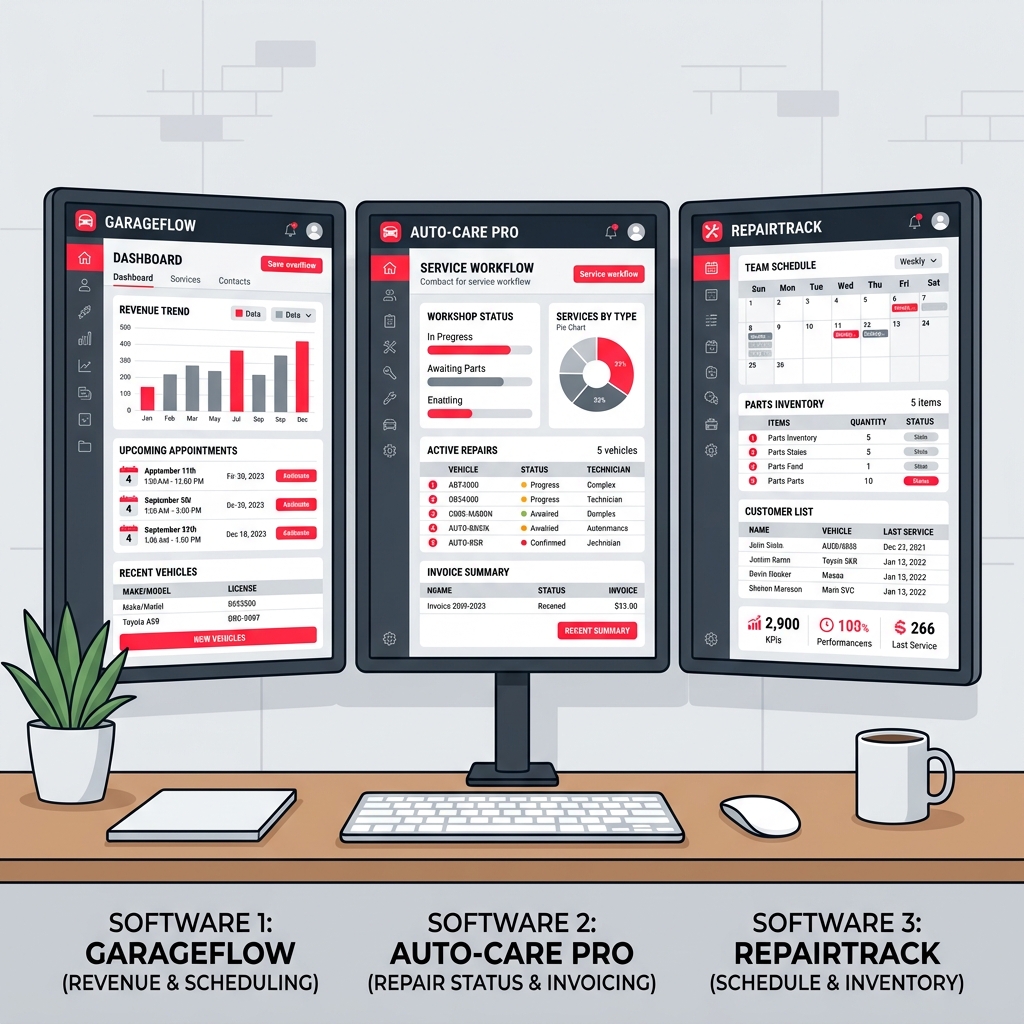
RedAppy — All-in-One Shop Management With Built-In AI
RedAppy is a cloud-based shop management platform built specifically for auto repair businesses. It handles the full workflow from the moment a customer calls to the moment they pay — no switching between separate tools.
Best for: Independent shops and growing multi-location operations that want one platform to replace several disconnected tools.
The platform's Kanban-style Digital Shop Board gives every team member a live view of where each vehicle sits — from check-in through diagnosis, repair, and checkout. In practice, this alone reduces the back-and-forth between service advisors and technicians that eats up hours each week.
Key capabilities include:
- Digital inspections with photo and video capture, sent directly to customers for faster approvals
- Instant estimates and one-click invoicing to cut down on admin time
- Online payments so customers can pay from their phone
- Parts ordering across multiple suppliers with real-time inventory visibility
- Vehicle history and customer lookup by name, plate, or VIN
- Team calendar for scheduling and workload management
- Branded website included with every subscription, with contact forms and optional used-car listings
RedAppy reports that shops typically save 10+ admin hours per week and see higher repair order approval rates thanks to photo-rich inspection reports. Customers who can see what's wrong are more likely to approve the work.
Photo-based digital inspections consistently outperform text-only reports for work approval — customers trust what they can see.
Every plan comes with a professionally branded website, which is a genuine differentiator. Most shop management tools charge extra or don't offer this at all.
Pricing and flexibility: RedAppy operates on month-to-month terms with transparent pricing, so there's no long-term contract locking you in. It scales from single-bay garages to multi-location shops without requiring an upgrade to a different product tier.
Honest limitation: RedAppy is a newer platform compared to legacy tools like Mitchell 1 or Alldata. Shops that need decades-deep OEM repair data libraries will want to pair it with a dedicated repair information tool. What it does, it does well — but it's designed as a management and workflow platform, not a replacement for OEM technical data.
Use case: A shop owner who is currently juggling a separate invoicing tool, a paper inspection sheet, a phone call for parts pricing, and a spreadsheet for tracking technician performance. RedAppy consolidates all of that into one login.
RedAppy's AI Repair Assistant and Real-Time Analytics
The is one of RedAppy's most practical differentiators. Instead of searching through manuals or calling a parts supplier for labor estimates, technicians and service advisors can pull labor times, diagnostic guidance, and repair recommendations directly from within the platform.
This matters most during the estimate stage. Getting an accurate labor time quickly means customers get their quote faster, and service advisors spend less time on research.
The AI Repair Assistant delivers:
- Labor time estimates on demand, without leaving the job screen
- Diagnostic guidance to help technicians narrow down fault causes
- Shop insights — pattern recognition across your own repair history to flag recurring issues or common failures for specific makes and models
From experience, the biggest time savings from AI tools in a shop setting come from reducing the lookup time during busy periods. A technician waiting 10 minutes for a labor estimate adds up across dozens of jobs per week.
Analytics dashboard: RedAppy's real-time analytics track the metrics that actually drive shop profitability:
| Metric | What It Shows |
|---|---|
| Revenue tracking | Daily, weekly, and monthly income at a glance |
| Technician efficiency | Billed hours vs. hours on the clock per tech |
| Average repair order | Trends in ticket size over time |
| Repeat business rate | How often customers return within a set period |
According to RedAppy, shops using the platform see strong first-year ROI — driven in part by spotting underperformance in technician efficiency before it becomes a revenue problem.
Tracking average repair order value over time is one of the fastest ways to identify whether upselling and inspection processes are actually working.
The analytics are built for shop owners who aren't data analysts. Dashboards are visual and readable, not a spreadsheet dump. You can see at a glance whether this week is tracking ahead of last month, which technicians are hitting efficiency targets, and whether your repeat customer rate is moving in the right direction.
Use case: A shop owner who knows they're busy but can't explain why profit margins aren't growing. The analytics dashboard surfaces the answer — whether it's a technician efficiency gap, a low average repair order, or a drop in returning customers — without needing to pull reports manually.
Visit to explore current pricing and request a demo.
RedAppy's AI Repair Assistant and Real-Time Analytics
The AI Repair Assistant is one of the features that separates RedAppy from older software car repair platforms. Instead of switching between tabs or calling a parts supplier for labor times, technicians can query the assistant directly from within the platform and get answers on demand.
What the AI Repair Assistant covers:
- Labor times — accurate time estimates for specific repairs, so advisors can build estimates faster and price jobs consistently
- Diagnostic guidance — step-by-step troubleshooting suggestions tied to the vehicle in the current work order
- Shop insights — on-demand summaries of shop performance, flagging trends or inefficiencies without requiring manual report pulls
In practice, this removes a common bottleneck: advisors waiting on a technician to estimate a job before they can quote the customer. The assistant handles the baseline, and the tech focuses on the actual work.
Analytics Dashboard: What Gets Measured Gets Managed
RedAppy's real-time analytics track four metrics that directly affect shop profitability:
| Metric | What It Tells You |
|---|---|
| Revenue tracking | Daily, weekly, and monthly income at a glance |
| Technician efficiency | Billed hours vs. hours clocked per tech |
| Average repair order (ARO) | Whether upsells and inspections are moving the needle |
| Repeat business rate | How many customers are coming back |
Tracking technician efficiency alongside ARO gives shop owners a clearer picture than revenue alone — a busy shop can still be leaving money on the table if individual ticket values are low.
Based on how these dashboards function, the analytics are most useful during weekly reviews. Owners can spot which technicians are under-billing, which service categories drive the most revenue, and whether inspection-driven upsells are converting. That last point ties directly back to the photo-rich digital inspections covered in the main RedAppy section — the data shows whether those inspections are actually increasing approval rates.
The combination of AI assistance and live analytics makes RedAppy a strong fit for owners who want data-driven shop management without hiring an operations manager to interpret reports.
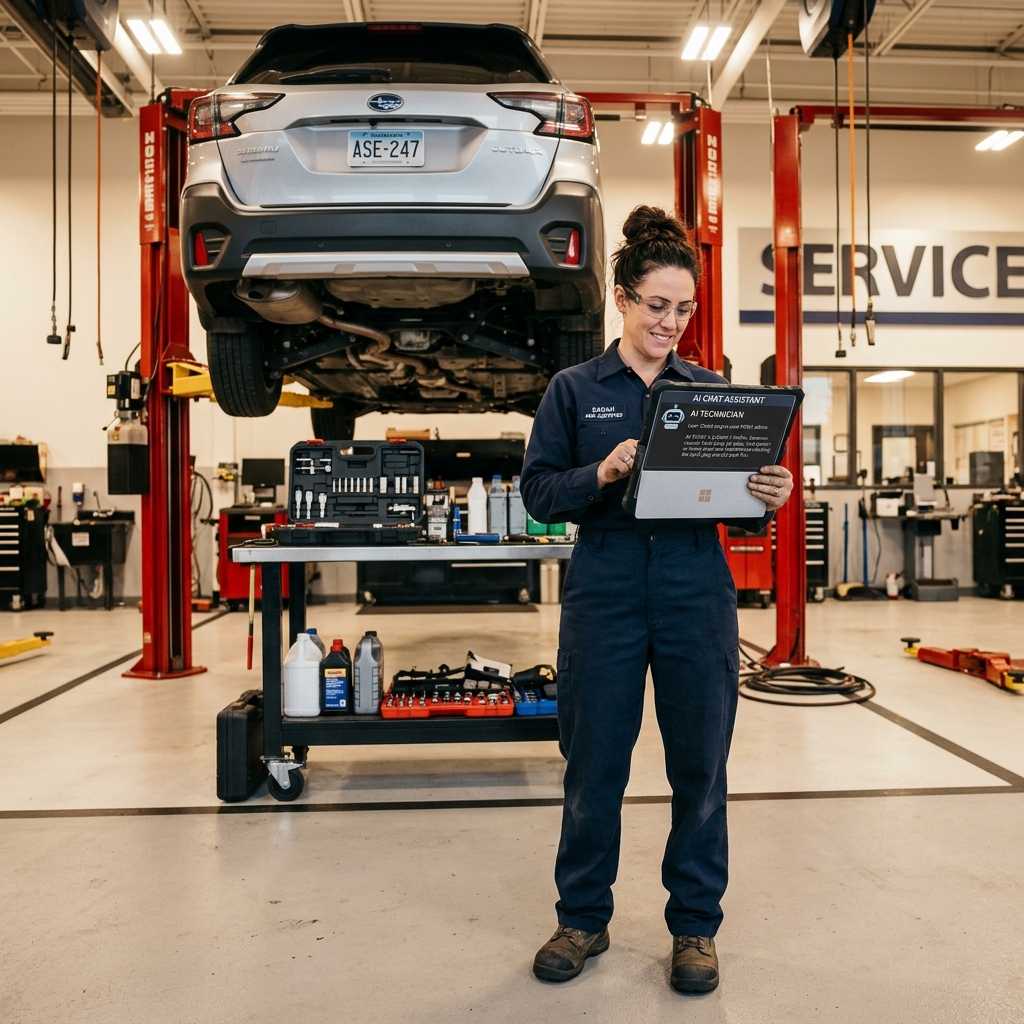
Mitchell 1 — Repair Data and Shop Management for Established Shops
Mitchell 1 has been a fixture in the auto repair industry for decades. It offers two core products that work well together: Manager SE for shop management and for repair information.
Manager SE — Shop Workflow and Customer Management
Manager SE handles the day-to-day operations side of running a shop. It covers estimates, repair orders, invoicing, parts ordering, and customer history in one system.
Who it's for: Established shops that want a proven, feature-complete management system with a long track record. Many multi-bay shops and dealership-adjacent operations run on Manager SE because it integrates smoothly with parts suppliers and accounting software.
- Generates repair orders and estimates from a single screen
- Tracks parts, labor, and sublet work per job
- Connects with major suppliers for parts lookup and ordering
- Stores full customer and vehicle history for repeat visits
Mitchell 1 reports that shops using Manager SE alongside ProDemand cut diagnostic time significantly by pulling repair data without switching tools.
Limitation: Manager SE is desktop-based software, which means it lacks the cloud flexibility that newer platforms offer. Remote access requires additional setup, and the interface reflects its legacy roots — functional, but not as modern as cloud-native alternatives.
ProDemand — OEM Repair Data When You Need It
is Mitchell 1's repair information database. It gives technicians access to OEM procedures, wiring diagrams, technical service bulletins (TSBs), labor times, and diagnostic codes for a wide range of vehicles.
Who it's for: Shops that work across many makes and models and need factory-accurate repair data fast. Independent shops handling complex diagnostics especially benefit from having verified OEM procedures at hand rather than relying on general guides.
- Covers domestic and import vehicles with OEM-sourced procedures
- Includes SureTrack real-world repair data from millions of professional repairs
- Integrates with Manager SE so technicians can pull data directly into repair orders
- Regularly updated to reflect new model years and TSBs
Use case: A technician diagnosing an intermittent electrical fault on a late-model import can pull the exact wiring diagram and related TSBs from ProDemand without leaving the repair order workflow — reducing time spent hunting for information.
Mitchell 1 Pricing
According to Mitchell 1's published pricing, Manager SE starts at around $149/month, though the combined Manager SE and ProDemand bundle costs more depending on the number of users and subscription tier. Pricing isn't fully transparent online, so most shops go through a sales conversation to get an accurate quote.
| Product | What It Does | Best For |
|---|---|---|
| Manager SE | Shop management — estimates, ROs, invoicing | Operations and workflow |
| ProDemand | OEM repair data, TSBs, wiring diagrams | Diagnostics and repair info |
| Bundle | Both systems integrated | Shops wanting one vendor for both |
Limitation to consider: Mitchell 1's pricing can feel complex compared to simpler all-in-one platforms. Shops that only need shop management software without deep repair data may find better value elsewhere. The learning curve is also steeper than more modern tools, which can slow onboarding for smaller teams.
In practice, Mitchell 1 works best for shops that handle a high volume of diagnostic work and want their management and repair data systems connected under one vendor. It's a reliable, established choice — though shops prioritizing cloud access or a cleaner modern UI may want to weigh their options before committing.
Conclusion
The best software for car repair shops isn't one-size-fits-all — it depends on what's slowing your shop down right now.
Here's a simple way to match tool to need:
| Shop Type | Best Fit |
|---|---|
| Wants all-in-one with AI and analytics | RedAppy |
| Needs deep OEM repair data | Alldata or Mitchell 1 |
| Prioritizes modern UI and cloud workflow | Tekmetric or Shop-Ware |
| Combines repair data with shop management | Mitchell 1 (Manager SE + ProDemand) |
The shops that get the most from software for car repair are the ones that pick based on workflow gaps, not brand recognition.
If admin time is the biggest drain, an all-in-one platform like RedAppy — with digital inspections, one-click invoicing, and a Kanban shop board — addresses that directly. Shops saving 10+ admin hours per week aren't doing it by accident; they're using tools built around how a repair order actually moves through the day.
If technicians are losing time hunting for wiring diagrams or labor times, that points toward Alldata or Mitchell 1 ProDemand. Both deliver OEM-accurate data at scale, with Alldata covering over 38,000 engine-specific vehicles. Mitchell 1 adds the option to run shop management and repair data from a single vendor.
For shops that want a clean, modern interface and strong reporting without a heavy legacy system, Tekmetric is worth a serious look. Shop-Ware suits operations that bill by time in granular detail. Identifix works best as a diagnostic supplement rather than a full platform.
Before committing to any platform, take the free trial or demo seriously. Use it on a real job, not a test scenario. In practice, the tools that feel intuitive during a busy Tuesday are the ones your team will actually use. Most platforms covered here offer no-commitment trials — there's no reason to buy blind.
Frequently Asked Questions
What is the best automotive repair software?
Mitchell 1 ProDemand, ALLDATA, and Identifix Direct-Hit consistently rank as top automotive repair software platforms. Mitchell 1 ProDemand is widely favored by independent shops for its OEM data and real-world repair guidance, while ALLDATA is preferred for its comprehensive, unaltered manufacturer information.
How much does Alldata repair cost?
ALLDATA Repair costs approximately $149 per month for a single-user subscription covering one vehicle make, with a multi-line subscription running around $179–$199 per month for unlimited makes. Annual pricing options are also available and can reduce the overall cost compared to monthly billing.
What's better than Alldata?
Mitchell 1 ProDemand is often cited as a strong alternative to ALLDATA, offering integrated OEM data alongside Real Fixes sourced from millions of actual repair orders. Identifix Direct-Hit is another popular competitor, particularly valued for its community-driven diagnostic tips and confirmed fix database.
How much does Mitchell 1 software cost?
Mitchell 1 ProDemand typically costs around $149–$179 per month for a single-user subscription, depending on the tier and features selected. Pricing can vary based on shop size, contract length, and whether add-on modules like shop management tools are included.
Ready to Transform Your Shop?
RedAppy helps auto repair shops create professional digital estimates with photos and videos, send them instantly via text or email, and get customer approvals in seconds. No credit card required to start.