
Standard Operating Procedures for Auto Repair Shops
A shop can have a clean counter, a full board of repair orders, and still lose money because the work is being done three different ways in three different bays. One service advisor promises a callback that never happens. A technician skips a torque check because the next car is already waiting. Another location across town writes oil-change notes in a completely different format, so nobody can tell which process is working.
That's where standard operating procedures matter. The term was first recorded in the mid-20th century, and Britannica defines it as a set of written guidelines for completing routine tasks to improve performance, efficiency, and quality through standardized methods. Clinical literature also shows the abbreviation was already in use during World War II, which says a lot about where SOP discipline came from, high-reliability work where people couldn't afford guesswork. In a repair shop, the same lesson still applies, but the procedure only works if it lives where the job happens.
Table of Contents
- Why Most Shop SOPs Fail Before They Start
- Building an SOP Lifecycle That Technicians Respect
- Role-Based SOP Examples for Every Position in Your Shop
- Embedding SOPs Into Your Digital Shop Workflow
- KPIs That Reveal Whether Your SOPs Are Working
- Rollout Checklist and Ongoing Maintenance Cadence
- Take the Next Step With RedAppy
Why Most Shop SOPs Fail Before They Start
The weakest SOPs fail where the first mistake happens, at the counter or on the lift. A customer asks about additional repairs, the advisor gets pulled into another call, and the follow-up never happens. A tech relies on memory for a torque spec, and a comeback shows up two days later. Nobody planned to cut corners, but in a busy shop, good intentions do not prevent mistakes.
Written for auditors, not operators
A lot of repair shop SOPs look like they were built to survive a filing cabinet review. They may be neat and organized, yet they do little to help a tech decide what to do when a wheel is already off, parts are missing, or the estimate changes midstream. The document can feel formal and still leave people guessing at the point of execution.
That is the main problem with binder-based SOPs. They sit away from the bay, away from the front desk, and away from the moments that force a decision. SOPs are written guidelines for routine tasks, but they only help when the team can reach them while the work is happening. A procedure that lives in a binder often loses to the pace of the shop floor.
Practical rule: if a procedure cannot be followed while the hood is open or the phone is ringing, it is probably too detached from the job.
The hidden shop-floor failure modes
Repair shops run into a few predictable friction points. High turnover means a procedure has to teach, not just remind. Time pressure means nobody wants to decode a paragraph while a customer waits. Variable vehicle condition means no two brake jobs, diagnostics, or inspections are identical, so the SOP has to define what stays fixed and what can flex.
The old checklist mindset still matters, because memory works only until the day the workload spikes. The B-17 test-flight crash showed how badly complex work can fail when crews rely on memory alone. Aviation turned that lesson into checklist discipline, and shops need the same habit when the process repeats all day. For a practical primer on, the point is simple, build something technicians can use instead of something that only looks complete on paper.
Building an SOP Lifecycle That Technicians Respect
A tech can spot a dead SOP fast. It is the one that looks clean in a folder and falls apart the first time a bay gets busy, a customer is waiting, and two people are trying to make the same call.
A procedure earns attention when it moves through draft, field test, and revision with the crew that has to live with it. The people doing the work need to see their own reality reflected in the steps, or they will stop trusting the document and fall back on memory. That controlled workflow usually starts with identifying the task, drafting the steps, reviewing them with the team, validating them with a fresh set of eyes, then posting, training, and retraining the final version. EPA guidance says SOPs should describe methods with enough detail to protect data quality and integrity, and Pennsylvania State University recommends writing the steps in the exact order they're performed and testing the procedure verbatim.
Start with the jobs that keep causing pain
The first SOPs should come from the places where the shop keeps bleeding time. Comebacks, customer complaints, rework, missed approvals, and inconsistent vehicle intake are the obvious candidates. If a process already runs smoothly, it can wait.
That ranking matters because technicians ignore paperwork that tries to solve every problem at once. Start with one recurring task, define the result, and write only the steps needed to get there. Practical SOP guidance from quality-focused sources also emphasizes defining scope, role ownership, and success criteria up front, so the procedure does not drift into vague advice.
Validate it with someone who did not write it
This is the step many owners skip, and it is the one that exposes hidden assumptions. Have an unfamiliar team member run the SOP exactly as written, without coaching, and watch where they hesitate. If they need clarification, the document is not finished.
The test is about finding where a step depends on tribal knowledge that never got written down. A rigorous SOP program also needs controlled document structure, so the final version should include a cover page, the step sequence, and references or definitions, plus a revision form that lists the version number, reason for change, reviewer data, and signatures. For a useful template structure, the shows how governance and documentation can stay organized without becoming bloated.
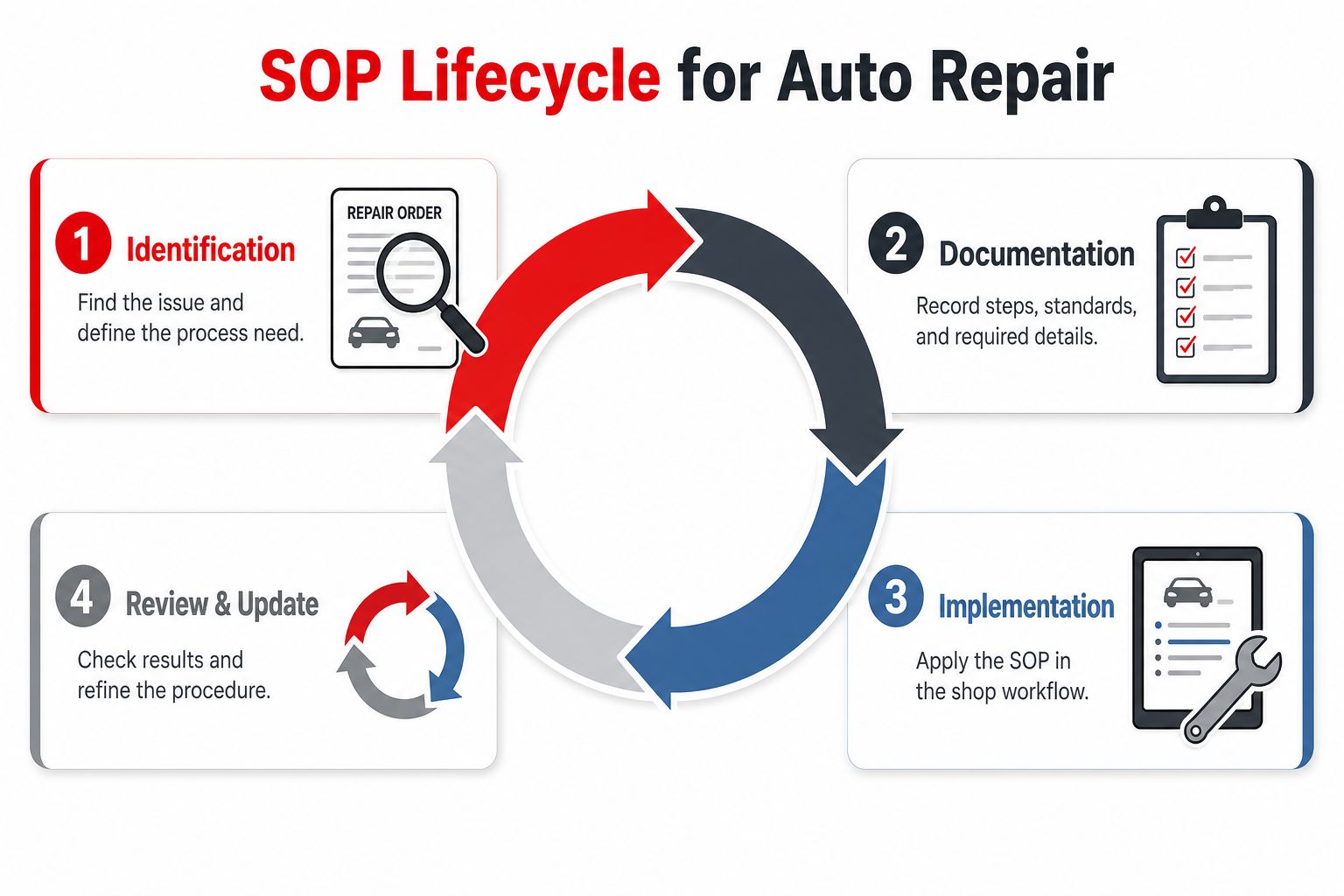
The best draft is the one that gets challenged by the person least familiar with the task.
Role-Based SOP Examples for Every Position in Your Shop
A repair shop doesn't need one giant SOP binder. It needs role-specific procedures that match the way work moves from the front counter to the bay to the handoff. The trick is to keep the scope tight enough that a new hire can follow it, but not so detailed that the team feels micromanaged. A good SOP uses plain action verbs and the right format for the task, because linear jobs read best as a step list, while decision-heavy jobs often need hierarchical steps or a simple flowchart.
Service advisor and front desk
The advisor SOP should cover the intake conversation, digital inspection launch, estimate approval flow, and customer follow-up. The front desk SOP can be narrower, handling the phone greeting, appointment scheduling, payment processing, and review request. These steps sound simple, but they fail when the sequence changes or when the handoff between people is vague.
A practical advisor SOP might look like this:
- Greet the customer, confirm the vehicle, and verify the concern.
- Open the repair order and start the digital inspection.
- Record visible condition notes and attach photos.
- Present the estimate after internal review.
- Track approval status and follow up at the agreed time.
- Close the loop after pickup with a quick callback if needed.
Each of those steps should include the decision point that matters. If the customer declines work, the SOP should state what gets documented and who gets notified. If the vehicle needs to stay overnight, the SOP should say who arranges storage, keys, and next-day contact.
Technician, lube tech, and shop foreman
The technician SOP should cover bay setup, diagnostic sequence, parts staging, quality check, and bay cleanup. For a lube tech, the process can be shorter and more repetitive, but it still needs a defined sequence so nothing gets skipped. The shop foreman SOP should focus on triage, job assignment, quality review, and escalation when a job blocks the schedule.
A useful benchmark is whether a new team member on the second day could do the task without guessing. That doesn't mean every tiny motion gets documented. It means the procedure captures enough detail that the job can be repeated consistently by someone who has not learned the hidden shortcuts yet.
| Role | Key SOP Processes | Best Format |
|---|---|---|
| Service advisor | Intake, estimate presentation, approval tracking, follow-up | Sequential steps with decision points |
| Technician | Bay setup, diagnostics, repair flow, quality check, cleanup | Hierarchical steps |
| Lube tech | Standard service, fluid checks, reset steps, handoff | Simple numbered checklist |
| Front-desk receptionist | Phone greeting, scheduling, payment, review request | Short sequential list |
| Shop foreman | Dispatch, prioritization, escalation, final review | Flowchart or decision tree |
Embedding SOPs Into Your Digital Shop Workflow
A paper SOP falls apart when a tech has to leave the bay to find it. Digital workflow works better because the procedure shows up at the moment it is needed, inside the tool the team already uses to move jobs forward. Shops that do this well turn SOPs into in-app steps instead of separate documents sitting in a binder on a shelf.
Make the procedure part of the task flow
Vehicle intake is the easiest place to start. A digital inspection can serve as the SOP itself when each checkpoint mirrors the procedure, condition notes, photos, tire depth, fluid checks, and recommendations all appear in one sequence. The system guides the order of work so the advisor is not relying on memory to know what to ask next.
A Kanban-style board does the same thing for job progression. A Shop Board built around stages like check-in, diagnosis, estimate, parts, repair, quality check, and checkout makes skipped steps visible. It also lets a foreman see where a job is stuck without walking the whole floor.
Reduce the friction that kills compliance
The more a technician has to leave the bay, the more likely the SOP gets shortened, bent, or skipped. On-demand labor times, diagnostic guidance, customer lookup by name, plate, or VIN, and one-click invoicing matter because they cut down on interruptions and keep the next action in front of the person doing the work.
One platform that fits that pattern is RedAppy, which combines digital inspections, a Kanban-style Digital Shop Board, vehicle history, and an AI Repair Assistant that surfaces labor times and diagnostic guidance on demand. Used well, those tools place the procedure inside the workflow instead of asking the team to leave the workflow to find the procedure.
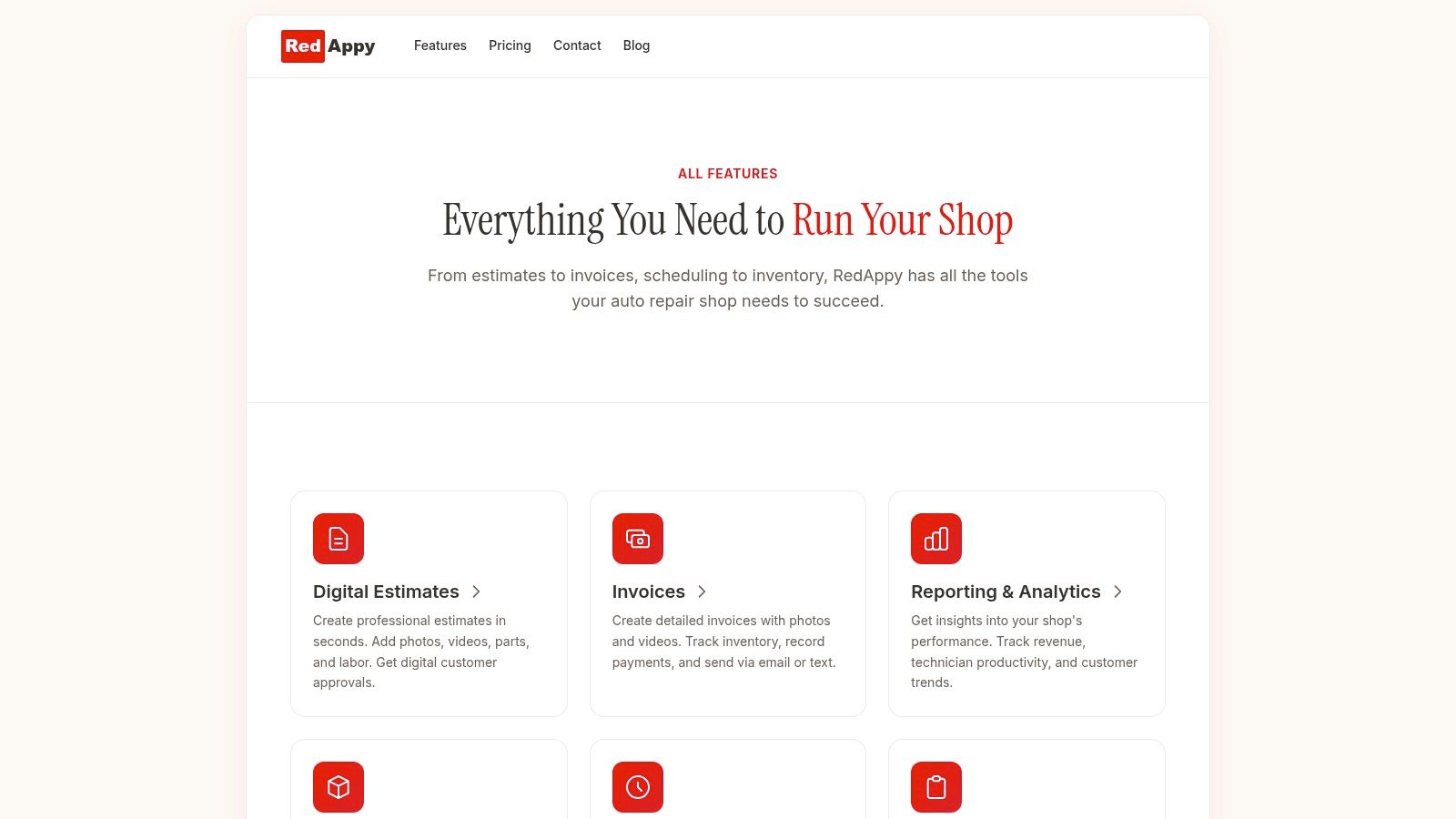
That kind of setup makes the procedure easier to follow in real time, and the next question is whether the shop is getting the consistency it expects.
KPIs That Reveal Whether Your SOPs Are Working
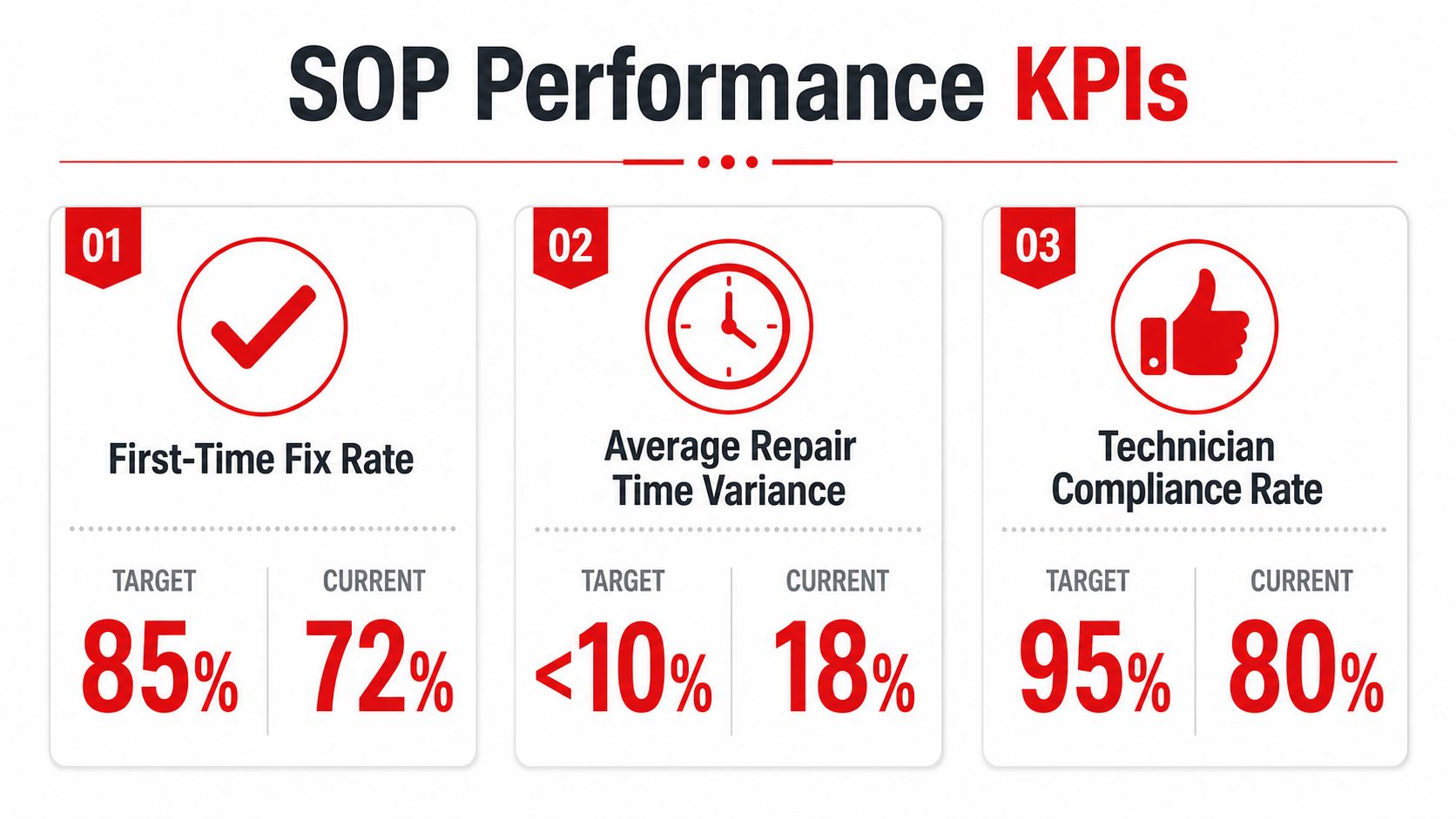
SOPs are only useful if they change what the shop sees on the board. If the same problems keep showing up, the procedure is either too vague, too rigid, or too disconnected from the way jobs move. That's why measurement matters, not as a punishment tool, but as feedback on whether the SOP is creating consistency.
Track the numbers that reflect process quality
Some measures are more useful than others because they point to repeatable behavior. Comeback rate by service type shows whether the repair process is holding. Estimate approval rate reflects how clearly the advisor presented the work. Time from check-in to first invoice shows whether the intake and diagnosis flow is moving cleanly. Repeat customer percentage gives a broad signal on whether customers trust the experience enough to return.
A real-time analytics dashboard helps because it removes manual tallying from the equation. A good dashboard should make it obvious when one location follows the SOP and another location drifts. The point is not to create a scoreboard that shames people, it's to reveal where the procedure is failing the workflow.
Watch for over-standardization
There's a contrarian truth here. SOPs can improve consistency, but they can also turn into rigid scripts that slow down experienced diagnostic work. Research-based SOP guidance in clinical and scientific settings frames procedures as step-by-step practices and emphasizes testing them with real users before release, but it also leaves an open question for shops, how much standardization is enough before adaptability starts to suffer?
That trade-off shows up in fast-moving bays. A foreman may need a standard inspection path, yet a seasoned diagnostic tech still needs room to chase a symptom that doesn't fit the normal flow. The useful SOP doesn't remove judgment, it keeps judgment from becoming chaos.
Rule of thumb: standardize the handoff, the documentation, and the quality check first. Leave room for expert judgment where the diagnosis itself changes from car to car.
Rollout Checklist and Ongoing Maintenance Cadence
A shop SOP program falls apart when it launches like a one-time cleanup project. The better approach is a short rollout with a clear owner, followed by regular upkeep that treats the SOP as a working document. That keeps the process from drifting the minute staff changes, software changes, or equipment changes.
A practical rollout sequence
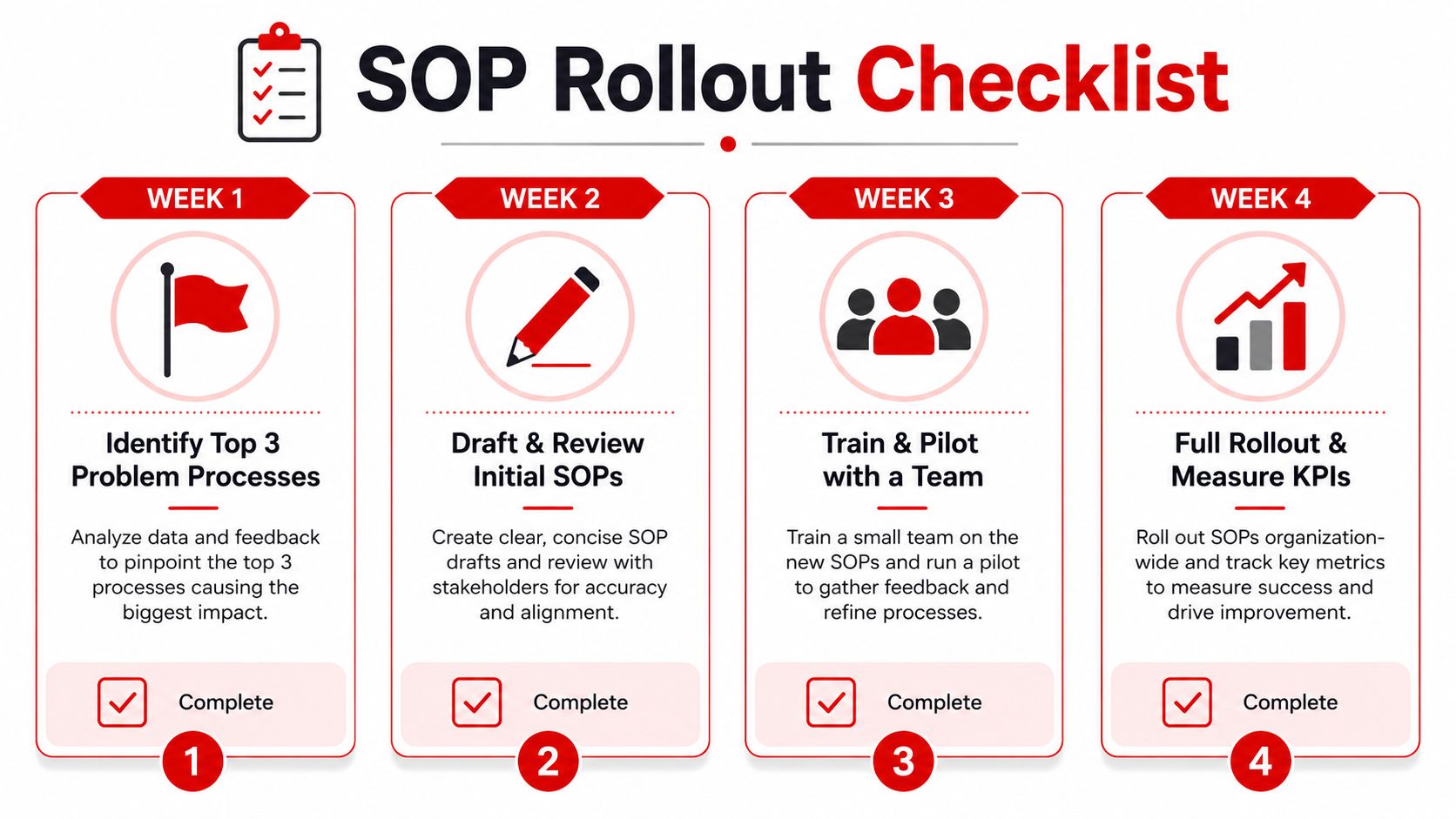
Week one should focus on the top three processes causing the most friction. Week two should be drafting and validating those SOPs with frontline staff, not just managers. Week three should be training in the bay, with live examples and short sessions. Week four should be go-live with close monitoring.
After launch, the maintenance rhythm matters just as much as the rollout. Quarterly reviews work well when KPI drift shows the procedure is slipping. Full audits belong on a longer cycle. Event-driven revisions should happen whenever new equipment arrives, software changes, or the team reorganizes.
Keep the document close to the work
The SOP should be available where the job happens, not buried in a folder no one opens. The FAO guidance on SOP structure says the document should include the regularly recurring operations relevant to quality, be available at the place where the work is done, and carry the approval date or version number, page number, and equipment or reagent requirements. That logic translates cleanly to repair shops, where access matters more than elegance.
Multi-location shops need one more layer of discipline. The base procedure should stay consistent across sites, but local adaptations can account for building layout, customer mix, or staffing pattern. The important thing is that the variation is deliberate, not accidental.
- Week 1, Identify: Pick the three jobs where mistakes, delays, or customer friction show up most often.
- Week 2, Draft: Write the procedure in the order the work is done, then test it with someone who did not write it.
- Week 3, Train: Use short, hands-on coaching at the bay, not long classroom sessions.
- Week 4, Monitor: Watch the board, the approvals, and the follow-up work to see whether the SOP holds.
Take the Next Step With RedAppy
SOPs work when they live inside the workflow, not in a binder on the shelf. RedAppy brings digital inspections, the shop board, analytics, and the AI Repair Assistant into the same operating rhythm, so the procedure is part of the job instead of a separate chore. Shops that want to see how that looks in practice can review the platform's features and talk through a rollout that fits their bays, their advisors, and their technicians.
RedAppy helps shops turn standard operating procedures into daily habits through digital inspections, job tracking, and workflow tools that fit the way real repair work moves. Visit RedAppy to see how the features support your shop's procedures, or reach out for a walkthrough that maps the right setup to your front counter and bays.
Ready to Transform Your Shop?
RedAppy helps auto repair shops create professional digital estimates with photos and videos, send them instantly via text or email, and get customer approvals in seconds. No credit card required to start.