
Tips for Setting Your Auto Shop’s Labor Rate Profitably
The bays are full. Phones keep ringing. Technicians are moving from one vehicle to the next, and the parking lot still has cars waiting for pickup. Then payroll, rent, insurance, and a parts statement land in the same week, and the money left over does not match how busy the shop feels.
That gap usually is not a volume problem. It is a pricing problem hiding inside non-billable time. Moving cars, waiting for parts, chasing approvals, doing comebacks, cleaning bays, and answering front counter questions all consume paid hours. Customers do not pay for most of that time directly. If the posted rate was copied from a competitor or set years ago and never recalculated, it may not cover what one billed hour costs.
Strong tips for setting your auto shop's labor rate start with arithmetic, not courage. A rate has to survive real payroll, real overhead, and real production. Once an owner knows the loaded cost per billed hour, market checks, specialty tiers, and customer explanations become much easier to defend.
Table of Contents
- Start With Your Loaded Cost Per Billable Hour
- How to Calculate Your Rate Step by Step
- Check Your Rate Against Local Market Benchmarks
- Justify Higher Rates for Specialty Work
- Track the Metrics That Show Your Rate Works
- Explain Your Rate So Customers Approve Estimates
- Roll Out Your New Rate Without Losing Customers
Start With Your Loaded Cost Per Billable Hour
A labor rate can never work if it sits below the loaded cost per billable hour. That is the floor. Everything else, including profit, sits on top of it. Wages are only the first layer, and treating them as the whole cost is where many shops lose money without noticing.
The reports a median annual wage of $50,620, or $24.34 per hour. That figure is useful as a wage benchmark. It is not a customer-facing labor rate, and it should never be doubled or tripled by guesswork and posted on the wall.
What rides on top of the wage
The shop also pays payroll taxes, workers' compensation, health benefits, and paid leave. Training time costs money. So do tools, uniforms, facility costs, equipment, software, utilities, and insurance. Non-billable front-office time belongs in the pile too, because service advisors, owners, and office staff support the work that produces billed hours.
Some of those costs feel distant from a brake job or alternator replacement. They aren't. A lift payment, scan tool subscription, alignment machine calibration, and shop management software all exist so technicians can produce work safely and correctly. If those costs do not land in the labor rate calculation, they land in the owner's margin instead.
Why billable efficiency changes everything
A technician is paid for time present. A customer pays for time billed. Those two numbers are rarely equal. Billable efficiency is the share of paid time that becomes billed time, and it has a direct effect on cost.
Say a technician earns $24.34 per paid hour. If only 70% of paid time becomes billed time, direct wages alone equal about $34.77 per billed hour. At 60% billed efficiency, the wage component rises to about $40.57 per billed hour. Benefits and overhead have not been added yet.
| Billable share of paid time | Wage cost per billed hour | Non-billable share |
|---|---|---|
| 80% | $30.43 | 20% |
| 70% | $34.77 | 30% |
| 60% | $40.57 | 40% |
| 50% | $48.68 | 50% |
The table shows why two shops paying the same hourly wage can need very different rates. The shop billing half of paid time spreads the same paycheck across far fewer sold hours. Its wage cost per billed hour is much higher before rent or insurance enter the picture.
A busy shop is not the same as a productive shop. Paid hours tell an owner who showed up. Billed hours tell an owner what customers actually bought.
Non-billable time is not automatically waste. Training prevents comebacks. Cleaning prevents accidents. A careful inspection can prevent a misdiagnosis. The point is not to eliminate every unbilled minute. The point is to count it, price for it, and reduce the parts caused by poor workflow, such as waiting on approvals, hunting for keys, or rewriting estimates.
Before choosing any number, an owner should pull one recent month and compare paid technician hours with billed hours. Payroll records give the first number. Closed repair orders give the second. Divide billed hours by paid hours and write the percentage down without rounding it into something more flattering. That single percentage explains more about labor pricing than any competitor's sign across the street.
Digital job tracking and accurate time reporting help because memory is unreliable. A technician can feel busy all day while producing few billed hours if vehicles arrive without parts, approvals stall, or diagnostic work is given away. The rate decision still has to rest on local payroll and overhead, not a national wage figure. The national figure starts the conversation. The shop's own records finish it.
How to Calculate Your Rate Step by Step
The calculation is clear once the inputs are honest. Total the costs that support labor, count the hours customers buy, divide one by the other, then add profit on purpose instead of hoping some remains.
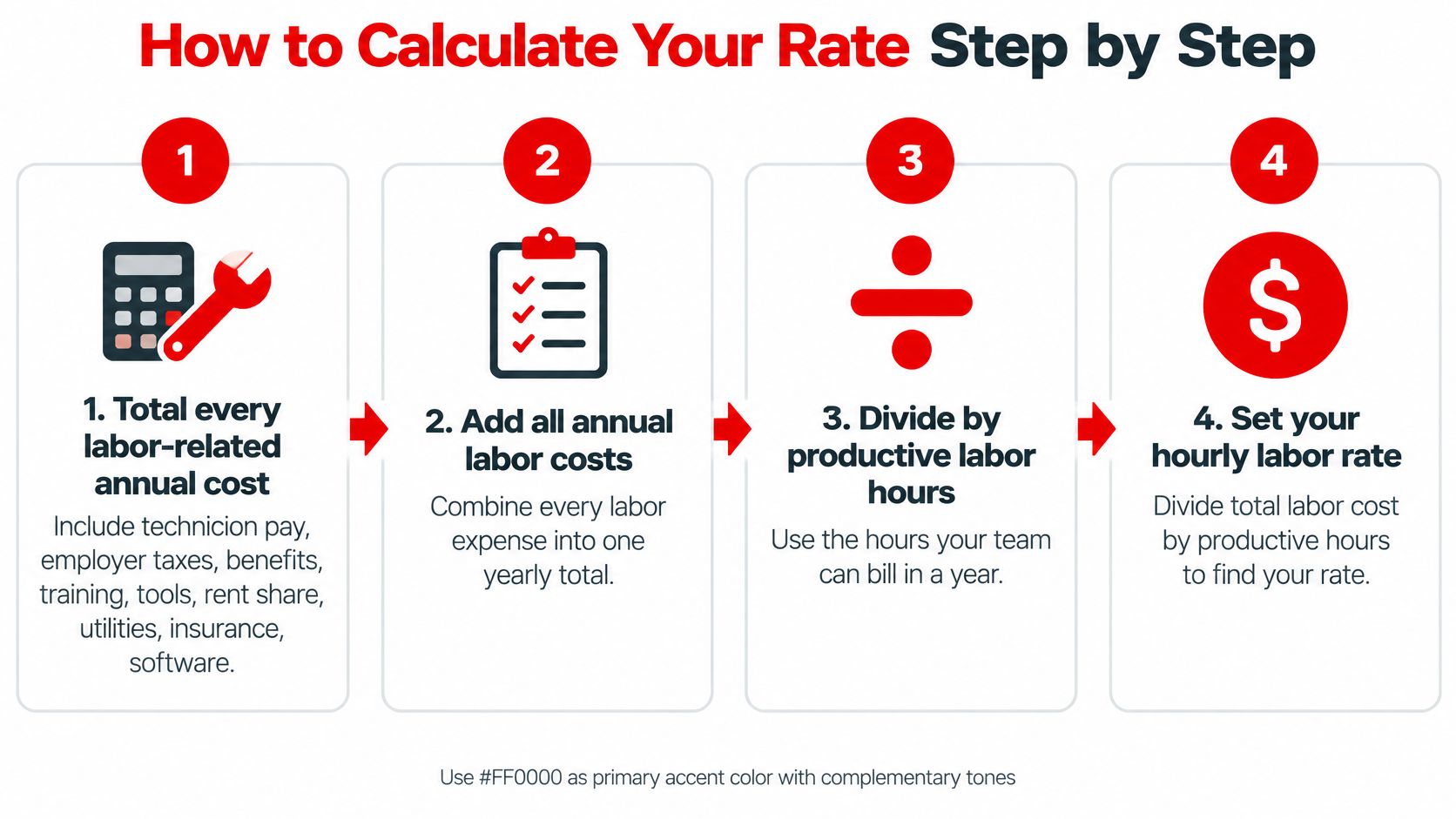
The six-step routine
Total every labor-related annual cost. Include technician pay, employer taxes, benefits, workers' compensation, training, and tools. Add the rent share for bays, utilities, insurance, software, shop supplies, equipment costs, and owner pay tied to producing or supporting labor. Leaving out owner pay makes the rate look healthier than the business really is.
Count realistic billable hours. Use sold and billed time from completed repair orders across a full operating cycle. Do not use hours the shop is open. Do not use hours technicians are present. Open hours describe the building. Billable hours describe revenue-producing capacity.
Divide total cost by billable hours. For example, $300,000 in annual labor-related costs divided by 3,000 billable hours equals $100 per billed hour. That $100 figure is break-even before profit, taxes on profit, or a cushion for slow weeks and warranty work.
Add the target margin. A 40% markup on $100 produces $140 per hour. Markup and margin are not the same term, so the owner should state which one is being used and stay consistent. What matters is that profit is added deliberately, not treated as whatever survives the month.
Split the result by work type where costs differ. Standard mechanical work, advanced diagnostics, and specialty platforms do not always require the same technician, tooling, or risk. A single blended rate is simpler, but it can underprice difficult work and overprice routine work at the same time.
Check the answer two ways. Compare it with the local market band and with the shop's effective labor rate. A calculated rate that looks sound can still fail if advisors discount it, technicians give away diagnostic time, or estimates miss labor operations.
The common slip that understates the rate
The most damaging mistake is using open hours as the denominator. Say two technicians are present for a combined 4,000 paid hours in a period but only bill 3,000 hours. Dividing $300,000 by 4,000 gives $75 per hour. Dividing by the 3,000 hours customers bought gives $100. The first answer feels competitive. The second answer is the one the bank account experiences.
That difference explains the familiar complaint that a shop is booked solid and still short on cash. Cars in bays create activity. Billed hours create labor revenue. Activity without enough billed hours just wears out people and equipment faster.
Owners who want a broader view of cost-based pricing outside auto repair can compare the logic with from Data Hunters Agency. The products differ, but the discipline is similar. Know the full cost first, then decide what margin the business needs, then test the result against the market.
Keep the worksheet simple enough to repeat. One page is enough if it lists total labor-related cost, billable hours, break-even cost, target markup, and the resulting rate. A calculation buried in a complicated spreadsheet tends to be done once and forgotten. A clear calculation can be rerun when wages, rent, insurance, or production change.
At the end of the routine, the owner should hold one number that can be defended without emotion. It is not the cheapest number in town and it is not a guess. It is the rate required for that shop, with those technicians, at that level of production, to cover cost and earn the chosen return.
Check Your Rate Against Local Market Benchmarks
A shop owner sees a nearby posted rate that is lower and wonders whether to match it. Cost sets the floor. The local market shows whether the rate that clears cost is believable to customers in that area. Treat benchmarks as a sanity check. Copying a nearby shop without knowing its rent, staffing, tooling, or warranty exposure imports someone else's problems.
A reported that nearly half of surveyed shops charged between $120 and $159 per hour, with state averages ranging from about $110 in Mississippi to $176 in California.
| Benchmark | Reported rate | Use it for |
|---|---|---|
| Nearly half of surveyed shops | $120 to $159 per hour | Typical mid-market band |
| Lowest state average (Mississippi) | about $110 per hour | Lower-cost market floor |
| Highest state average (California) | about $176 per hour | High-cost market ceiling |
Use the table for orientation. A shop in a high-cost city can justify the upper end. A shop in a low-cost county may need to live with less.
How to use the band without surrendering to it
Start with the shop's own category. A general repair shop should not anchor its thinking to a European specialist rate unless it has the tooling, training, and customer base to match. A diesel operation should look at diesel-capable competitors, not only the quick service shop down the road.
Then narrow the comparison to geography. State averages hide city differences, but they still expose how much location matters. Rent, wages, insurance, and customer expectations in a high-cost market push rates up. Lower-cost markets compress them. A rate that is ordinary in one state can look extreme in another.
Local checking should include nearby independents, dealerships, and specialty competitors. The goal is to document a range, not to find one magic competitor and match it. Call for a common job quote, review published rates where available, and note what's included. A lower rate with a short warranty is not the same offer as a higher rate with documented inspections and stronger coverage.
- Compare like with like: Match shop type, vehicle brands, warranty, and service level before comparing dollars.
- Adjust for capability: Certifications, factory-level scan tools, ADAS equipment, and experienced diagnosticians support a higher position in the band.
- Adjust for overhead: A larger facility, more advisors, loaner support, or extended hours cost money and should be reflected in the rate.
If the cost-based rate sits far above the local band, check billable hours first. Low billable efficiency can inflate the required rate until it looks unrealistic. The fix may be better scheduling, faster approvals, parts readiness, or estimate discipline rather than forcing customers to fund idle capacity.
If the cost-based rate sits far below the band, the shop may be underpricing out of habit. That leaves no money for training, equipment, or technician pay increases. That is not a competitive advantage. A low rate that slowly drains the business helps customers only until quality drops or the doors close.
The final test is simple. The chosen rate should cover loaded cost, produce the target return, and sit in a market position the owner can justify with a clear reason. That reason might be specialist equipment, faster turnaround, stronger warranty terms, or lower overhead passed along as value. "Because the shop across town charges it" is not a reason.
Justify Higher Rates for Specialty Work
One rate for every job is easy to post and hard to defend. Routine mechanical work and advanced electrical diagnosis do not place the same demands on a shop. A standard mechanical rate should cover ordinary repairs. Separate, higher rates make sense for diagnostics, programming, ADAS calibration, EV high-voltage systems, European platforms, and complex diesel work when the shop is equipped to do them properly.
The rule comes first. Charge a specialty rate only when the shop has the scan tools, software subscriptions, training, and competence the job requires. A premium without capability is just a higher price. Customers sense that quickly, especially when the vehicle comes back with the same fault.
Price spread already exists in every metro
describes reported hourly rates ranging from less than $100 to more than $200, and consumer research in the same source material found observed hourly charges in one metropolitan area ranging from $90 to $260. That spread matters. The lowest rate in a market is not automatically the most competitive offer, because customers also judge accuracy, warranty, communication, and turnaround.
A shop that documents the local range can make calmer decisions. Instead of reacting to one bargain competitor, the owner sees where dealerships, independents, and specialists sit. The shop then chooses a position based on overhead, technician capability, equipment, warranty exposure, and customer value.
Connect the premium to something measurable
A higher specialty rate needs a plain explanation. Diagnostic equipment is measurable. Certifications are measurable. Warranty terms, documented test results, faster turnaround, and photo records are measurable. Vague claims about being the best shop in town are not.
Say a shop posts $149 per hour for standard mechanical work. It buys ADAS calibration equipment, pays for software access, and trains two technicians until they can perform and document calibrations correctly. At that point, a separate ADAS or advanced diagnostic tier is justified. The customer is paying for equipment, training, reduced guesswork, and a repair that can be verified.
The same logic applies to European platforms that need brand-specific tooling, diesel work that needs heavier equipment, and EV work that needs high-voltage safety training and insulated tools. The tier should name the work included, the requirement that qualifies for it, and the rate that applies. Advisors should not have to invent the boundary at the counter.
- Standard mechanical: Routine repairs completed with general tooling and established labor operations.
- Advanced diagnostic: Electrical, drivability, network, and intermittent faults that require testing time and higher skill.
- Platform specialty: European, diesel, EV, ADAS, or programming work that requires dedicated equipment and training.
Write the tier list down and keep it where estimates are built. Each tier needs a rate, a qualifying requirement, and the customer value behind it. That written structure protects margin and protects trust. It stops specialty work from being sold at a routine rate, and it stops routine work from being pushed into a premium tier just because a customer looks unlikely to question it.
Track the Metrics That Show Your Rate Works
A posted rate proves very little by itself. The key question is what the shop collects for each billed hour after discounts, unbilled work, comebacks, and estimate mistakes. That's why effective labor rate comes first. It is labor sales divided by billed hours, and it exposes the gap between the number on the wall and the number customers pay.
Say the posted rate is $145 but the effective rate is $118. The shop is losing $27 per billed hour somewhere. The cause might be discounting, missed labor operations, weak diagnostic charges, or rework that never reaches an invoice. Raising the posted rate without finding the leak just makes the wall sign bigger while the leak continues.
| Metric | How to calculate it | What to watch for |
|---|---|---|
| Effective labor rate | Labor sales divided by billed hours | Should sit at or near the posted rate |
| Billable efficiency | Billed hours divided by paid technician hours | Below target means lost capacity |
| Loaded cost per billed hour | Total labor-related costs divided by billed hours | Must stay below the posted rate |
| Labor discount rate | Discounted labor dollars divided by total labor sold | Rising discounts signal weak estimates |
| Comeback rate | Repeat repairs divided by completed jobs | Unbilled rework erodes effective rate |
| Average repair order | Total sales divided by number of repair orders | Shows whether rate changes lift ticket size |
Read the metrics in order of damage
Effective labor rate shows realized pricing. If it trails the posted rate month after month, advisors may be discounting to close jobs, estimates may be missing labor, or technicians may be doing work that was never sold. Tightening estimate review often recovers more profit than another small rate increase.
Billable efficiency shows capacity use. A drop can mean poor scheduling, parts delays, slow approvals, or too many vehicles waiting for diagnosis. It can also mean the shop is taking in work it cannot move. More cars do not help if technicians spend the day pushing vehicles in and out of bays.
Loaded cost per billed hour is the pricing floor in motion. Wages rise. Insurance renews higher. A technician leaves and production falls. When loaded cost creeps toward the posted rate, margin disappears. Owners who watch this number monthly see the squeeze before the checking account explains it.
Labor discount rate separates planned promotions from uncontrolled giving. A coupon with a purpose is marketing. Repeated counter discounts because estimates were unclear are a process failure. Tracking discounted labor dollars forces that conversation into the open.
Comeback rate belongs in a pricing discussion because rework consumes billed capacity without producing new labor sales. A comeback also damages trust, which makes future approvals harder. Quality control, road tests, torque checks, and clear diagnostic notes are pricing tools as much as repair tools.
Average repair order shows whether better inspections and clearer estimates are lifting the value of each visit. A rate increase that scares customers away from needed work can raise hourly price while lowering total ticket health. The shop needs both fair hourly pricing and approved work that solves the customer's problem.
Shops that sell work by phone before a vehicle arrives face a similar measurement problem at the front counter, and the thinking behind from Voicedial.ai is a useful parallel. Count what was offered, what was approved, and where the drop-off happened. Opinion fades when the funnel is visible.
Monthly routine: Pull effective labor rate, billable efficiency, and loaded cost per billed hour first. If one is off target, fix that cause before changing the posted rate again.
Break the numbers down by technician, service type, and bay. Shop-wide averages hide the problem. One technician may bill efficiently while another loses hours to comebacks. One service category may carry the shop while another is chronically underpriced. Averages make those situations look acceptable.
Review monthly and make one change at a time. Tighten discount approval. Add a diagnostic charge that matches policy. Require photos before authorization. Reprice a specialty tier. Then watch the next month. Small controlled changes tell the owner what worked. Changing everything at once leaves only noise.
Explain Your Rate So Customers Approve Estimates
Customers are not shocked that prices differ. They already see wide spreads when they call around. What frustrates them is a total with no visible logic. A clear estimate gives the labor rate a context, and context makes approval easier.
found a starter replacement for a Chevrolet Malibu priced from $452 to $950, while surveyed hourly labor rates ranged from $90 to $260. With that kind of spread, a shop cannot rely on reputation alone. It has to show what the customer is buying.
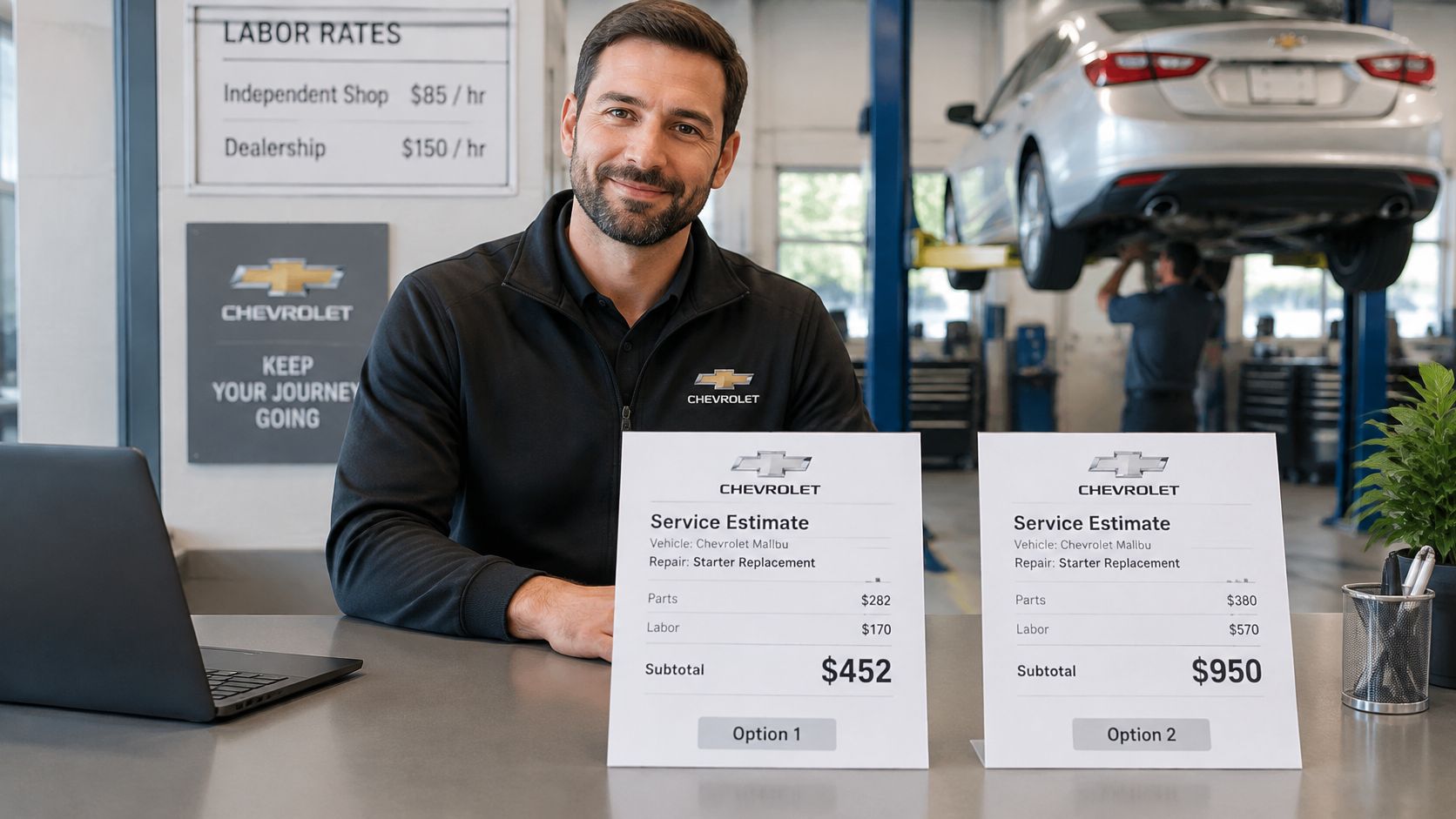
Publish the policy before the estimate
A written labor-rate policy should state whether the shop uses flat-rate labor, diagnostic fees, minimum charges, specialty rates, inspection rates, or after-hours rates. Customers do not need a lecture on shop economics. They need to know how charges are built and when a different tier applies.
Each estimate should show labor hours, the applicable rate, parts pricing, taxes, shop supplies, and authorization limits before work begins. For example, 1.5 hours at $150 per hour is $225 in labor. Put that labor line beside parts, tax, and supplies instead of burying it in one total. A customer can question a line. A customer can only argue with a lump sum.
An estimate is the price a shop quotes before the work starts. That makes it the right place to prevent disputes. If diagnosis may change the scope, state the authorization limit and the point at which the shop will stop and call. Surprises after teardown feel like pressure, even when the additional work is legitimate.
Send evidence with the numbers
A customer receives an estimate by SMS or email, opens a link, reviews the labor, parts, and total, and approves it from their phone. That flow works because the customer can read it away from the counter, share it with a spouse or fleet manager, and respond without playing phone tag.
Attach photo inspections to that estimate. A leaking water pump, cracked belt, worn brake pad, or damaged tire sidewall is easier to approve when the customer can see it. Time-stamped approval records also protect the shop if a question arises later about who authorized the work and at what price.
- Show the operation: Name the repair in plain words, not internal shorthand.
- Show the labor math: Hours multiplied by the applicable rate, on its own line.
- Show the proof: Photos, measurements, fault codes, or inspection notes tied to the recommendation.
- Show the limit: The authorized amount and what happens if hidden damage appears.
If the shop charges more than a local competitor, connect the premium to concrete benefits. Documented inspections count. Warranty coverage counts. Technician expertise counts when it is named specifically. Faster turnaround counts when the shop can commit to it. A premium explained with evidence sounds like value. A premium explained with adjectives sounds like markup.
Advisors should also separate safety and reliability items from maintenance that can wait. Customers approve more readily when they understand urgency and consequence. Bundling every recommendation into one intimidating total invites a full refusal. Prioritized options let the customer approve the critical repair now and plan the rest.
Transparency does not mean apologizing for the rate. It means making the rate legible. When hours, rate, parts, and proof line up, the customer is no longer asked to trust a total. The customer is asked to approve a documented repair at a stated price.
Roll Out Your New Rate Without Losing Customers
A calculated rate does nothing while it sits in a notebook. It needs an effective point, updated systems, and a short review window so the owner can see whether customers approve work at the new price and whether the shop collects it.
Five steps for a clean rollout
Give written notice before the change applies. Existing customers and fleet accounts should hear it from the shop, not discover it on an invoice. About a month of notice for regular accounts is a practical target where relationships allow. State the reason plainly, such as higher technician training costs, new diagnostic equipment, or expanded warranty coverage.
Read every fixed-rate agreement. Insurer, fleet, warranty, and commercial contracts may set a labor rate or require notice before a change. Those terms can override the posted rate. Finding that out after invoices are disputed wastes time and credibility.
Update the system before the first new estimate. Every new estimate should pull the correct standard and specialty rates automatically. Open estimates that have not been approved should be reviewed and re-quoted where policy requires it. Mixed old and new rates on similar jobs create arguments advisors do not need.
Compare approval and collection after launch. Watch approval rate and effective labor rate against the prior period for the first stretch after the change. A small approval dip on discretionary work may be acceptable if effective rate and gross profit rise. A sharp drop on core repairs needs attention to explanation, not instant retreat.
Run a full review and adjust once. After enough repair orders have closed, review the tracking metrics as a set. Change one lever at a time, such as diagnostic policy, discount approval, or a specialty tier boundary. Stacking several changes makes the cause of any improvement impossible to identify.
Setup matters during that system update. In RedAppy, initial setup covers shop details, hours, tax and labor rates, and the first staff accounts. Getting those settings right at the start means estimates pull consistent numbers instead of relying on each advisor's memory.
Labor time consistency helps too. Nitro gives labor hour estimates by combining industry-standard labor guides with the shop's historical data. That kind of support does not replace technician judgement or owner review. It gives advisors a steadier starting point when they build estimates under the new rate structure.
Staff need the explanation before customers do. Advisors should be able to say what changed, when it applies, and what value supports it in two or three sentences. Technicians should know which work qualifies for specialty tiers so they flag it early. If the team hears about the new rate from a confused customer, rollout discipline has already failed.
Owners ready to put the new structure into daily estimates can review RedAppy features to see how rates, inspections, and approvals fit together, or contact the RedAppy team to talk through setup for a specific shop. The next step is not another month of debating the number. It is loading the defended rate, training the team, and watching the first closed repair orders closely.
Set a rate that covers loaded cost, track effective labor rate and billable efficiency every month, and send customers estimates they can review and approve from a phone with photos attached. RedAppy brings labor rates, digital inspections, estimates, invoicing, and analytics into one shop management platform, so the numbers behind a rate stay visible after rollout. Visit the site to see how those tools fit the way a shop already writes, approves, and tracks repair work.
Ready to Transform Your Shop?
RedAppy helps auto repair shops create professional digital estimates with photos and videos, send them instantly via text or email, and get customer approvals in seconds. No credit card required to start.