
Tire Pressure Sensor Problems: A Practical Shop Guide
A TPMS light shows up at the worst time. The customer says the car just started complaining after a tire rotation, or the dash has been glowing for days even though the tires look fine. In the bay, that usually means one of three things, a real low-pressure condition, a relearn problem, or an actual sensor or communication fault that's being blamed on the wrong tire.
The trap is treating every warning as a dead sensor. Direct TPMS systems can report pressure well, but the world is messy, tires drift low, wheel positions change, batteries fail, and receiver-side issues can make a good sensor look bad. The smart move is to separate pressure problems from sensor problems before anyone sells parts.
Table of Contents
- What Walked Into the Bay Today
- Reading the Warning Light Like a Technician
- Running the Visual, Electrical, and Scan Tool Tests
- What Actually Breaks and Why
- Replacement, Programming, and Getting Paid for the Job
- Putting It Into the Shop Workflow
What Walked Into the Bay Today
The first clue usually isn't the tool cart, it's the story. A customer pulls in with a steady TPMS light, or a flashing lamp that never settles down, or a complaint that started right after a tire rotation, winter swap, or new set of wheels. That story matters because tire pressure sensor problems often get blamed on the sensor when the car is really reacting to low air, a missed relearn, or a broken communication path.

The complaint is usually the map
A steady light after an overnight sit often points to pressure loss before it points to electronics. A warning that started right after service points somewhere else, especially if the wheels were rotated or new sensors were installed without a proper relearn. A flashing start-up lamp that later stays on is the one that pushes technicians toward communication or sensor faults instead of simple underinflation.
A TPMS complaint is not a verdict. It's a starting point, and the dash pattern tells you which direction to walk first.
That's why a quick background conversation saves time. Ask when the warning started, whether the tires were recently serviced, and whether the car was jump-started or had a weak battery event. Those details often turn a “bad sensor” into a straightforward reset or pressure correction.
Why this gets misdiagnosed
The public sees one light and assumes one problem. In the bay, the breakdown is usually wider than that. A major U.S. government fleet study found that only about 44% of commercial vehicle tires were within ±5 psi of target pressure, and roughly 7% were underinflated by 20 psi or more in that study, while TPMS-related issues were common enough to create 257 sensor issues and prevent pressure reporting in 44% of tire inspections.
That's the practical lesson. Some complaints are real inflation problems. Some are hardware or signal failures. Some are threshold or calibration issues that look like a sensor failure until the readings are checked against the vehicle's actual setup. For a broader driver-facing overview, a solid can help explain why the warning light and the tire condition don't always tell the same story.
Reading the Warning Light Like a Technician
The dash pattern is the fastest triage tool in the building. A solid light usually means the system sees a real pressure problem. A flash-then-stay pattern points more toward a sensor, receiver, or communication fault. If the complaint is intermittent, especially after service, the likely cause shifts toward relearn, mismatch, or a borderline battery.
What the lamp is really saying
A direct TPMS system can be working and still mislead the driver if the threshold hasn't been crossed yet. In a U.S. passenger-vehicle survey cited by NHTSA, 72.3% of 766 vehicles had at least one underinflated tire, and 51.0% had at least one tire underinflated by 5 psi or more. That's why a solid light is never just a dashboard nuisance, it usually means the tires need to be checked before anything else.
| Common TPMS Warning Light Patterns and What They Usually Mean | ||
|---|---|---|
| Lamp Behavior | Most Likely Cause | First Check |
| Solid light | Actual low tire pressure | Gauge every tire, then compare to door placard |
| Flash at key-on, then stays on | Sensor, receiver, or communication fault | Scan for IDs and live data |
| Light appeared after rotation | Missed relearn or wheel position mismatch | Run the relearn procedure |
| Light appeared after battery jump | Voltage-related confusion or module upset | Recheck system communication after power stabilizes |
A practical clue from the bay is a light that showed up right after a dead battery or low-voltage event. That can make the receiver act like it lost its place, even when the sensors are fine. The job looks like a bad wheel sensor at first, but the fix can be a relearn or a correction on the vehicle side.
Read the complaint before you touch the valve stem
The cleanest approach is simple. Does the warning match low pressure, or does it match a data problem? If the dash is flashing for about 60–90 seconds at key-on before it stays on, technicians treat that as a sensor or communication fault rather than a basic low-pressure warning.
For diagnosis support, a shop can also use a resource when it needs vehicle-specific context before choosing the next test. That matters because the right response to a TPMS complaint changes with platform, sensor protocol, and reset method.
If the warning showed up after tire service, assume relearn first. If it showed up with no service history and one tire is visibly low, assume pressure first.
Running the Visual, Electrical, and Scan Tool Tests
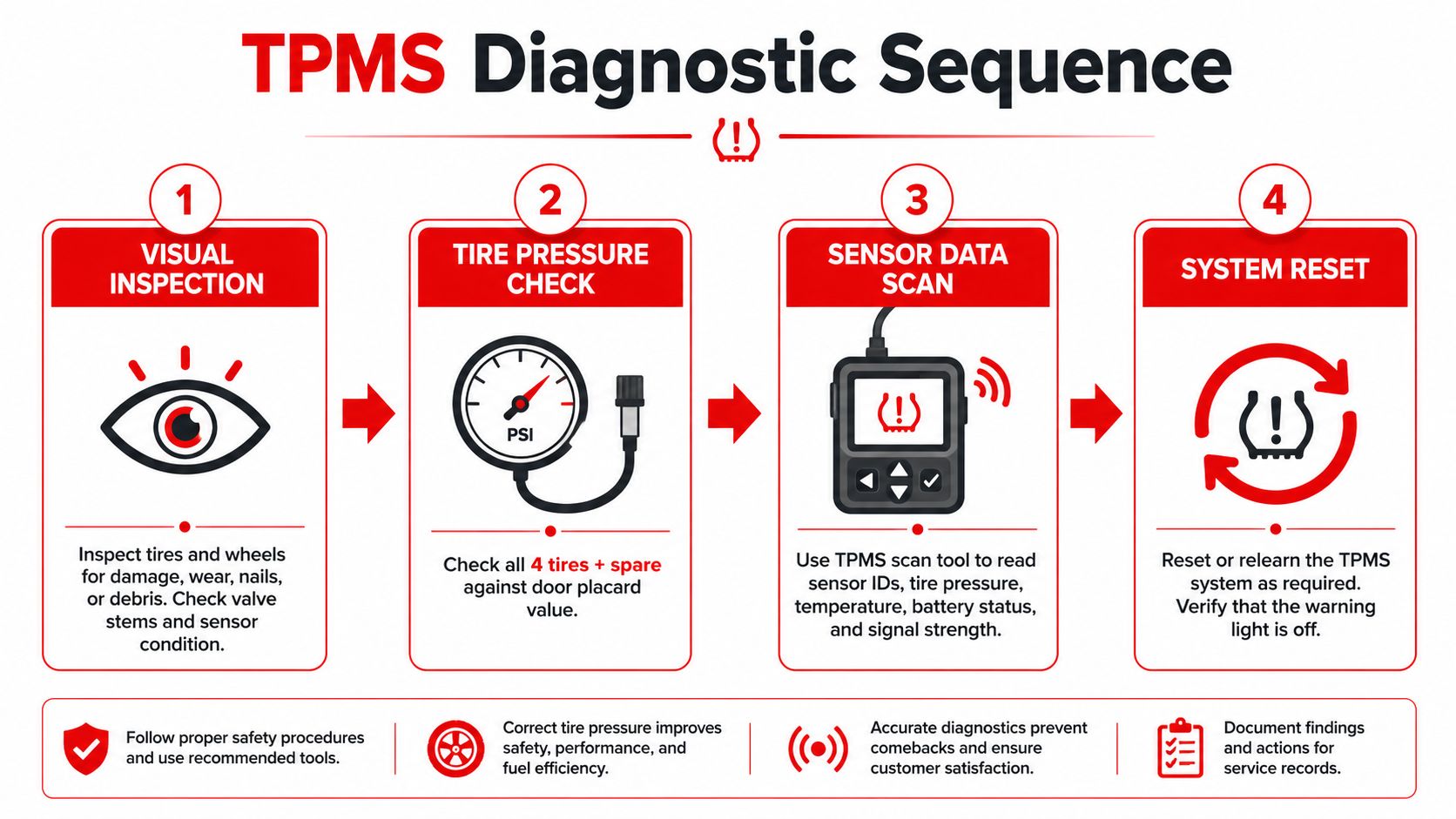
The best TPMS diagnosis starts with air, not electronics. Verify all four tire pressures with a calibrated gauge, and check the spare if the vehicle uses it in the system. Correct any underinflation to the door-placard spec, then perform the vehicle's TPMS reset or relearn before blaming a sensor that may have been reacting to the wrong baseline.
Start with what the tire is actually doing
A lot of bad decisions get made because someone trusts the dash more than the gauge. That's backwards. If the tire is underinflated, the sensor may be telling the truth, and the warning light is doing exactly what it should.
Once pressures are correct, the scan tool becomes useful instead of noisy. Wake each wheel, then compare live pressure, temperature, and sensor ID against the ECU's stored values. If the live data doesn't match the stored ID after rotation, the issue is usually relearn or reprogramming, not a failed pressure sensor.
Visual inspection catches the cheap failures
Before any parts call, inspect the valve stem, sensor housing, and seal. Look for cracked hardware, corrosion, bent stems, or the kind of damage that happens when a tire was mounted carelessly. Field guidance also points to dead battery, mechanical damage, corrosion, water ingress, RF interference, and ECU or receiver glitches as common causes of false warnings or no-read conditions.
A TPMS activation tool helps confirm whether the wheel transmits. If the wheel wakes up and sends a believable signal, but the ECU still flags a fault, the wheel sensor is not the only suspect. The next place to look is relearn status, wiring, or the receiver side.
When the sensor transmits good data but the car still complains, the wheel is usually innocent. The fault has moved upstream or into the memory of the car.
The vehicle's own behavior should match the scan data. If one wheel shows no response, a mismatched ID, or a reading that never changes, the technician can narrow the path fast. That is the difference between replacing hardware blindly and proving the fault first.
What Actually Breaks and Why
The most common failure is still the boring one, a sensor battery that's finally done. The battery is sealed into the module, so once it fades, the whole unit becomes unreliable. That's why TPMS faults often show up on older sensors, especially on vehicles that live outside or spend long stretches parked.
Battery, damage, and water tell different stories
A dying battery usually shows up as intermittent behavior first, then missing data. Mechanical damage tells a different story, often after tire service, curb impact, or corrosion at the stem. Water ingress can mimic a dead battery because the sensor may still be physically there, but the signal path is broken.
| Failure mode | What it looks like in the bay | What confirms it | Practical fix |
|---|---|---|---|
| Low battery | Intermittent signal, missing wheel data | Wheel doesn't respond consistently on scan | Replace the sensor |
| Sensor damage | Visible stem or housing damage | Physical inspection plus failed transmission | Replace sensor and service valve parts |
| Signal interference | Random warnings or no-read events | Data drops in and out, receiver tests weak | Check electronics, nearby interference, receiver health |
| Incorrect programming | Light stays on after service | Sensor data exists but IDs don't match | Relearn or program the correct sensor |
Wrong-frequency parts create their own kind of headache. 315 MHz and 433 MHz are common TPMS frequencies, so the wrong variant can produce a complete communication failure even when the part looks correct on the bench (parts and frequency guidance). That's why parts matching matters as much as the symptom.
The silent failure is the relearn gap
A missed relearn after tire rotation is one of the easiest problems to overlook. The sensors can be healthy, transmitting, and physically installed correctly, but the car still complains because the ECU is listening for the old wheel positions. In that case, replacement doesn't solve anything, because the fault isn't in the wheel.
Use the symptom pattern to separate the branches. A sensor that transmits but the vehicle flags a fault after service points to relearn or receiver-side logic. A sensor that won't wake at all points toward battery or hardware. A wheel that works until the car is driven, then drops out, points more toward communication or intermittent power loss than a dead tire sensor.
Replacement, Programming, and Getting Paid for the Job
A TPMS replacement isn't just a bolt-on part swap. The right job includes the sensor, the valve service pieces, the programming path, and the relearn method. On many vehicles, the rubber snap-in valve should be replaced when it's part of the sensor assembly, and the core and stem cap should be serviced at the same time if they're worn or corroded.
Match the part before the wheel comes apart
Parts sourcing should start with the vehicle's frequency, protocol, and exact fitment, not with the cheapest sensor on the shelf. A sensor that looks right but sends the wrong signal will waste more time than it saves. OE-specific scan tools, multi-brand TPMS tools, and vehicle auto-relearn procedures all have a place, but they're not interchangeable.
The workload changes with the method. An auto-relearn can be quick if the vehicle supports it cleanly. A scan-tool relearn or programming step takes longer, especially when the ECU needs to be taught a new ID after rotation or replacement. The shop should price that work as a diagnostic and programming service, not just a parts line.
Present the job as a system repair
Customers approve TPMS work more easily when the estimate explains why the part alone isn't the whole repair. A pressure sensor may be one item, but the vehicle also needs the correct protocol, the correct location in memory, and a final confirmation that the light clears and data returns. That's the difference between a parts sale and a finished repair.
A smart estimate should separate the line items clearly.
- Sensor replacement: the physical module and any valve service parts.
- Programming or relearn: the step that makes the car recognize the new sensor.
- Verification: the check that proves the warning light is gone and the data is stable.
A TPMS quote lands better when it sounds like a repair plan, not a mystery bill.
That approach protects the shop and the customer. The shop gets paid for the actual labor. The customer understands why a “sensor” job includes programming and setup, not just a part swap.
Putting It Into the Shop Workflow
TPMS work goes smoother when it's handled like every other modern repair, from intake to handoff. The advisor records the symptom, the technician documents the light pattern and tire readings, and the estimate spells out exactly what's being tested, replaced, or relearned. That keeps the job from turning into a surprise at pickup.

Turn the diagnosis into a visible job
A photo of the warning light and a simple capture of each tire's pressure reading gives the customer context fast. Once those numbers are attached to the estimate, the line item stops looking arbitrary. It becomes obvious why a relearn, a sensor replacement, or a valve service is part of the repair.
That's also where workflow tools matter. A Kanban-style Digital Shop Board keeps the TPMS job visible alongside brake work and alignments, so the ticket doesn't disappear between inspections and parts ordering. An AI Repair Assistant can help the team pull labor times for the correct vehicle, while multi-supplier parts ordering helps make sure the right-frequency sensor is on the bench before the wheel is dropped.
Make the estimate do the selling
Customers usually accept TPMS work when the estimate is clean. It should show the failed sensor if there is one, the programming or relearn step if needed, and the reason valve service is included. That keeps the conversation tied to the car, not to a vague warning lamp.
RedAppy fits that workflow because it keeps inspection photos, job stages, parts sourcing, and customer communication in one place. If your shop wants TPMS jobs to move from complaint to approved repair without the back-and-forth, visit RedAppy to see the features or reach out through the contact page and put the workflow to work in your bay.
Ready to Transform Your Shop?
RedAppy helps auto repair shops create professional digital estimates with photos and videos, send them instantly via text or email, and get customer approvals in seconds. No credit card required to start.