
Vehicle History by Plate for Repair Shops
A customer drops off a pickup and says it's never been in an accident. The advisor has a short window to confirm the vehicle before writing an estimate, ordering parts, or promising an approval timeline. The plate is visible, but the repair order still needs a verified vehicle identity.
That's where vehicle history by plate helps a service desk move from an unverified claim to a usable vehicle file. A plate lookup can support plate-to-VIN resolution, expose title and registration issues, and give the team context before inspection work begins. It doesn't replace a physical inspection or a direct VIN check, but it can make intake faster and more disciplined.
Table of Contents
- Why a Customer's Plate Matters the Moment They Pull In
- What a Plate Actually Tells You and What It Doesn't
- Free vs Paid Plate Lookup Sources Compared
- Reading a Vehicle History Report Like a Technician
- Plugging Plate Lookups Into Your Shop Workflow
- Privacy and Legal Boundaries Every Shop Must Respect
- Troubleshooting and a Quick-Start Checklist
Why a Customer's Plate Matters the Moment They Pull In
The plate often arrives before the paperwork does. A technician may see the truck's exterior condition, while the advisor is still waiting for the customer to find the registration card. Running the plate with the issuing state gives the shop a starting point for matching the vehicle to a VIN and checking whether the record fits the car in front of the bay.
The useful question isn't whether the vehicle has an accident record. The service desk needs to know whether the history changes the repair decision. A branded title can affect insurance handling and parts sourcing. Prior salvage or flood information can change the inspection scope. A registration mismatch can signal a data-entry problem, a transferred plate, or a vehicle that deserves closer identity verification.
Practical rule: Treat the plate as an intake identifier, not as final proof of the vehicle's identity.
A plate-based lookup generally resolves the plate and state to a VIN, then checks title, brand, and related records through sources such as NMVTIS, state DMV systems, insurers, and auctions. The describes the federal title-information system that supports this type of vehicle-history work. The result depends on whether the vehicle is registered and whether reporting systems have current coverage.
For a busy shop, that context supports three practical outcomes:
- Fewer avoidable comebacks: The estimate can account for known prior damage instead of treating every condition as a new failure.
- Cleaner insurance conversations: The advisor can attach relevant history to the repair order before an adjuster reviews the scope.
- Stronger fraud screening: A plate-to-VIN mismatch can prompt a physical VIN comparison before work proceeds.
The following workflow focuses on identifiers, source selection, report interpretation, RedAppy integration, privacy boundaries, and common lookup failures.
What a Plate Actually Tells You and What It Doesn't
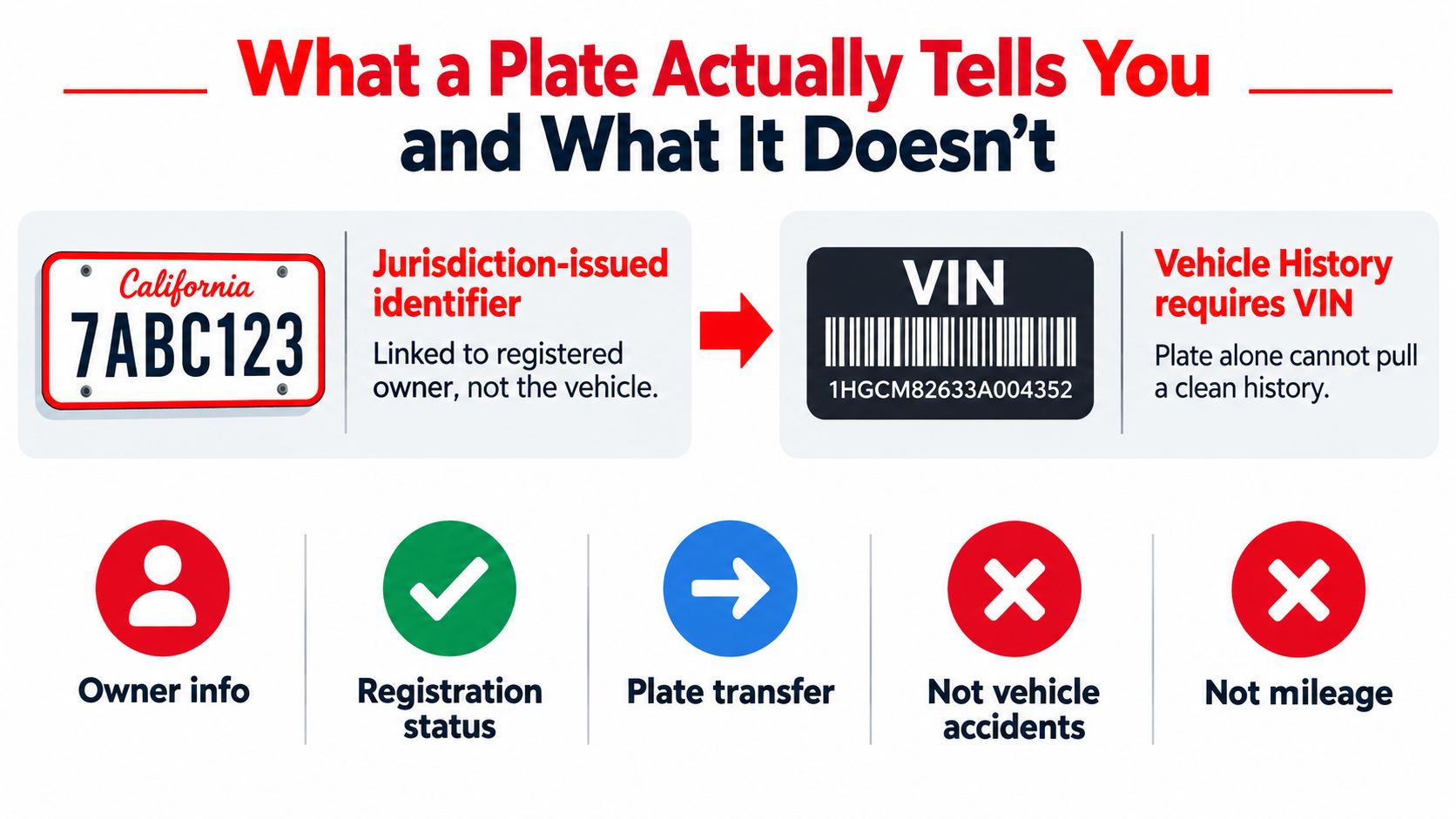
A license plate is a jurisdiction-issued identifier connected to a registration record. It isn't the vehicle itself, and it generally doesn't provide the owner's personal identity to an ordinary lookup user. Federal privacy rules restrict disclosure of names, addresses, phone numbers, driver's license numbers, and similar personal information from motor vehicle records, as explained in this overview of.
A reliable intake record should capture:
- Plate number: Record every letter and number exactly as displayed.
- Issuing state: The same plate format can produce different results when the state is wrong or omitted.
- VIN: Read the VIN from the dashboard or door-jamb label whenever possible.
- Registration card: Use it as a cross-check if the plate result is incomplete or ambiguous.
The lookup service first attempts plate-to-VIN resolution. It matches the plate and state against a registration or registry record, then uses the resolved VIN to request vehicle details such as make, model, model year, title status, and other available history. The VIN remains the stronger identifier because it stays attached to the vehicle while plates can be replaced, surrendered, or transferred.
A plate can help a shop locate a vehicle record, but it can't guarantee a complete history. Records may be missing across states, older vehicles may have thinner reporting, and privacy controls can redact personal information. A transferred or personalized plate can also connect to more than one vehicle over time, so the advisor must confirm that the resolved VIN matches the car physically present.
Free vs Paid Plate Lookup Sources Compared
Repair shops usually choose between public or low-cost sources and paid history providers. Free options can establish a baseline, but they often require more manual work and may stop once the plate is resolved. Paid tools tend to combine more reporting sources and offer a smoother process for high-risk jobs, though the shop pays for that convenience and depth.
State DMV portals may help verify registration-related details where access is available. NMVTIS-approved providers can support title and brand checks, while a VIN decoder can describe the vehicle after the plate has successfully resolved to a VIN. These options work well when the shop already has the VIN and needs a focused verification.
Paid providers such as Carfax, AutoCheck, and dealer-grade services can add broader accident, service, ownership, lien, branding, and cross-state information. Coverage still varies, so a paid report should be treated as evidence to compare with the vehicle, not as an unquestionable record.
| Source | Cost | Data Depth | Best Use Case |
|---|---|---|---|
| State DMV portal | May be free or access-controlled | Registration and state-held records | Basic state verification |
| NMVTIS-approved lookup | Usually paid through an approved provider | Title, brand, and salvage-related records | Baseline title compliance checks |
| VIN decoder | Often free after VIN capture | Vehicle specifications and identity details | Confirming make, model, and configuration |
| Paid history provider | Paid per report or through a subscription | Broader accident, service, lien, ownership, and use records | High-ticket repairs and insurance work |
| Dealer-grade platform | Subscription or account-based | Deeper workflow support and possible system integration | Multi-advisor or multi-location operations |
A hybrid model suits many shops. Use an NMVTIS-oriented source for baseline title and brand screening, then use a paid provider for insurance jobs, expensive structural repairs, used-car intake, or a suspicious mismatch. For a make-specific identity check, the can serve as a supplementary reference after the shop has confirmed the VIN.
The deciding factors are data depth, turnaround, integration, and risk tolerance. A free source that requires several manual steps may cost more staff time than expected, while a paid source is difficult to justify for every routine oil service.
Reading a Vehicle History Report Like a Technician
A report is useful only when the service desk connects each field to a physical inspection. A title brand can change how the shop evaluates structure and safety systems. An odometer inconsistency can affect maintenance assumptions. A flood entry can justify looking beyond the customer's stated complaint and checking connectors, modules, corrosion, and hidden moisture.
Fields that deserve immediate attention
| Report Field | What It Means | Tech Priority | Buyer Priority |
|---|---|---|---|
| Title brand | Salvage, flood, rebuilt, or another title designation | High | High |
| Odometer record | Reported mileage history and possible inconsistencies | High | High |
| Accident or structural entry | A reported loss, collision, or structural event | High | High |
| Service record | Documented maintenance or repair activity | Medium to high | Medium |
| Registration history | Recorded registration periods and jurisdictions | Medium | Medium |
| Lien status | A recorded financial interest in the vehicle | Medium | High |
| Vehicle use | Rental, fleet, taxi, lease, or personal use | Medium | Medium |
The technician should scan title brand, mileage sequence, salvage or flood events, structural damage indicators, VIN consistency, and the most recent registration or service entry before approving a major estimate. Market value and ownership count may matter to a buyer, but they don't tell a technician whether a steering system, restraint system, or wiring harness requires closer examination.
A clean-looking report can still contain gaps. Compare the odometer sequence against the instrument cluster, service stickers, inspection records, and customer description. Duplicate VIN entries, impossible mileage movement, or a report that stops at plate-to-VIN resolution should trigger a verification step, not an automatic diagnosis.
For additional background on interpreting imported records, the offers useful context around checking a vehicle's recorded past before relying on the report alone.
A report identifies questions for the bay. It doesn't answer every mechanical question by itself.
Plugging Plate Lookups Into Your Shop Workflow
The lookup should happen before the vehicle disappears into the bay. A shop that waits until estimate approval has already missed the easiest moment to catch a mismatch, prior damage record, or incomplete vehicle profile.
A practical intake sequence
- Capture the plate at write-up. The advisor enters the plate and issuing state on the tablet or write-up station, then photographs or records the VIN when accessible.
- Resolve the vehicle identity. The system matches the plate to a VIN and displays the returned make, model, and vehicle details for confirmation.
- Attach the history to the repair order. The report belongs with the RO, not in a separate browser tab that the next advisor can't find.
- Carry the VIN into the estimate. Parts catalogs, labor references, inspection templates, and invoices should use the verified vehicle record.
- Show relevant warnings in the inspection. Prior damage, title brands, and mileage flags should be visible to the advisor and technician before inspection photos are reviewed.
- Retain an audit trail. The record should show who initiated the lookup, which vehicle was matched, and whether the customer corrected any identifier.
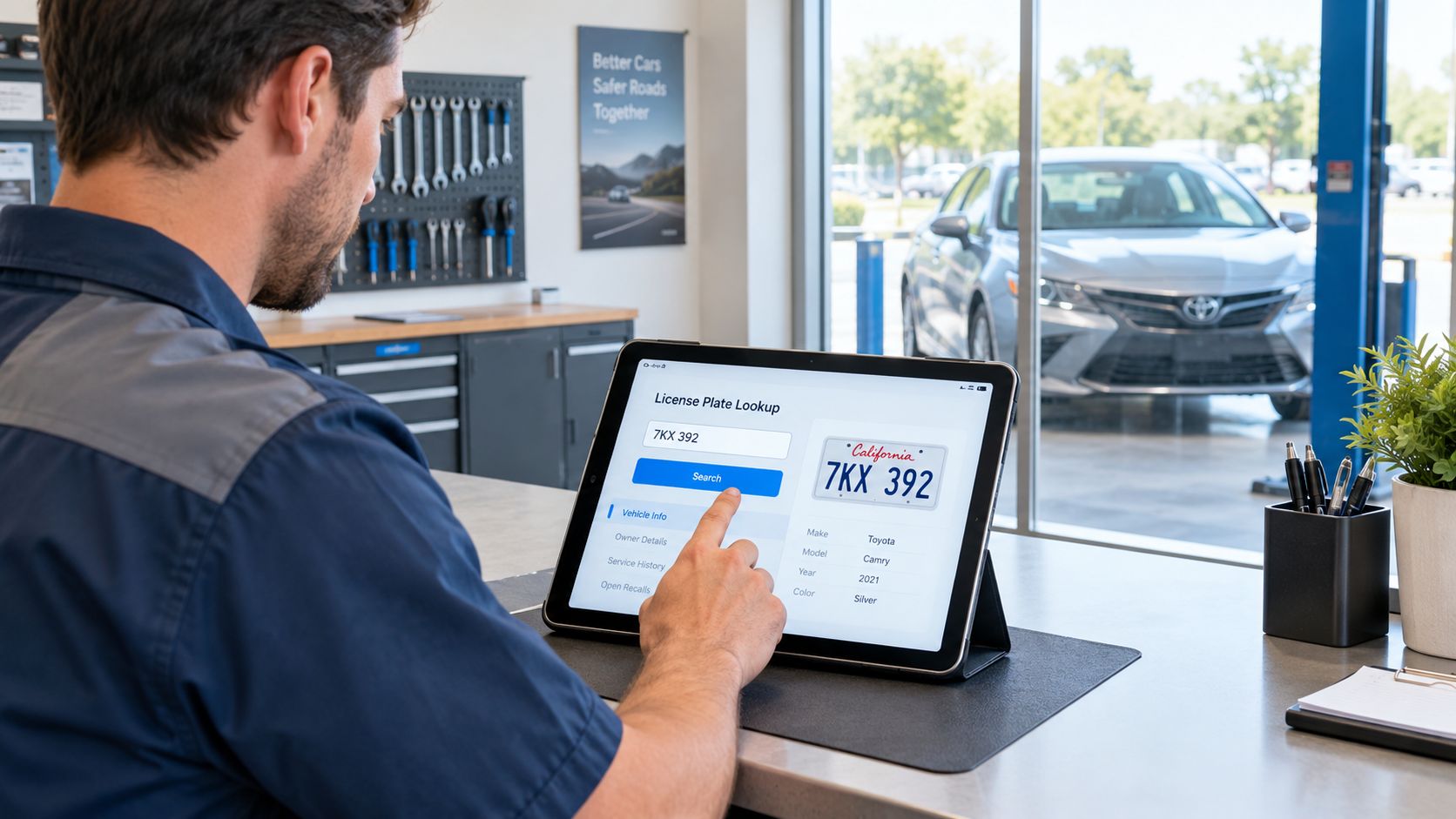
RedAppy can place plate-based customer and vehicle lookup inside the service workflow, allowing staff to search by plate or VIN, view stored service history, and connect vehicle information with digital inspections and estimates. The shop can configure the trigger for intake only or for each repair-order opening, depending on subscription cost, workflow speed, and how often customers return with the same vehicle.
Role-based visibility keeps the process practical. Advisors may need the full history and customer context, technicians need relevant vehicle warnings and inspection information, and managers may need access to audit activity and vendor usage. The objective is not to make every employee read every report. It's to put the right vehicle facts in front of the right person before a decision is made.
Privacy and Legal Boundaries Every Shop Must Respect
A plate lookup isn't a free pass to collect or distribute personal information. The Driver's Privacy Protection Act limits access to personal data held in motor vehicle records, and permitted-purpose rules matter even when the request begins as a normal service appointment. A shop should verify the vehicle needed for service, but it shouldn't use plate data to track people, build marketing lists, or sell location information.
Written customer authorization gives the intake process a clearer boundary. The form should identify the purpose of the lookup, explain what vehicle information may be retrieved, state who may access the record, describe the retention period, and explain how the customer can ask about stored data. The shop's privacy policy should also define when records are deleted or restricted.
If a customer refuses, the shop can continue with a manual VIN and registration review where appropriate, but it shouldn't pressure the customer into unnecessary data sharing. Plate information shouldn't be passed to marketers, unrelated tow companies, or other third parties because those parties request it. An insurer may receive information needed for a specific claim, but the shop should document the purpose and limit the disclosure.
Unauthorized access can create serious exposure. Under the DPPA, civil liability can include a minimum $2,500 penalty per violation, and criminal fines may also apply, as described in this.
A concise intake clause could read:
Vehicle record consent: The customer authorizes the shop to use the supplied plate, state, VIN, and registration information to verify the vehicle and support service estimating, inspection, repair, warranty, or insurance documentation. The shop will limit access to these purposes, will not sell the information for marketing, and will handle retention and deletion under its privacy policy.
Privacy expectations are also tightening around automated plate data. The explains why retention, access, deletion, and broad location-history exposure have become central concerns.
Troubleshooting and a Quick-Start Checklist
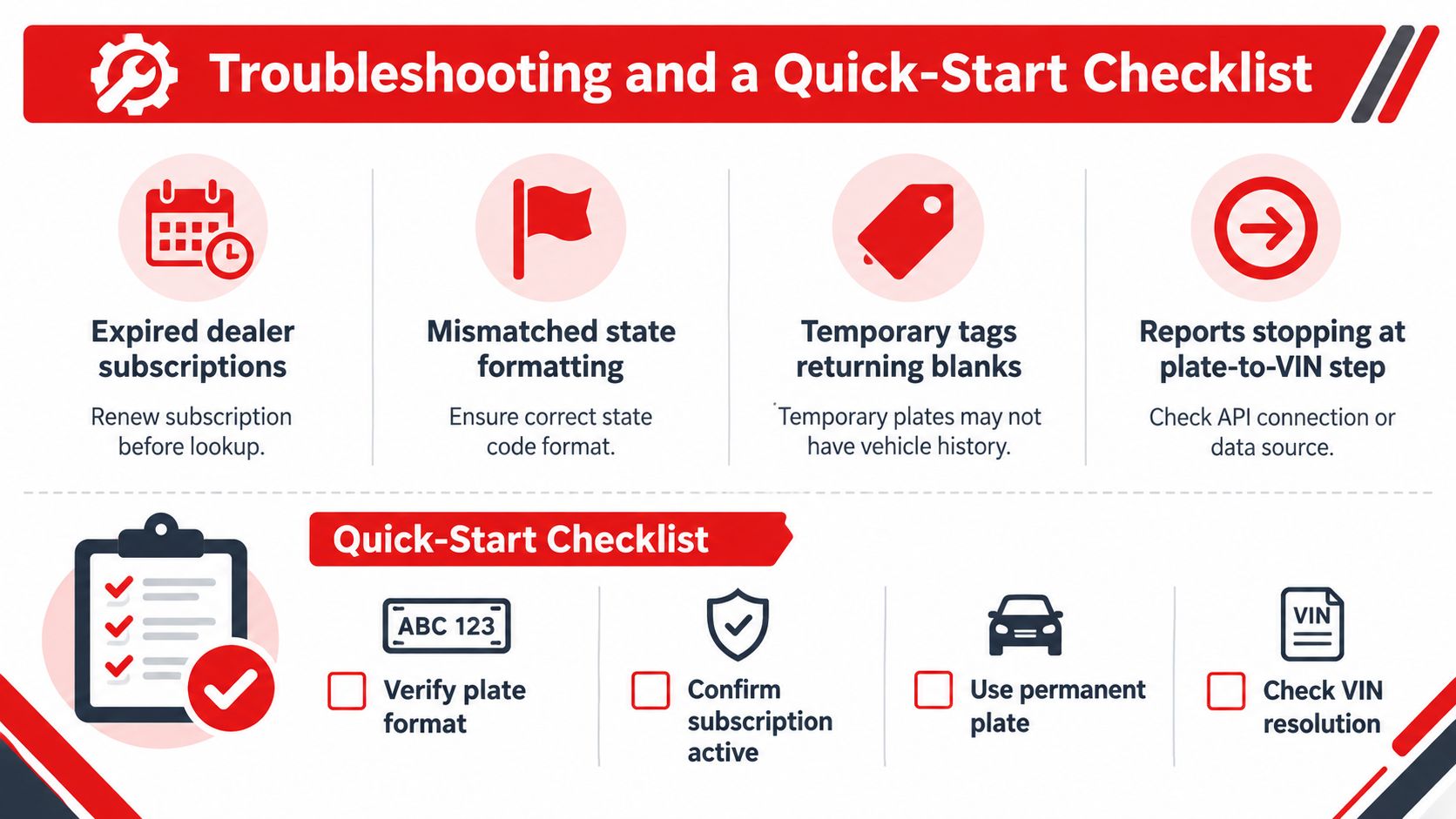
Plate lookup failures usually come from input, account, or source problems. An empty result doesn't prove that the vehicle has no history. It may mean the plate format is wrong, the tag is temporary, the vendor subscription has expired, or the system reached the plate-to-VIN stage and couldn't complete the match.
The service desk can recover methodically:
- Recheck the state format: Confirm the issuing state, letter order, spaces, and special characters.
- Confirm account access: Check whether the dealer subscription is active before treating a failed report as a data gap.
- Handle temporary tags carefully: Ask for the registration card and VIN because temporary plates may not have a usable history record.
- Investigate a stalled match: Check the vendor connection or API status, then retry with the VIN.
- Resolve ambiguity: Compare the returned vehicle details with the dashboard VIN, door-jamb label, registration, and customer order.
A Monday launch checklist should include:
- Approve the shop's lookup and privacy policy.
- Train advisors on plate, state, VIN, and consent capture.
- Activate the selected free and paid data sources.
- Configure the RedAppy intake and repair-order lookup trigger.
- Add history review to the inspection and estimate handoff.
- Define role-based access and retention rules.
- Record a sample audit entry, such as: “Advisor completed plate-to-VIN verification, confirmed dashboard VIN, attached report to RO, and documented customer authorization.”
The shop should test the process on a small group of routine and complex repair orders before making it standard. That trial usually exposes formatting issues, unclear permissions, and report fields that need a plain-language explanation for customers.
RedAppy connects plate and VIN lookup with stored service history, digital inspections, estimates, repair orders, and invoicing so the team can work from one vehicle file. Visit RedAppy to review the platform, or contact the team through the RedAppy contact page to discuss a workflow that fits the shop.
Ready to Transform Your Shop?
RedAppy helps auto repair shops create professional digital estimates with photos and videos, send them instantly via text or email, and get customer approvals in seconds. No credit card required to start.