
Vehicle History Report by VIN: A Shop Owner's Playbook
A vehicle history report by VIN is a multi-source record assembled from title databases, insurers, and reporting entities, identified by a 17-character Vehicle Identification Number. It can reveal title brands, reported losses, mileage observations, and recall information, but it isn't a mechanical inspection and cannot prove that an unreported event never happened.
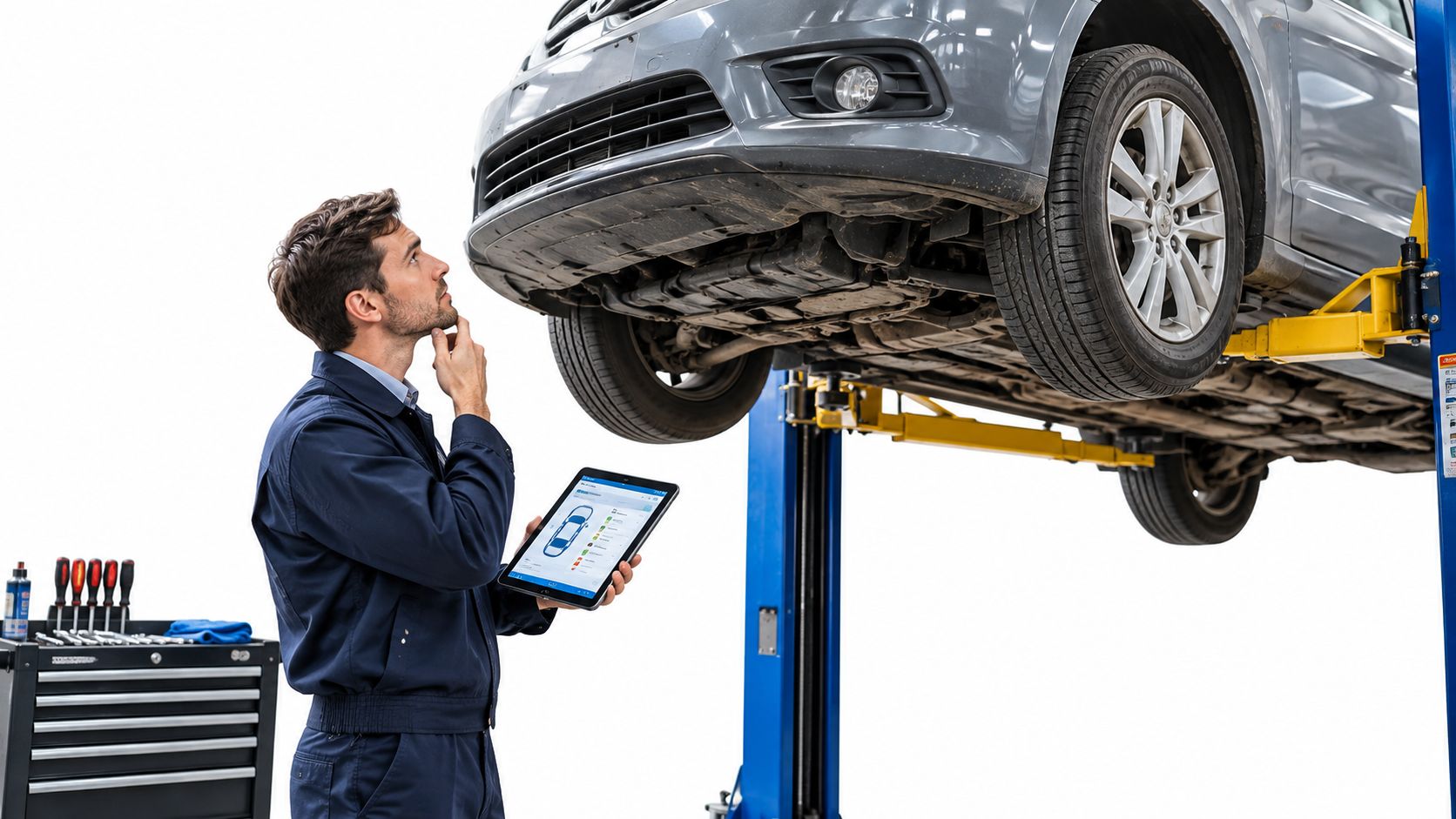
A service advisor may face the situation on any busy morning: a used vehicle is on the lift, the customer wants a repair estimate, and the vehicle's background is unclear. The dashboard looks ordinary, the seller's description sounds confident, but the shop still needs to know whether the car has a salvage history, inconsistent mileage, flood exposure, or an open safety campaign.
That's where a vehicle history report by VIN becomes useful. It gives the shop a documented starting point before the technician spends time diagnosing the vehicle. The important distinction is that the report doesn't replace inspection. It adds an identity and risk-validation layer to the inspection process.
Table of Contents
- What a Vehicle History Report by VIN Actually Is
- How the VIN Becomes a Reliable Lookup Key
- What a Vehicle History Report Actually Contains
- How a VIN-Based Report Gets Generated
- How a Repair Shop Uses the Report Day to Day
- Why a Clean Report Does Not Mean a Clean Vehicle
- How to Choose a Vehicle History Report Provider
- Building a Repeatable VIN History Workflow in Your Shop
What a Vehicle History Report by VIN Actually Is
The VIN is the key that connects records belonging to one vehicle. A report provider uses it to gather available information from sources such as title agencies, insurers, salvage and auction organizations, repair businesses, and state systems. The result is presented as one readable record, even though the underlying events may come from separate databases.
The modern system depends on a 17-character VIN. The established the fixed-format framework in the United States, requiring over-the-road vehicles sold beginning with the 1981 model year to use it. The rule also required that no two vehicles manufactured within a 30-year period have identical VINs.
That standardization matters inside a shop. A vehicle's make and model can be entered incorrectly, a registration plate can change, and a customer can misremember a trim level. The VIN gives staff a more dependable identity to attach to the customer record, inspection, estimate, recall lookup, and future service history. Readers who want a broader explanation of VIN-based vehicle records can also review.
The report is evidence, not a verdict
A history report can show that an insurer reported a total loss or that a state recorded a branded title. It can't confirm that every collision, repair, or maintenance visit entered the database. Reporting behavior controls the record's completeness.
A practical shop workflow treats the report as the first layer:
- Identify the vehicle with the VIN.
- Screen for recorded risks such as salvage, flood, theft, or mileage anomalies.
- Inspect the physical vehicle and run diagnostic tests.
- Document the findings before the customer approves work.
That approach makes the lookup useful beyond a one-time used-car purchase. Each future visit can add new observations to the vehicle's digital timeline.
How the VIN Becomes a Reliable Lookup Key
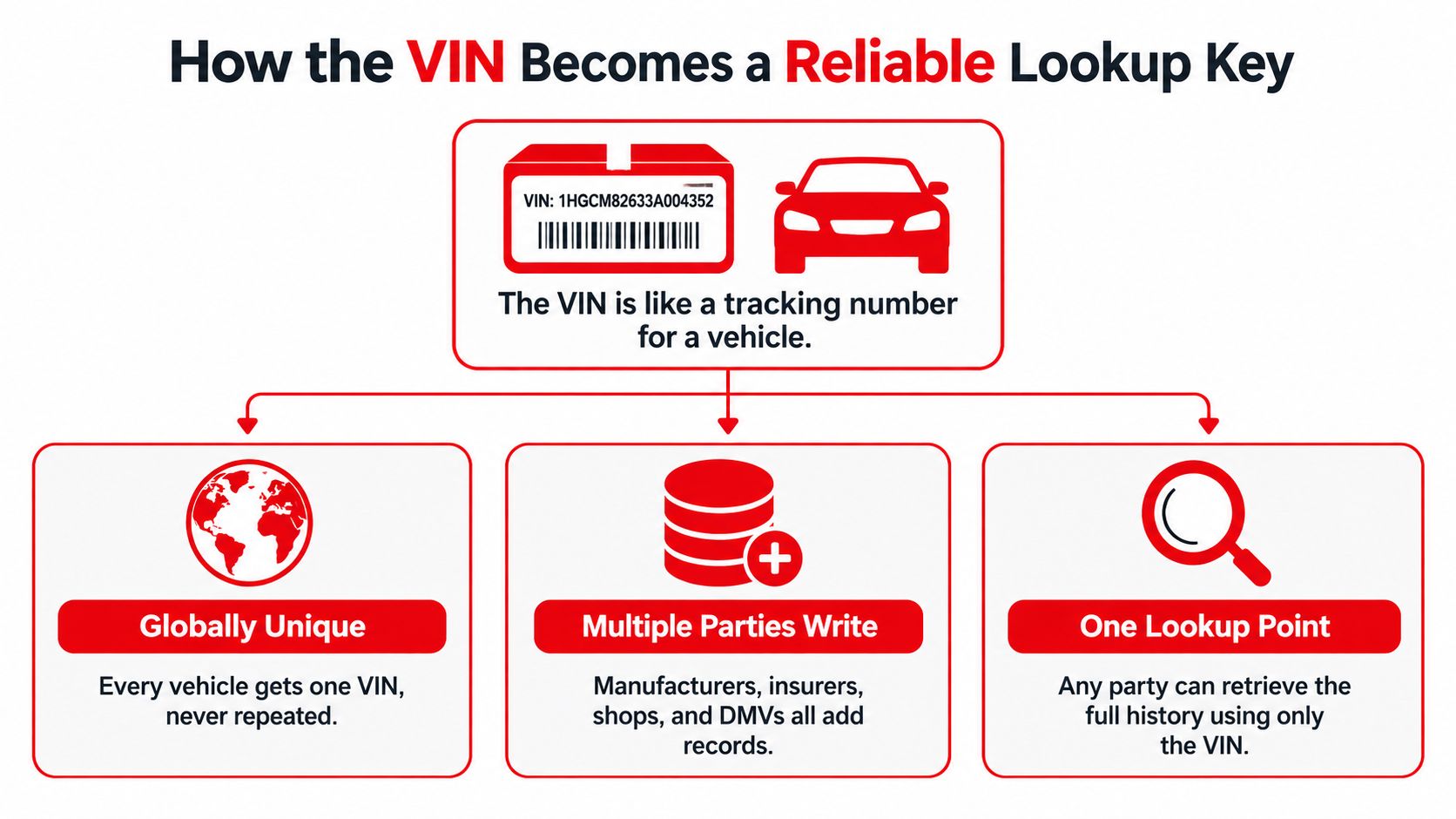
A VIN works much like a package tracking number. The tracking number identifies one parcel while carriers add scans from different locations. The VIN identifies one vehicle while manufacturers, state agencies, insurers, and other reporting organizations add records connected to that identifier.
The characters aren't random. A VIN can encode structured information including the manufacturer, vehicle attributes, model year, production plant, and serial sequence. Those details help a provider compare the submitted identifier with vehicle descriptions and records from different systems.
The fixed-format standard is especially useful for vehicles from 1981 onward. Earlier vehicles may use older identification formats that don't connect as cleanly across databases. For a shop, that means staff should be cautious when a pre-standard vehicle produces limited results. A thin record may reflect the vehicle's age or the available reporting systems, not an uneventful history.
Why exact entry matters
One mistyped character can send a lookup toward the wrong vehicle. The advisor should read the VIN from the vehicle itself rather than rely only on a text message, old invoice, or registration entry. A useful second reference for physical VIN verification is this guide to a.
The VIN should be compared with:
- The dashboard VIN visible through the windshield.
- The door-jamb label.
- The title or registration document.
- The VIN stored in the shop management record.
A mismatch doesn't automatically prove fraud. It does mean the shop should stop, verify the identity, and avoid attaching another vehicle's history to the job.
The identifier has limits
A VIN identifies the vehicle, not its complete condition. It can connect records across organizations, but it can't guarantee that every provider reported an event. The lookup is dependable as an identity key, while the information returned still depends on the sources that contributed records.
What a Vehicle History Report Actually Contains
A report is easier to use when each category has a defined purpose. Title data can reveal branding, mileage fields can reveal chronology, and recall information can identify a safety campaign. None of those categories should be treated as a complete mechanical assessment.
NMVTIS provides an important title-data backbone. Its states that the system contained 256 million records and represented approximately 99% of U.S. motor-vehicle title data. Participating junk, salvage, and insurance entities reported 16.9 million records, and 62% completed the reporting process with a final disposition such as crush, parts, retained, salvage, scrap, or sold.
Those figures show why title and disposition records can change a shop's risk assessment. They also show why broad coverage shouldn't be confused with total coverage.
| Report Category | What It Confirms | What It Cannot Prove |
|---|---|---|
| Title and brands | A state or reporting system recorded a title status or brand such as salvage, rebuilt, flood, or other designation. | It cannot prove that every physical repair was performed correctly or that a vehicle with no brand has never been damaged. |
| Damage and loss events | A participating source reported a collision, total loss, flood event, or other recorded damage. | It cannot show every unreported collision, private repair, or incident handled outside a reporting channel. |
| Odometer readings | The report contains mileage observations tied to particular events or title records. | It cannot prove that the current odometer is accurate without reconciliation against the vehicle and supporting documents. |
| Ownership and registration activity | Available title or registration records may show transfers, locations, or usage indicators. | It cannot guarantee a complete ownership story or explain how every owner maintained the vehicle. |
| Recalls and campaigns | A VIN may be associated with an open manufacturer safety campaign. | It cannot automatically prove that the campaign applies to the exact vehicle or that the remedy remains incomplete. |
Reading the categories as questions
A branded title should lead to questions about the event, repair quality, state inspection, corrosion, wiring, airbags, and legal status. An odometer entry should be placed in date order and compared with service invoices. A recall result should be checked with the manufacturer or dealer when applicability or completion is unclear.
NMVTIS is designed to connect title information across state systems. State agencies report the VIN, title description, title-brand information, the odometer reading disclosed when a title is issued, and later mileage information when available, as described in the.
The advisor's job isn't to read every line as a final answer. The job is to identify which entries require a physical check, a document request, or a customer conversation.
How a VIN-Based Report Gets Generated
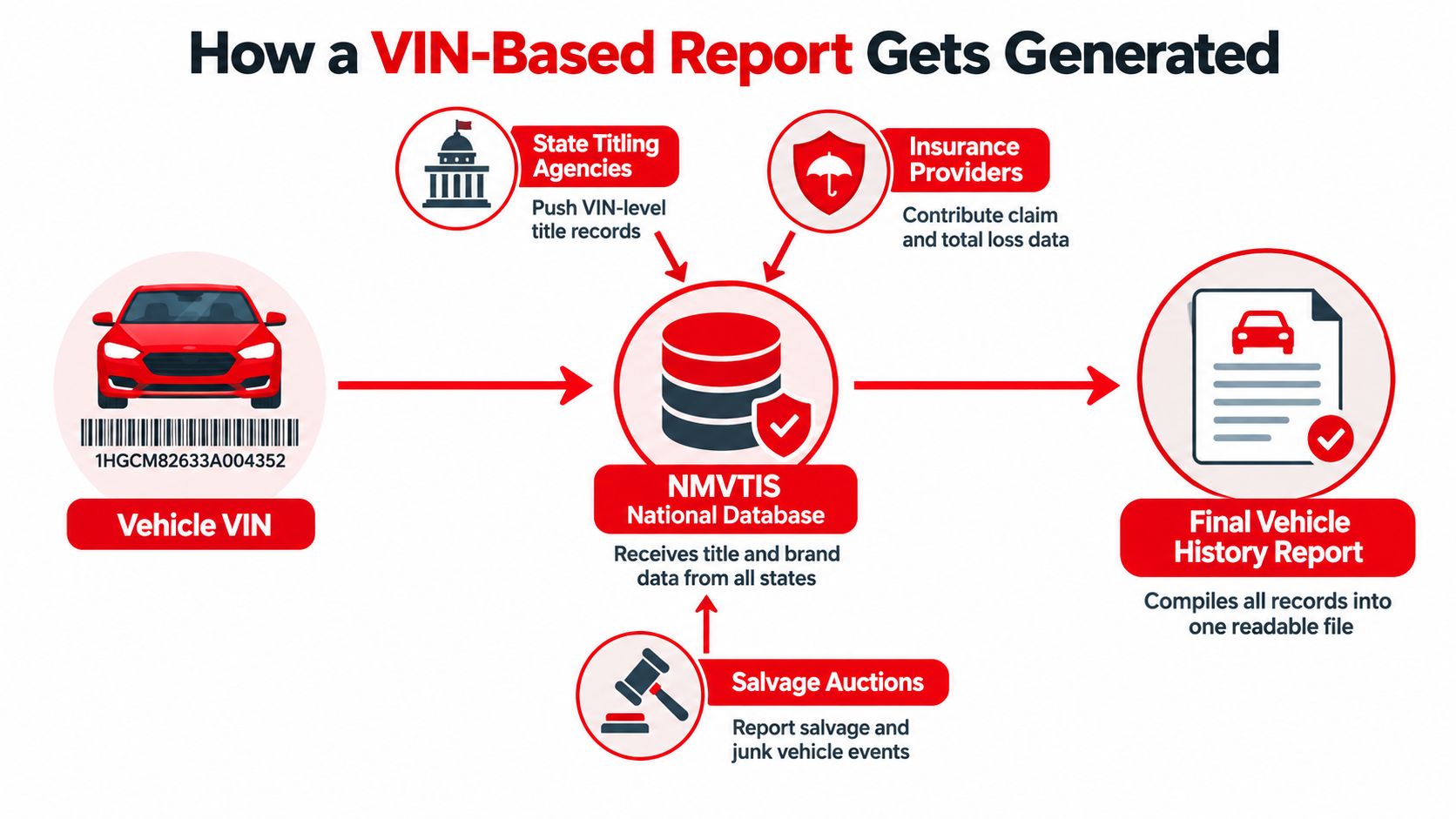
A vehicle arrives for an inspection, and the advisor enters its VIN into a lookup service. The provider decodes the identifier, searches connected sources, compares matching records, and organizes the findings into a report the shop can use. The result is a starting layer for verification, not a substitute for inspecting the vehicle.
Title and brand information may come from NMVTIS and state titling agencies. Available state records can include the VIN, title description, brands, and mileage information. Participating insurers may report total-loss, salvage, flood, or theft-related events. Auction and salvage organizations can add records about vehicle disposition or observed damage. Each source contributes a piece, much like separate pages that must be assembled before the vehicle's history makes sense.
Manufacturer and government systems add recall information. NHTSA's can show open safety recalls associated with a vehicle. A recently announced campaign may not yet include every affected VIN, and manufacturer-provided information may take time to appear.
The four actions behind the screen
A provider generally performs four connected actions:
- Decode: The system reads the VIN structure and associates it with vehicle attributes.
- Aggregate: It searches available title, insurance, auction, registration, recall, and related records.
- Validate: It compares identifiers and event details to reduce obvious mismatches.
- Surface: It presents alerts, dates, mileage observations, brands, and source details in a usable report.
The provider is organizing existing information, not conducting a new inspection. That explains why two services can produce different results. It also explains why a clean report cannot prove that no event ever occurred. A clean result should prompt the advisor to confirm the vehicle's present condition and ask focused follow-up questions.
Why source coverage affects the result
A collision repaired privately may never reach an insurer or reporting shop. A title brand may enter one system before another, and a recall campaign may be announced before every affected VIN is loaded. The report gains value by combining available records, while the shop verifies anything that affects safety, repairability, or customer authorization.
How a Repair Shop Uses the Report Day to Day
A report becomes valuable when it changes a decision at the service counter, in the inspection bay, or during vehicle delivery. Three common shop situations show the pattern.
Intake inspection after a vehicle arrives
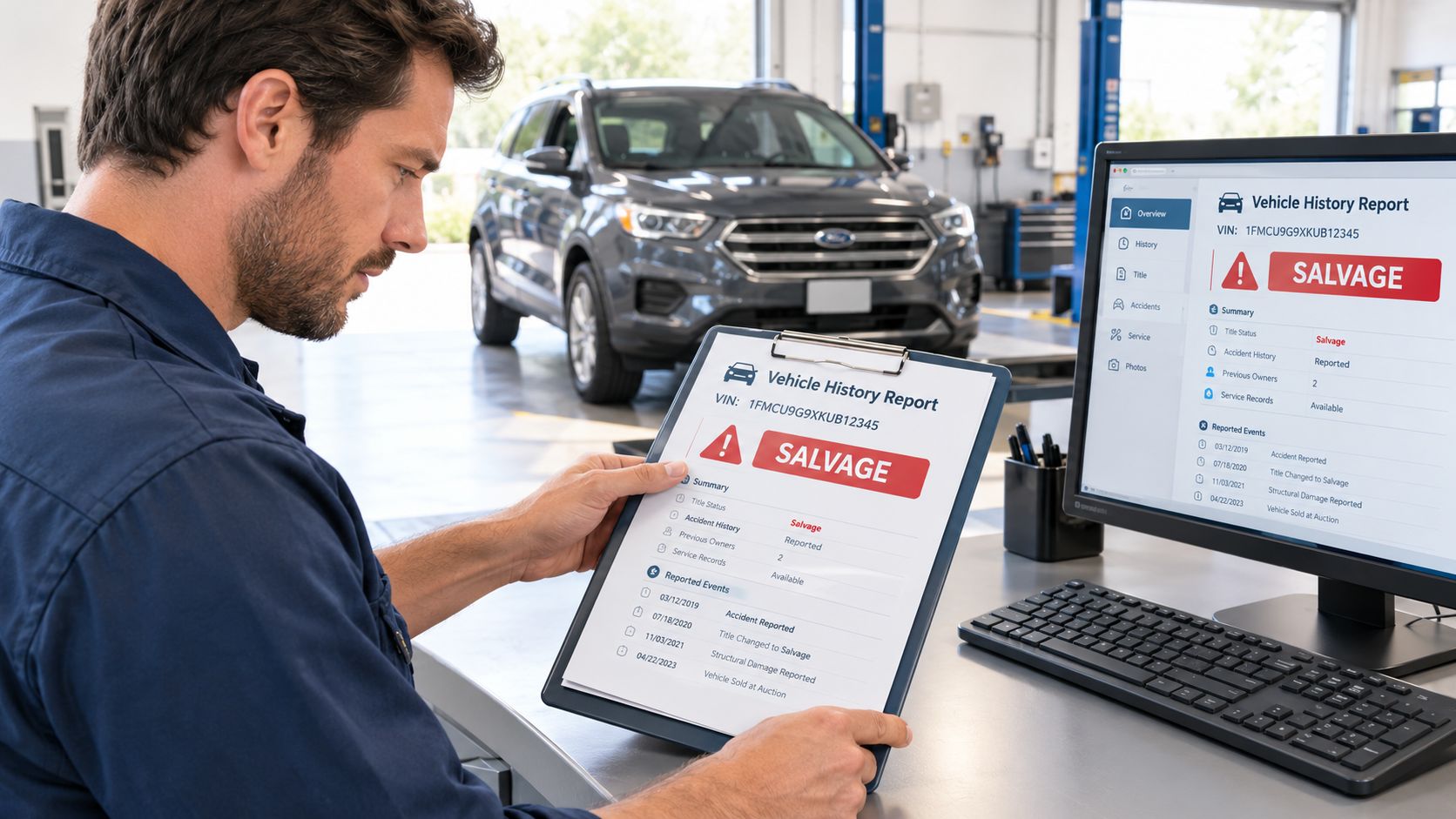
A customer brings in a recently purchased vehicle for suspension noise. The advisor runs the VIN and sees a salvage or flood indicator. The noise still needs diagnosis, but the original estimate now requires a wider inspection.
The technician checks corrosion in connectors, signs of water intrusion, harness routing, structural repair quality, airbag components, and scan-tool data. The advisor records the report result and photographs relevant findings before presenting work.
The action: a positive salvage or flood result triggers a documented risk inspection, not an automatic repair rejection and not a routine estimate based only on the customer's complaint.
A used-car sale that needs evidence
A shop preparing a vehicle for sale can place the report alongside its inspection findings, repair invoices, and photographs. The report may document available title history while the shop's own inspection demonstrates present condition.
That combination gives the buyer clearer information than either item alone. The history report addresses recorded events, while the technician's inspection addresses what exists on the vehicle now.
The action: attach the report and inspection to the vehicle record, then disclose relevant findings in plain language before the sale.
A mileage reading that moves backward
The advisor arranges every available mileage observation in chronological order. One later entry is lower than an earlier entry, or the gaps between readings appear inconsistent with the vehicle's documented use.
NHTSA recommends using vehicle history information to identify odometer discrepancies and defines odometer fraud as disconnecting, resetting, or altering an odometer to change the displayed mileage, as explained in its. Mileage affects maintenance intervals, timing-belt and fluid-service recommendations, warranty eligibility, and resale-risk disclosures.
The action: pause major recommendations that depend on mileage, reconcile the cluster with invoices and service data, document the discrepancy, and communicate it before authorization.
Practical rule: A report alert should change the inspection plan, not replace the inspection plan.
Why a Clean Report Does Not Mean a Clean Vehicle
A clean result usually means no relevant event was found in the searched sources. It doesn't mean no event occurred. An owner may have paid for a repair privately, used a non-reporting shop, handled a minor collision without an insurance claim, or repaired damage before the record reached a database.
That limitation matters because a vehicle with fewer entries may have fewer reporting connections, not a better history. Free federal checks have a narrow scope, and include incomplete accident history, incomplete mileage progression, limited ownership detail, and missing service records in NMVTIS title data.
The layered verification response
A shop can reduce the risk of over-trusting a clean report by adding independent checks:
- Verify identity: Compare the VIN on at least two physical locations, such as the windshield plate and door-jamb label, then compare it with the title and shop record.
- Check condition: Look for structural repair clues, inconsistent panel gaps, paint variation, corrosion, water intrusion, and scan-data concerns.
- Review mileage: Put every available reading in chronological order and flag a later reading that falls below an earlier one.
- Request evidence: Ask for repair invoices, inspection documents, ownership paperwork, and maintenance records when the report is silent.
- Document findings: Use photographs and technician notes to record discrepancies before work begins.
The report gives the team a reason to look closer. The inspection determines what the vehicle presents today.
A clean database result answers one question: what was reported? It doesn't answer every question about what happened.
How to Choose a Vehicle History Report Provider
A service advisor receives a vehicle with an unclear past and needs answers before recommending work. The right provider should match that decision, not just produce the longest report. Each provider type supports a different part of the shop's process.
| Provider type | Best use | Main limitation |
|---|---|---|
| NMVTIS-approved or low-cost provider | Checking title brands, salvage indicators, and available title-related mileage information. | The scope is narrower than a full commercial history product. |
| Paid consumer history service | Combining collision, ownership, auction, service, and other available records in one customer-facing report. | Coverage depends on the provider's sources and reporting relationships. |
| Shop-integrated lookup | Attaching VIN results and in-house service history to the vehicle record used by advisors and technicians. | The shop still needs outside verification for recall status, title documents, and physical condition. |
Criteria that matter at the counter
Coverage depth matters for rebuilt, imported, auction, fleet, and high-mileage vehicles. Ask which record categories the provider searches and which events may be absent. A clear list of limits is more useful than a general promise of completeness.
Recall latency matters because campaigns can be announced or updated after an earlier lookup. NHTSA allows searches for up to 100 VINs at a time, which can support batch checks during intake or routine service operations. The shop should still confirm the current result before making a safety recommendation through the.
Workflow fit affects whether the report changes daily work. A result left in an email or browser tab can disappear from view. A result attached to the vehicle record gives advisors and technicians a shared reference when the customer returns.
A practical recommendation
Use a title-focused source when the immediate question concerns a serious brand. Choose a broader paid report when event history will help explain findings to a customer or support a sale. Select an integrated lookup when the shop needs repeatable access, searchable records, and regular advisor use.
A clean report is a starting point for verification. The strongest provider states its coverage clearly and fits the shop's intake process.
Building a Repeatable VIN History Workflow in Your Shop
The workflow can begin with a simple sequence that every advisor follows:
- Run the VIN lookup when the vehicle arrives.
- Attach the result to the vehicle record.
- Verify the VIN in two physical locations.
- Place mileage observations in chronological order.
- Check recall applicability and remedy status.
- Document salvage, flood, theft, or title concerns.
- Complete the physical inspection and diagnostic tests.
- Recheck unresolved safety information before delivery.
The Federal Trade Commission recommends a vehicle history report before a used-vehicle purchase and identifies ownership history, accident history, repair records, and salvage status as possible report categories. It also states that a history report isn't a substitute for an independent inspection, as explained in its.
The same principle works in repair operations. The report identifies questions, the technician supplies condition evidence, and the advisor records the decision trail. A shop-integrated system can keep the VIN, customer, inspections, estimates, invoices, mileage, and future service history connected instead of leaving the report as a one-time attachment.
RedAppy offers customer and vehicle lookup by VIN alongside digital inspections, estimates, invoicing, scheduling, and service-history records, giving repair teams a practical place to connect history findings with daily work. Visit RedAppy to see how the platform can fit a VIN verification workflow, or contact the team through the website to discuss the process with the shop's current intake and delivery routines.
Ready to Transform Your Shop?
RedAppy helps auto repair shops create professional digital estimates with photos and videos, send them instantly via text or email, and get customer approvals in seconds. No credit card required to start.