
Vehicle Inspection Checklist: A Complete Guide for Car Owners and Shops
A vehicle inspection checklist is one of the most practical tools in automotive maintenance — yet most car owners never see a complete one, and many shops still run them on paper clipboards. According to the, vehicle defects and poor maintenance contribute to hundreds of thousands of crashes each year in the United States. A structured checklist turns a vague "look it over" into a repeatable, documented process that protects drivers and builds trust between shops and customers.
For car owners, knowing what a thorough inspection covers means you can ask better questions, spot upsells that aren't warranted, and understand exactly what you're paying for. For repair shops, a consistent inspection process is directly tied to revenue — digital inspections with photos have been shown to increase customer approval rates significantly compared to verbal estimates alone. The difference between a shop that earns loyalty and one that loses it often comes down to how well the inspection is communicated.
This guide covers every major category on a professional vehicle inspection checklist — from brakes and tires to fluid levels, lights, and underhood systems. It also explains how modern shop management platforms like RedAppy are replacing paper checklists with digital inspections that include photos, customer-facing reports, and real-time technician workflows.
Table of Contents
- What Is a Vehicle Inspection Checklist?
- What a Full Vehicle Inspection Covers
- Conclusion
- Frequently Asked Questions
What Is a Vehicle Inspection Checklist?
A vehicle inspection checklist is a structured document that guides the systematic examination of a vehicle's key systems and components. It ensures that nothing is overlooked during an inspection — whether the goal is routine maintenance, a pre-purchase evaluation, or compliance with a legal requirement. Technicians, car owners, fleet managers, and state-licensed inspectors all use checklists, though the scope and format differ by context.
A checklist converts an experienced technician's knowledge into a repeatable process that produces consistent, documented results.
It is important to distinguish between two common types of inspections. A routine maintenance inspection is typically performed during an oil change or service visit to assess overall vehicle health and flag upcoming repairs. A state-mandated safety inspection is a government-required examination that a vehicle must pass to remain legally registered and road-worthy — failure results in a rejection sticker and a deadline to make repairs.
Who Uses a Vehicle Inspection Checklist
Different users apply the checklist for different purposes:
- Car owners use simplified checklists to perform monthly self-checks and catch problems early
- Auto repair technicians follow shop-specific or software-generated checklists during service appointments to document findings and generate repair recommendations
- State inspectors (often licensed mechanics) work from legally defined criteria set by the state's Department of Transportation or Motor Vehicles
- Fleet managers use standardized checklists across large vehicle pools to track maintenance schedules and reduce downtime
- Pre-purchase inspectors apply comprehensive checklists to evaluate used vehicles before a sale
Routine Maintenance vs. State Safety Inspections
These two inspection types share some overlap but serve different purposes.
| Feature | Routine Maintenance Inspection | State Safety Inspection |
|---|---|---|
| Purpose | Identify wear, schedule upcoming service | Verify legal roadworthiness |
| Who requires it | Shop or owner discretion | State law |
| Frequency | Every service interval or annually | Annual or biennial, varies by state |
| Pass/fail outcome | No — produces recommendations | Yes — vehicle passes or fails |
| Documentation | Service record, estimate | Official inspection sticker or certificate |
| Scope | Comprehensive vehicle health | Defined by state statute |
According to the, vehicle defects and poor maintenance are contributing factors in a significant portion of road crashes each year — which is the core justification for mandated inspection programs.
The Role of Digital Inspection Tools
In practice, paper checklists are increasingly being replaced by digital inspection platforms in professional shop environments. These tools allow technicians to record findings, attach photos, and send results directly to customers via text or email — all from a tablet or smartphone. The shift to digital has measurable impact: shops using photo-rich digital inspections report higher customer approval rates on recommended repairs, because customers can see the problem rather than simply being told about it. Learn how digital inspections connect to repair orders and estimates.
What a Full Vehicle Inspection Covers
A full vehicle inspection covers every major system that affects safety, performance, and legal compliance. Inspectors work through a structured sequence — from the engine bay to the exhaust system — to identify worn, damaged, or non-compliant components before they become failures on the road.
Safety Systems
Safety systems are inspected first because their failure poses the most immediate risk to occupants and other road users. Inspectors follow a defined sequence across brakes, lighting, restraints, and visibility components.
Brakes Technicians measure brake pad thickness (minimum is typically 2/32" to 3/32" depending on state), inspect rotors for scoring or warping, check brake fluid condition, and test parking brake function. Hydraulic lines and calipers are examined for leaks or corrosion.
Lights and Signals Every exterior light is tested — headlights (high and low beam), taillights, brake lights, turn signals, hazard flashers, reverse lights, and license plate illumination. Inspectors verify that lenses are intact and output meets brightness standards.
Horn The horn must be audible at a minimum distance (commonly 200 feet) and must operate from the driver's position without modification.
Seatbelts and Restraints Each belt is checked for fraying, retraction function, latch engagement, and secure anchorage. In vehicles equipped with airbags, inspectors look for warning lights that indicate a fault in the supplemental restraint system.
Mirrors The driver's side mirror is mandatory in all states. Passenger and rear-view mirrors are checked for secure mounting, adjustment range, and absence of cracks that distort reflection.
Brake system defects are the single most common cause of vehicle inspection failure across U.S. state programs.
Mechanical and Under-Hood Components
Under-hood inspection covers the systems that keep the engine running reliably and safely. Inspectors check condition, not just presence — a cracked belt or low coolant level is as significant as a missing component.
| Component | What Inspectors Check |
|---|---|
| Engine | Oil condition and level, visible leaks, unusual noise or smoke |
| Battery | Terminal corrosion, secure mounting, charge voltage (typically 12.6V+ at rest) |
| Serpentine/Drive Belts | Cracking, fraying, glazing, correct tension |
| Radiator Hoses | Softness, bulging, cracking, clamp integrity |
| Coolant | Level, color (degraded coolant appears rusty or oily), freeze protection |
| Brake Fluid | Level in reservoir, color (dark fluid indicates moisture contamination) |
| Power Steering Fluid | Level and condition (where applicable; electric systems are noted) |
| Windshield Washer Fluid | Level and nozzle function |
| Air Filter | Restriction or heavy soiling that affects engine efficiency |
According to the, approximately 77% of vehicles on U.S. roads need some form of maintenance or repair — many of which are identified first during routine under-hood checks.
Tires, Wheels, and Suspension
Tires are the vehicle's only contact with the road, making this category critical to handling and stopping distance. Federal minimum tread depth is 2/32 inch, measured in the principal grooves of the tire. Many states fail a vehicle at this threshold; some technicians recommend replacement at 4/32" for wet-weather safety.
Tire Inspection Points
- Tread depth at multiple points across the tire width
- Sidewall condition — no bulges, cuts, or cord exposure
- Inflation pressure compared to the vehicle placard (located on the driver's door jamb)
- Uniform wear pattern (uneven wear indicates alignment or suspension problems)
- Matching tire sizes across each axle
Wheels Inspectors check for bent or cracked rims, missing lug nuts, and wheel bearing play. A loose wheel bearing produces a humming or grinding noise and can lead to wheel separation at speed.
Suspension and Steering Shocks and struts are tested for bounce rebound — a vehicle that continues to oscillate after a push-down test has worn dampers. Ball joints, tie rods, and control arm bushings are checked for excessive play. Steering components are evaluated for free play in the steering wheel and smooth operation through the full range of motion.
Exterior and Structural Integrity
Exterior inspection focuses on components that affect driver visibility, structural protection in a collision, and vehicle identification.
Windshield and Glass Cracks or chips in the driver's primary sightline (typically an 8.5" x 11" zone directly in front of the driver) are grounds for failure in most states. Minor chips outside this zone may pass depending on size.
Wipers Blades must clear the windshield without streaking or skipping. Wiper fluid nozzles must spray onto the glass, not into the air.
VIN Plate The Vehicle Identification Number plate must be present, legible, and unaltered on the dashboard. Altered or missing VINs trigger mandatory reporting in most jurisdictions.
Body and Frame Inspectors look for rust perforation in the floor, rocker panels, or frame rails that compromises structural integrity. Doors must open, close, and latch properly. Sharp or protruding body damage that could injure pedestrians may also result in a failure.
Emissions and Exhaust
Emissions testing is required in approximately 30 states, though the specific method varies. The outlines two primary approaches used by state programs.
OBD-II Diagnostic Scan For vehicles manufactured from 1996 onward, inspectors plug into the OBD-II port and read stored fault codes and readiness monitors. A vehicle fails if the check engine light is on, or if too many readiness monitors are incomplete (indicating a recent battery disconnect or reset).
Visual Exhaust Inspection Inspectors check for visible smoke (blue smoke indicates burning oil; black smoke indicates a rich fuel mixture) and verify that the catalytic converter and exhaust system are intact, properly mounted, and free of leaks.
Tailpipe Testing Older vehicles without OBD-II systems are tested with a probe inserted into the tailpipe to
Safety Systems
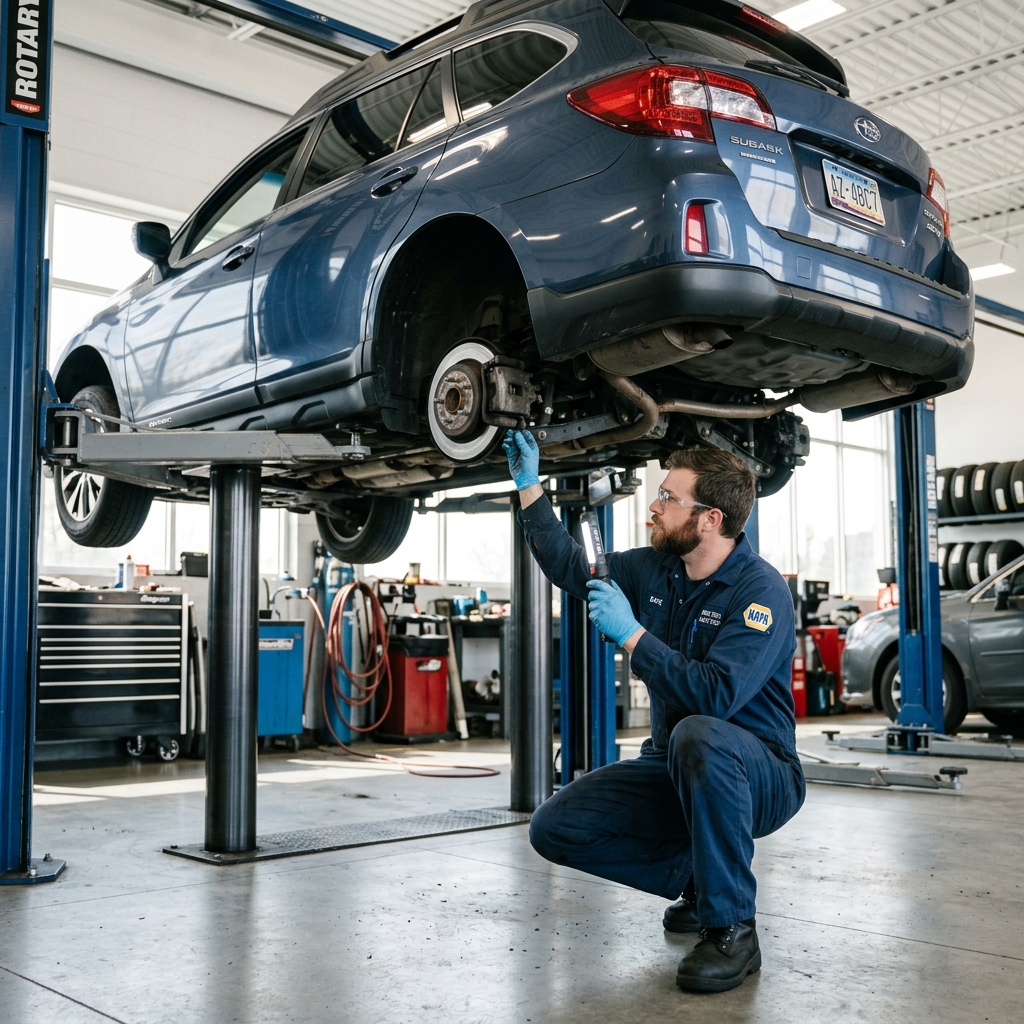
Brakes, lights, horn, seatbelts, and mirrors are the highest-priority items in any vehicle inspection because their failure directly increases the risk of collision or injury. State safety inspections treat these components as non-negotiable — a single deficient item in this category is typically enough to fail the entire inspection.
Brakes
Brake performance is the most scrutinized safety system in both routine and state-mandated inspections. Inspectors check brake pad thickness, rotor condition, brake fluid level, and the function of the parking brake. Most states set a minimum brake pad thickness of 2/32 to 3/32 of an inch before a vehicle is considered unsafe. Rotors are examined for scoring, warping, and minimum thickness specifications set by the manufacturer.
- Brake pads (front and rear): measured for remaining material
- Rotors and drums: checked for surface condition and minimum thickness
- Brake lines and hoses: inspected for leaks, cracks, or corrosion
- Parking/emergency brake: tested for holding ability on a grade
- Brake fluid: checked for level and contamination
Worn brake pads increase stopping distances significantly — according to the, brake-related issues are a contributing factor in approximately 22% of vehicle crashes linked to mechanical failure.
Lights
Every exterior light is tested for function, aim, and output. This includes headlights (low and high beam), taillights, brake lights, turn signals, hazard lights, reverse lights, and license plate illumination. Inspectors also check that headlights are properly aimed — misaligned headlights reduce forward visibility and can blind oncoming drivers.
| Light Component | What Is Checked |
|---|---|
| Headlights | Function, aim, lens clarity, beam output |
| Taillights | Function, lens condition |
| Brake lights | Activation on pedal press |
| Turn signals | Front and rear, correct flash rate |
| Reverse lights | Activation in reverse gear |
| License plate light | Illumination of plate |
Horn
The horn is checked for audibility and consistent operation. In practice, this is one of the fastest checks on the list — but a non-functioning horn is a legitimate inspection failure in most jurisdictions because it is a required warning device under federal motor vehicle safety standards.
Seatbelts
All seatbelts in the vehicle are tested for latching, retraction, and webbing integrity. A seatbelt that does not latch securely, fails to retract, or shows frayed webbing will result in a failed inspection. According to NHTSA, seatbelts reduce the risk of death in a front-seat crash by 45% for car occupants — making this check one of the most consequential on the list.
- Buckle and latch mechanism: must engage and release correctly
- Retractor mechanism: belt should retract fully when not in use
- Webbing: inspected for cuts, fraying, or significant wear
Mirrors
Inspectors verify that the driver has adequate rearward visibility through the required mirrors. At minimum, a vehicle must have a functioning rear-view mirror and at least one exterior side mirror. Both are checked for secure mounting, adjustability, and absence of obstructing damage. Cracked or missing mirrors that compromise visibility are a common cause of inspection failure.
Mechanical and Under-Hood Components
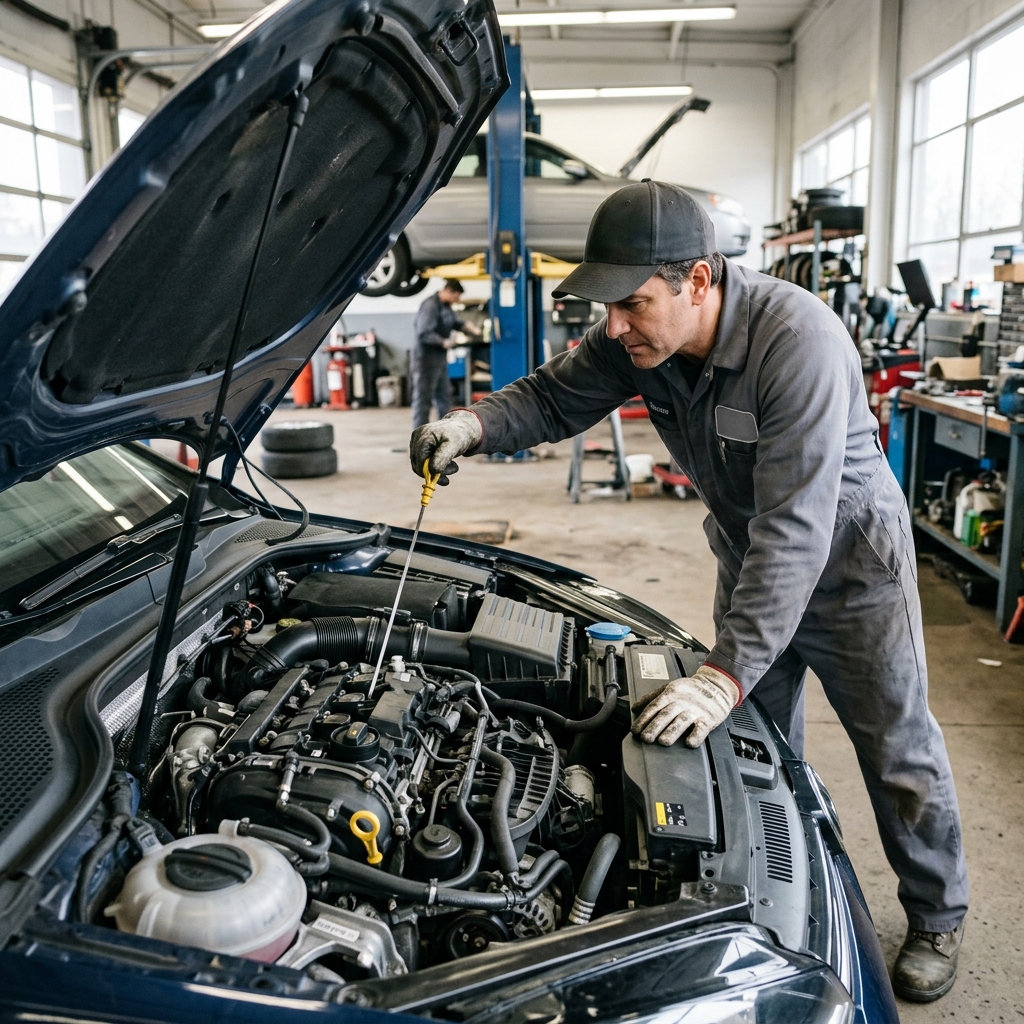
The under-hood inspection examines the systems that keep the engine running, prevent overheating, and supply the electrical power the vehicle needs. Technicians follow a standard sequence to check each component systematically before moving to the next.
Engine Oil
Oil level and condition are checked with the dipstick. Low oil signals a leak or consumption problem. Dark, gritty oil indicates it is overdue for a change. According to the, engine failure from neglected oil maintenance is one of the most common — and most preventable — causes of major repair costs.
A quart of oil costs around $5. An engine replacement can exceed $5,000. Oil condition is one of the highest-value checks on any inspection list.
Coolant and Cooling System
Technicians check the coolant level in the reservoir and inspect the radiator, hoses, and thermostat for signs of leaks or deterioration. Coolant should be tested for freezing point and pH, as degraded coolant loses its corrosion-inhibiting properties. Hoses that feel soft, brittle, or swollen are at risk of failure.
Battery and Charging System
Battery terminals are inspected for corrosion, and voltage is tested under load. A fully charged battery should read approximately 12.6 volts at rest. The alternator output is typically checked in the range of 13.7–14.7 volts while the engine runs. A battery that tests below specification may fail to start the vehicle in cold weather or after periods of inactivity.
Belts
| Belt Type | What Inspectors Look For | Consequence of Failure |
|---|---|---|
| Serpentine belt | Cracking, fraying, glazing, tension | Loss of power steering, alternator, A/C |
| Timing belt | Age, mileage, manufacturer interval | Engine damage (interference engines) |
| Drive belts | Wear, slippage, alignment | Accessory failure |
Timing belt replacement intervals vary by manufacturer — commonly between 60,000 and 100,000 miles — and failure on an interference engine can bend valves and destroy the engine.
Fluid Levels
A complete under-hood inspection includes all major fluids:
- Brake fluid — level and color (dark fluid absorbs moisture and lowers boiling point)
- Power steering fluid — level and condition
- Transmission fluid — level, color, and odor on dipstick-equipped units
- Windshield washer fluid — level only
In practice, fluid conditions often reveal underlying problems before symptoms appear. Milky or foamy oil, for example, can indicate a blown head gasket allowing coolant into the oil system.
Air Filter
The engine air filter is visually inspected for dirt, debris, and restriction. A clogged air filter reduces combustion efficiency and fuel economy. The notes that keeping engine components properly maintained — including air intake — supports optimal fuel efficiency.
Engine Condition — Visual Check
Technicians scan the engine bay for active leaks (oil, coolant, power steering fluid), damaged wiring, loose vacuum hoses, and any components that appear out of place or improperly secured. Burn marks or heat discoloration on wiring can indicate electrical faults that require further diagnosis.
Under-hood findings frequently drive the repair order. A single inspection that catches a failing water pump or a cracked serpentine belt can prevent a roadside breakdown and a much larger tow-and-repair bill.
Tires, Wheels, and Suspension
Tires, wheels, and suspension form the critical interface between a vehicle and the road. Inspectors evaluate tread depth, inflation pressure, physical condition, and the structural components that control ride and handling.
Tread Depth Standards
The legal minimum tread depth in the United States is 2/32 of an inch, as established by federal safety guidelines. Most states use this threshold as the pass/fail cutoff for safety inspections. However, the recommends replacing tires at 4/32" for drivers who frequently encounter wet roads, since stopping distances increase significantly below that level.
Tread depth is measured with a tread depth gauge or the penny/quarter test:
- Penny test (2/32"): Insert a penny into the tread groove with Lincoln's head facing down. If you can see the top of his head, the tire is at or below the legal minimum.
- Quarter test (4/32"): Use a quarter the same way. If Washington's head is visible, tread is low enough to consider replacement.
Tire Pressure and Condition
Tire pressure is checked against the vehicle manufacturer's specification, found on the door jamb sticker — not the maximum pressure printed on the tire sidewall. According to NHTSA, approximately 32% of passenger vehicles are driven with at least one underinflated tire, which increases blowout risk and reduces fuel efficiency.
Inspectors also examine each tire for:
- Sidewall bulges or cracks, which indicate structural failure
- Uneven tread wear patterns (center wear suggests overinflation; edge wear suggests underinflation; one-sided wear points to alignment problems)
- Exposed belts or cords
- Plugged or improperly repaired punctures in the sidewall
A tire can meet minimum tread depth requirements and still fail inspection if sidewall damage is present — tread depth alone does not confirm roadworthiness.
Wheel and Bearing Inspection
Wheel condition is checked visually for cracks, bends, and missing lug nuts. All lug nuts must be present and properly torqued to the manufacturer's specification. A missing or loose lug nut is a straightforward fail item in most state programs.
Wheel bearings are assessed by lifting the vehicle and checking for play:
- Grasp the tire at the 12 o'clock and 6 o'clock positions and push/pull to detect vertical play (indicates worn wheel bearing)
- Grasp at 9 o'clock and 3 o'clock and repeat for horizontal play
- Spin the wheel by hand and listen for grinding or roughness
Worn wheel bearings affect steering precision and, if left unaddressed, can lead to wheel separation.
Shocks, Struts, and Suspension Components
Shock absorbers and struts dampen the oscillation of the suspension springs. A vehicle with worn shocks takes longer to stop — according to some estimates, worn shocks can increase stopping distances by up to 10 feet at highway speeds.
Inspectors check shocks and struts by:
- Performing a bounce test: pressing down firmly on each corner of the vehicle and releasing; more than one to two oscillations suggests a worn damper
- Visually inspecting for oil leaks on the shock body
- Checking for physical damage or bent strut housings
The broader suspension inspection covers:
| Component | What Is Checked | Common Failure Sign |
|---|---|---|
| Ball joints | Play and movement under load | Clunking, uneven tire wear |
| Tie rod ends | Horizontal play at the wheel | Loose steering feel |
| Control arm bushings | Cracking, deterioration | Vibration, pulling |
| Sway bar links | Physical condition, looseness | Rattling over bumps |
| CV axle boots | Cracking, grease leakage | Clicking during turns |
In practice, suspension wear is often gradual. Owners may not notice degraded handling until a technician demonstrates the play during an inspection. Checking these components as part of a routine maintenance schedule — typically every 12,000 to 15,000 miles — catches wear before it creates a safety risk or causes secondary damage to related parts.
Conclusion
A vehicle inspection checklist serves one fundamental purpose: keeping drivers, passengers, and everyone else on the road safe. When used consistently, it also protects vehicle owners from costly breakdowns and helps shops deliver documented, trustworthy service.
Regular inspections catch developing problems before they become dangerous or expensive — the checklist is what makes that process reliable and repeatable.
The sections above outlined every major system a thorough inspection addresses, from brake pad thickness and tire tread depth to battery condition, fluid levels, and emissions compliance. That coverage reflects the full scope of what certified technicians examine, and what state programs require.
A few figures underline why this matters. According to the, vehicle defects and poor maintenance contribute to approximately 44,000 crashes annually in the United States. The Federal Highway Administration reports that roughly 1 in 5 vehicles on the road has at least one safety-related defect that the driver is unaware of.
For car owners, the practical takeaway is straightforward:
- Use the master checklist provided in this guide as a baseline for your own pre-trip and seasonal reviews.
- Schedule a professional inspection at least once per year, or before any long-distance travel.
- Address flagged items promptly — deferred maintenance rarely gets cheaper or safer over time.
- Keep records of each inspection, including photos and technician notes, as documentation of vehicle condition.
For shop owners and technicians, a standardized checklist is the foundation of a consistent inspection process. Digital inspection tools — like those built into platforms such as RedAppy — allow shops to document findings with photos, generate estimates directly from inspection results, and give customers a clear, transparent view of their vehicle's condition. That transparency builds the trust that drives repeat business and referrals.
State compliance adds another layer of importance. Whether your jurisdiction requires annual safety inspections, biennial emissions checks, or a combined program, the checklist ensures no required item is overlooked. Missing a mandatory inspection or failing to address a cited defect can result in fines, registration suspension, or liability exposure in the event of an accident.
The checklist in this guide is designed to cover the broadest set of inspection criteria in use across North America. Specific thresholds — such as minimum brake pad thickness or the 2/32" tire tread standard — reflect widely accepted standards, but consult your state DMV or DOT to confirm the exact requirements that apply in your jurisdiction.
A checklist only delivers value when it is actually used — printed and posted in the service bay, loaded into a digital inspection tool, or reviewed before every drive.
Consult a certified technician for any system you are uncertain about. Professional inspection equipment, lift access, and diagnostic tools reveal conditions that a visual walkaround simply cannot. The checklist is the guide; the trained technician is the authority.
Frequently Asked Questions
What should I include on my vehicle inspection checklist?
A vehicle inspection checklist should cover tires (tread depth and pressure), brakes, lights (headlights, taillights, turn signals), fluid levels (oil, coolant, brake fluid), windshield wipers, battery condition, belts and hoses, and steering and suspension components. Safety-critical systems like seat belts and mirrors should also be included. Most comprehensive checklists follow the same categories used by professional mechanics during routine service appointments.
What does a full car inspection consist of?
A full car inspection typically covers 30–50 inspection points, including the engine, transmission, exhaust system, brakes, tires, suspension, steering, electrical systems, and all exterior and interior lights. Technicians also check fluid levels, belts, hoses, filters, and the battery. Most dealerships and service centers use a multi-point inspection process that takes between 30 minutes and one hour to complete.
What do you need to bring for a car inspection in PA?
In Pennsylvania, you generally need to bring your vehicle registration and proof of insurance to pass a state inspection. The vehicle itself must be present at a licensed PA inspection station, and you'll need to pay the inspection fee, which is capped by the state at $35 for a combined safety and emissions inspection. No appointment is strictly required, but calling ahead to a licensed station is recommended.
What will fail a vehicle inspection?
Common reasons a vehicle fails inspection include worn brake pads or rotors, tires below the minimum 2/32-inch tread depth, broken or non-functioning lights, cracked windshields obstructing the driver's view, and excessive exhaust emissions. Faulty steering or suspension components, inoperative seat belts, and a failed check engine light can also result in rejection. Addressing these issues before your inspection appointment can save time and reinspection fees.
Ready to Transform Your Shop?
RedAppy helps auto repair shops create professional digital estimates with photos and videos, send them instantly via text or email, and get customer approvals in seconds. No credit card required to start.