
Vehicle Lookup by VIN: A Practical Guide for Auto Shops
A customer arrives for a brake inspection, and the service advisor enters the VIN from a blurry photo. The lookup returns a similar model, the parts catalog suggests the wrong brake configuration, and the mistake surfaces only after the vehicle reaches the technician's bay. In a busy shop, that single transcription error can disrupt scheduling, parts ordering, customer communication, and delivery promises.
A reliable vehicle lookup by VIN process prevents that chain reaction. It confirms vehicle identity, supports parts research, helps staff check safety recalls, and gives technicians a dependable starting point for service history. The key is to treat the VIN as operational data that needs validation, not as a magic key that guarantees a complete vehicle record.
Table of Contents
- Why VIN Lookups Matter in Your Shop
- How to Locate and Decode a VIN Correctly
- Free vs Paid VIN Lookup Services
- What Data to Expect from a VIN Report
- Integrating VIN Lookups into Shop Workflows
- Legal, Privacy, and Fraud Considerations
- Best Practices and Troubleshooting Tips
Why VIN Lookups Matter in Your Shop
A VIN is a unique 17-character vehicle identifier that lets a decoder query information encoded in the vehicle. The standardized format made machine-readable identification possible across manufacturers, allowing systems to extract attributes such as make, model, model year, engine type, and assembly plant from one code. The history of that standardization, including the move to the 17-character format, is documented in this overview of.
For a service advisor, the value appears before the repair order is written. A correct lookup can distinguish closely related trims, identify an engine configuration, and reduce the chance of ordering a part for the wrong platform. It can also help staff check safety-related information through the, where the agency explains that the VIN can be used to search for open recalls.
Practical rule: A VIN lookup should confirm the vehicle before the shop commits to parts, labor assumptions, or customer promises.
The operational risk comes from treating a returned result as automatically correct. A missing field doesn't mean the vehicle lacks that feature. NHTSA warns that a missing decoded value means the agency doesn't have data for that variable. If an advisor reads a blank engine or equipment field as “not equipped,” the team may build an inaccurate estimate.
Why standardization helps
The VIN format gives staff a common language across manufacturers. The first three characters identify the World Manufacturer Identifier, characters four through nine form the Vehicle Descriptor Section, and characters ten through seventeen form the Vehicle Identifier Section, which includes model-year, plant, and sequential production information. The structure is useful, but each manufacturer still applies its own coding conventions inside those sections.
That distinction matters in a mixed-brand repair facility. A decoder can provide a structured identity, while the manufacturer catalog, service information, and technician inspection determine what the vehicle needs. Advisors who want a general introduction before building a shop process can, then apply the same validation discipline at check-in.
How to Locate and Decode a VIN Correctly
A vehicle is already in the bay, but the VIN in the customer's text message is missing a character. Stop the parts search there. The dependable workflow starts with the vehicle itself, then confirms the paperwork. NHTSA says the VIN is typically visible through the lower-left windshield area. It may also appear on registration and insurance documents. Check the door-jamb label and title when the dashboard plate is hard to photograph.
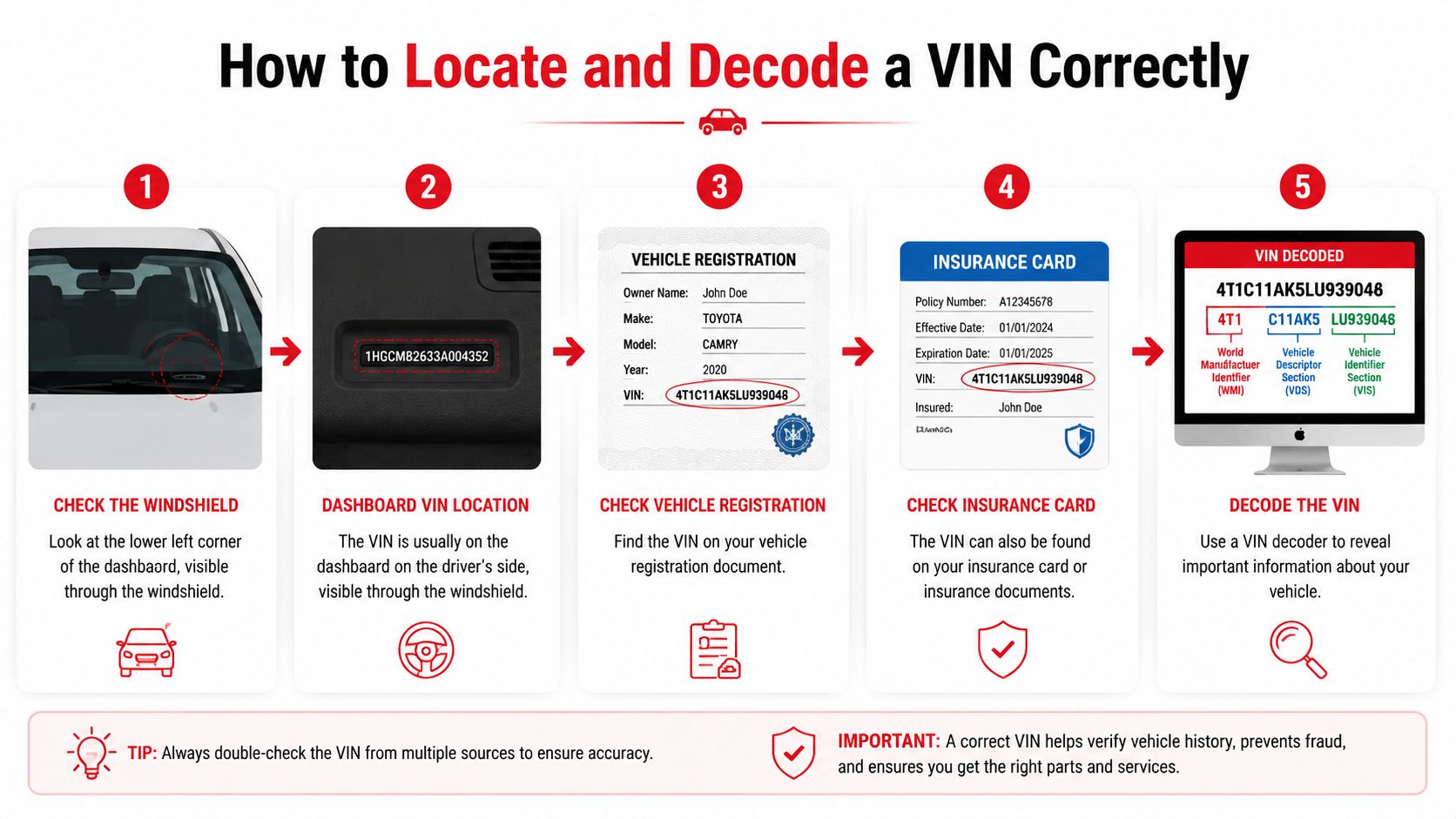
A five-step check-in method
Capture the complete string. Record all 17 characters. A partial VIN or license plate is not enough for vehicle-specific decoding.
Compare physical and paper records. Match the windshield VIN with registration, insurance paperwork, or the door-jamb label. If they differ, pause the lookup and confirm which record belongs to the vehicle in the bay.
Normalize the entry. Remove spaces and accidental punctuation, then check for invalid characters. Blurry photos often cause transcription errors, especially where letters and numbers look alike.
Validate the check digit. The ninth position serves as a check digit in the North American VIN structure. It helps software identify an incorrectly entered VIN before the shop uses the returned information.
Decode and inspect the returned fields. Use the to review model year, make, body, engine, plant, and country of origin. A successful query still needs a physical comparison with the vehicle and the repair order.
NHTSA reports decoding confidence of about 99% for model year 1995 and newer vehicles for most major brands, compared with about 60% to 65% for vehicles from 1980 through 1994. Those figures come from the agency's VIN decoder guidance. Older inventory needs more manual confirmation, particularly when a shop database contains both classic vehicles and newer service records.
Common failures include incomplete VINs, invalid characters, incorrect model-year codes, and blank returned fields. A blank field is missing data, not proof that the vehicle lacks the feature. Check the manufacturer catalog, service information, or the vehicle itself before approving parts or labor based on that field.
Free vs Paid VIN Lookup Services
Free tools are useful when the shop needs a basic identity check or a recall search. Paid services may add broader history, but more data doesn't automatically make a report complete or suitable for every repair decision. The right choice depends on whether the shop is decoding a vehicle for service, screening a used vehicle, or maintaining a long-term customer record.
| Service Type | Data Included | Accuracy | Best For |
|---|---|---|---|
| Free regulatory decoder | Structured VIN fields such as make, model year, body, engine, plant, and country of origin | Stronger for newer vehicles and major brands, with lower confidence for older vehicles | Confirming identity before parts and service research |
| Free recall lookup | VIN-linked safety recall information | Useful for records present in the agency database | Flagging open safety-related campaigns |
| Free theft or salvage screening | Participating database records for theft and salvage indicators | Limited by database coverage and record quality | Initial screening, not a complete history verdict |
| Paid vehicle-history service | May include title, accident, odometer, registration, and other contributed records | Varies by provider and source coverage | Used-vehicle assessment and broader history review |
| Shop management workflow | VIN-linked customer, vehicle, service, inspection, and repair-order data | Depends on the quality of the original entry and connected sources | Repeating the correct identity throughout the repair cycle |
The NHTSA vPIC decoder is a practical first step because it provides structured decoding from a regulated public source. The is appropriate for identity confirmation, but it shouldn't be treated as a full title or accident report.
NICB's free VINCheck can support theft and salvage screening, yet the organization warns that its database isn't independently verified and may omit vehicles or contain duplicate or incorrectly entered VINs. That limitation is explained on the. A clean result means only that the relevant participating database didn't show a matching record.
Paid services can be worthwhile when the business evaluates trade-ins, advises customers buying used vehicles, or needs history beyond basic decoding. They still require source awareness. A paid report can organize available records, but it can't reveal information that was never reported or entered.
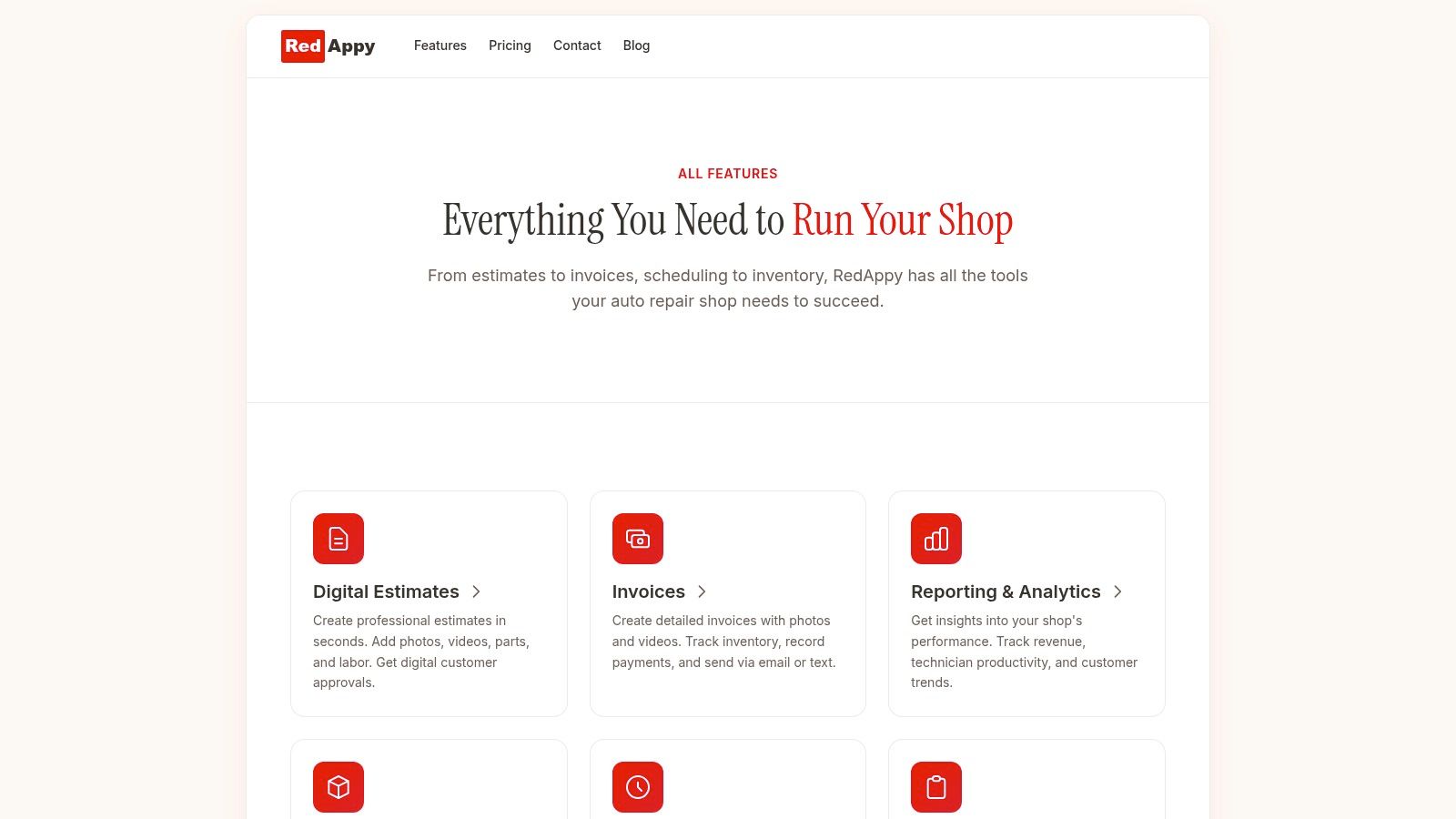
For repair operations, integration often matters more than report length. A lookup that fills the vehicle record, attaches service history, and follows the repair order is more useful than a separate report that an advisor must copy manually into several systems. RedAppy can be considered in that workflow because its vehicle and customer lookup supports VIN-based records and service-history access within shop management operations.
What Data to Expect from a VIN Report
A VIN report contains several layers, and each layer answers a different shop question. Decoding tells the team what the vehicle is supposed to be. History records may indicate what happened to it. Recall information identifies certain safety campaigns. None of those layers replaces a physical inspection or proves that a vehicle is safe.
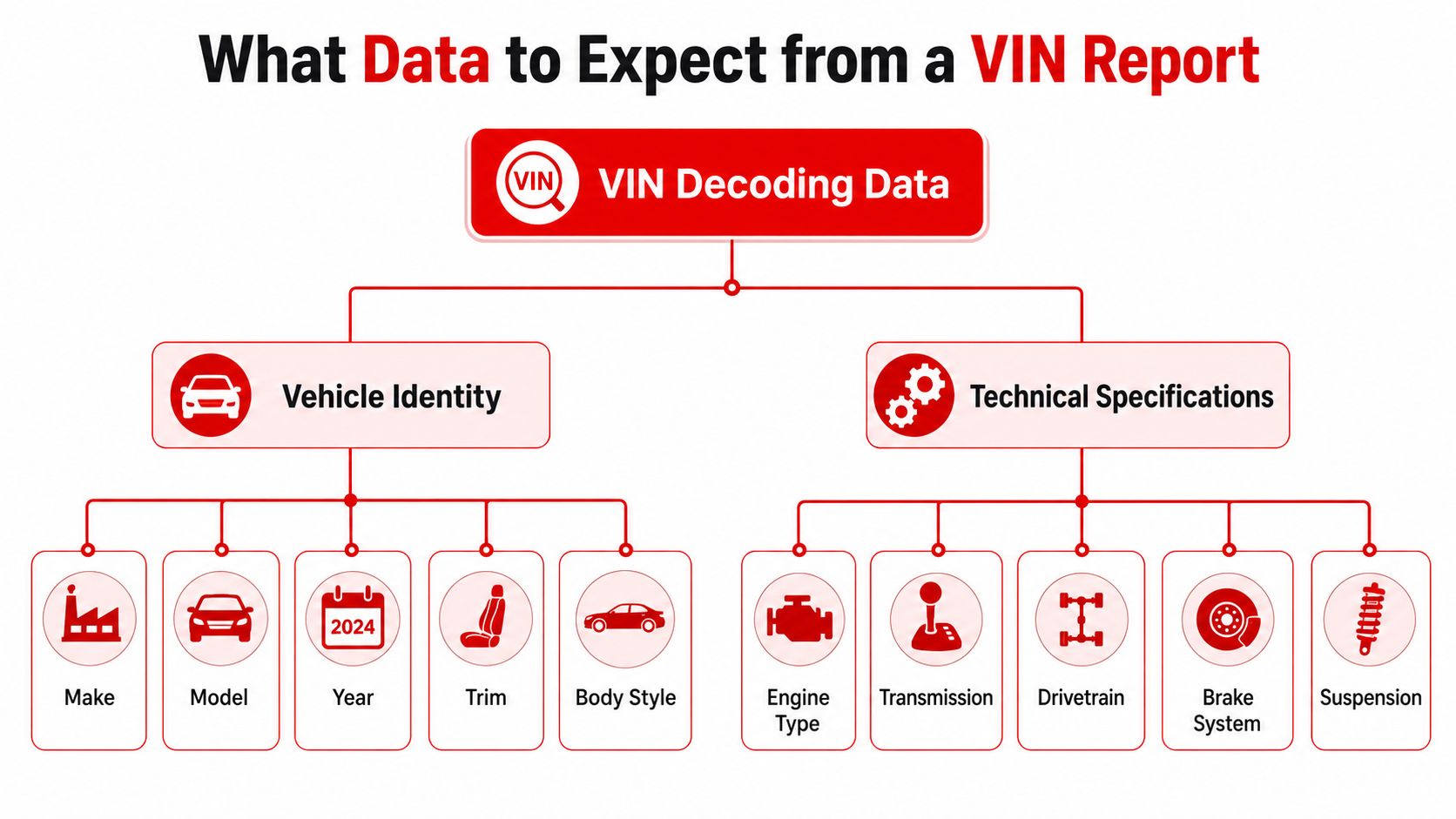
Identity and technical specifications
The first useful group is the decoded vehicle identity. Make, model, model year, body style, engine, plant, and country of origin can help an advisor select the correct catalog path. The technician can then verify the physical configuration, because factory coding and current vehicle condition aren't the same thing.
A parts request for a brake component illustrates the distinction. The lookup may identify the model and engine, but brake package, production changes, or aftermarket modifications may still require a visual check, measurement, or manufacturer catalog confirmation.
History and safety indicators
A broader report may include title brands, accident entries, odometer records, registration information, or ownership-related flags, depending on the provider. These records help a shop ask better questions. A salvage notation can prompt a closer inspection of structure and wiring, while an odometer inconsistency can affect how the advisor describes maintenance intervals.
Recall status deserves separate handling. The NHTSA recall system is designed for safety-related information, so an open recall should be recorded clearly and communicated without implying that every repair facility can complete the campaign. The shop should identify the campaign and direct the customer to the appropriate authorized repair channel when required.
A clean lookup is a screening result, not a mechanical inspection, title guarantee, or safety certificate.
The NICB limitation described earlier is important here. A report may look reassuring while missing title-brand issues, accident history, odometer rollback, or records outside the participating databases. The correct response is layered verification, not automatic approval or rejection.
A service advisor should separate decoded facts, reported history, and shop observations in the repair record. That separation prevents a database entry from being presented as a technician finding and gives the customer a clearer explanation of what the shop knows, what it suspects, and what still needs inspection.
Integrating VIN Lookups into Shop Workflows
A VIN lookup works best when it happens at the first controlled point of contact. The service advisor captures the identifier during check-in, validates it before opening the repair order, and links the result to the customer and vehicle record. The technician then works from the same identity instead of retyping the VIN from a handwritten note.
A practical workflow from check-in to checkout
At the service desk, staff should capture the VIN from the vehicle or a verified document. If the shop has barcode-scanning capability, scanning reduces manual entry, but the advisor should still compare the result with the physical VIN and registration record.
The next step is to decode the VIN and review the returned fields. The advisor should flag missing information rather than filling blanks with assumptions. The validated vehicle record can then support parts research, digital inspections, estimate creation, and customer updates.
When the technician begins work, the VIN should already be attached to the digital inspection. Photos, diagnostic notes, measurements, and recommended services then remain associated with the correct vehicle. That continuity is especially useful when a customer returns with a recurring concern or when another advisor handles the next visit.
A Kanban-style digital shop board can show the job moving from check-in to inspection, estimate approval, parts delay, repair, quality control, and delivery. The VIN doesn't replace those status controls. It gives every person viewing the job a consistent vehicle identity.
Make the process repeatable
Training should focus on the moments when errors occur:
- At intake: Never create a vehicle record from an incomplete or unverified VIN.
- Before ordering: Compare decoded identity with the catalog result and the vehicle's visible equipment.
- During inspection: Keep VIN-linked photos and findings in the same repair record.
- Before delivery: Confirm that the invoice and service history point to the correct vehicle.
A shop management platform can connect these steps so the advisor doesn't copy the same identifier into multiple disconnected systems. RedAppy is one option that combines customer and vehicle lookup by VIN with service history, digital inspections, estimates, invoicing, parts workflows, scheduling, and a digital shop board. The important operational requirement is consistency, regardless of which platform a shop selects.
Legal, Privacy, and Fraud Considerations
The most dangerous VIN mistake isn't always a mistyped character. It can be a correct lookup that gets interpreted as a complete answer.
A clean theft or salvage result doesn't prove that a vehicle has never been damaged, cloned, misrepresented, or assigned a problematic title. NICB states that its VINCheck database isn't independently verified, may miss many stolen or total-loss vehicles, and can include duplicate or incorrectly entered VINs. A shop that tells a customer “the vehicle is clean” based on one result creates avoidable trust and liability problems.
Protect the customer record
VINs are vehicle identifiers, but they often sit beside names, addresses, registration details, invoices, photos, and payment records. Staff should limit access to people who need the information for service, avoid posting VIN images publicly, and follow the shop's retention and deletion policies.
Greater VIN visibility helps legitimate buyers compare information, but it also gives scammers material they can copy and reuse. Vehicle cloning, fraudulent listings, and fake vehicle-history-report schemes all make source selection important. A seller who pressures a customer or shop to use a suspicious report page should be treated as a fraud warning, not as a routine administrative request.
Use trusted sources, record what each source actually confirms, and never promise more than the report can support.
A practical privacy review should cover where VIN data enters the business, which employees can view it, how long records remain available, and whether third-party processors handle customer information. Shops reviewing vendor terms can also examine resources such as the when assessing how an external service describes data-processing responsibilities.
Multiple checks don't mean copying every available report into the file. They mean matching the VIN, separating decoded identity from history claims, verifying unusual findings, and escalating conflicts to the manufacturer, title authority, insurer, or another appropriate source. The customer should receive a clear explanation of the limits.
Best Practices and Troubleshooting Tips
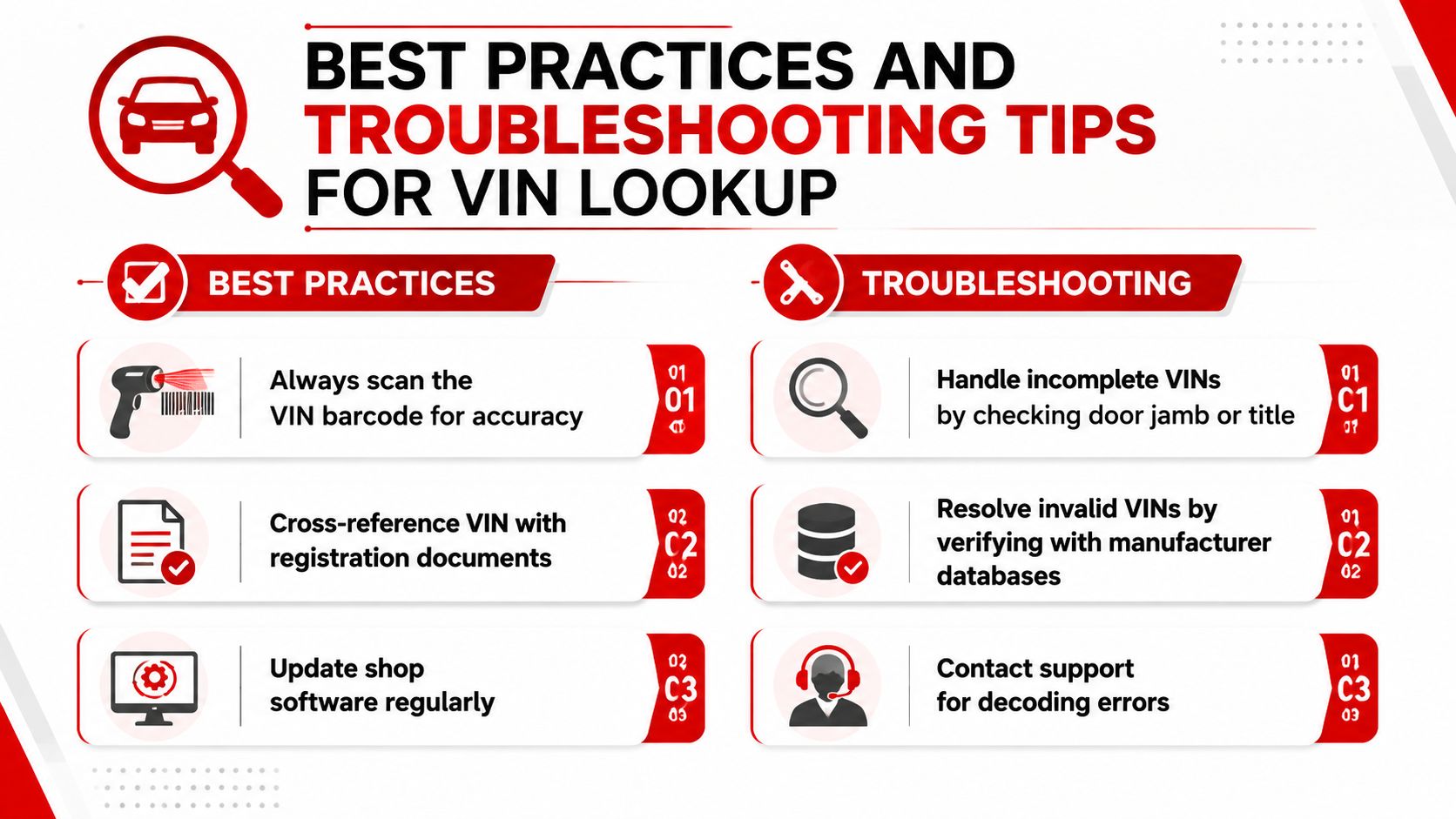
A dependable VIN process is short enough for a busy front desk and strict enough to catch preventable errors. The following checklist gives advisors a practical standard:
- Capture accurately: Read the dashboard VIN, scan it when possible, and compare it with registration or insurance documents.
- Validate before decoding: Confirm the full 17-character string, normalize formatting, and use the ninth-position check digit to detect entry problems.
- Review every returned field: Treat blank values as unavailable data, not as proof that the vehicle lacks a feature.
- Separate evidence types: Keep decoded specifications, third-party history, customer statements, and technician findings distinct.
- Escalate older records: Pre-1995 vehicles have materially lower NHTSA decoding confidence than newer vehicles, so confirm uncertain results through manufacturer or supplemental sources.
- Check safety information: Use the NHTSA recall tool for VIN-linked open recall information, then document the result and the customer's next action.
- Watch for fraud: Don't use suspicious report pages, publish unnecessary VIN images, or describe a clean partial result as a complete vehicle verdict.
- Track workflow quality: Review recurring entry errors, lookup delays, and repair-order mismatches so training addresses actual shop behavior.
When a decoder rejects the VIN, the advisor should first recheck the physical plate and documents. If the string remains valid but unregistered or incomplete, the next step may be manufacturer contact or a supplemental data source. A technician should not be asked to diagnose around an uncertain identity.
RedAppy connects VIN-based vehicle records with service history, digital inspections, estimates, parts workflows, scheduling, invoicing, and shop-board visibility. Visit RedAppy to review the platform, explore its features, or contact the team about building a more reliable VIN lookup process into daily shop operations.
Ready to Transform Your Shop?
RedAppy helps auto repair shops create professional digital estimates with photos and videos, send them instantly via text or email, and get customer approvals in seconds. No credit card required to start.