
Vehicle Service Reminder Guide: When Your Car Needs Work
The dashboard says service is overdue, but the driver remembers an oil change not long ago. Meanwhile, a text from the repair shop mentions another maintenance item. Before booking more work, the driver needs to know whether the alert means unfinished maintenance, a forgotten reset, or something the oil-change reminder never tracked.
A vehicle service reminder is useful when it connects a specific vehicle to a specific task. It's less useful when everyone assumes that a quiet dashboard means nothing needs attention.
Table of Contents
- What a Vehicle Service Reminder Tells You
- How Reminder Timing Gets Set
- Services Basic Oil Alerts Often Miss
- How to Check and Set Up Your Reminders
- What Reminders Help You Budget For
- How Shops Turn Reminders Into Repeat Visits
- Choose a Shop That Keeps Your Reminders Accurate
What a Vehicle Service Reminder Tells You
A vehicle service reminder is an alert, from the car or a shop system, that tells someone a maintenance task is due. It might appear as a dashboard message, a maintenance code, a calendar notification, or a text from a service advisor.
Consider a driver who receives an oil-service message after forgetting to book an appointment. The alert prompts a decision, but it doesn't confirm an appointment, inspect the engine, or establish that the oil was changed. A reminder works like a dentist's recall card: it nudges someone to book, but it never cleans their teeth.
The important distinction: A reminder identifies something to check or schedule. A service record documents what actually happened.
Drivers need understandable alerts and a clear next action. Repair shops need an accurate record of the message, the customer's response, and the completed work. Without that connection, even a well-timed notification can lead to confusion.
In a, 33% said service-reminder notifications were valuable. A reported that 47% of drivers who wanted data-powered auto service named a lack of personalized alerts for future maintenance as their biggest pain point.
A prompt, not a complete inspection
Useful reminders explain the task, its timing, and the reason it applies to that vehicle. They're strongest when paired with maintenance history and inspection findings, rather than treated as a complete assessment of vehicle health.
That distinction matters when interpreting service intervals, checking overlooked items, setting up notifications, and planning the cost of upcoming work.
How Reminder Timing Gets Set
A maintenance task becomes due when the first applicable limit is reached, whether that's mileage, elapsed time, or a condition-based indicator. Not every dashboard system monitors all those limits, so the owner's manual remains the reference for requirements outside the display.
A low-mileage vehicle can reach a time limit before its distance limit. A heavily used vehicle may reach its mileage threshold first, while an onboard calculation may call for attention sooner because of operating conditions.
According to, operation-based oil-change intervals can range from approximately 3,750 to 15,000 miles, with conventional or semi-synthetic applications commonly triggering reminders at 5,000 to 8,000 miles and full-synthetic applications generally allowing longer intervals.
Reminder triggers and what sets the due point
| Trigger | What it measures | Typical example |
|---|---|---|
| Mileage | Miles since last service | Oil change every 5,000 to 8,000 miles on conventional or semi-synthetic oil |
| Elapsed time | Months since last service | Service once a year, even if mileage stays low, when the vehicle's schedule specifies it |
| Operating conditions | Towing, short trips, dust, temperature, stop-and-go driving | Shorter oil intervals after severe use |
| Onboard indicator | The vehicle's own calculation of its service pattern | Honda Maintenance Minder displays a code for the service due |
| Full-synthetic oil | Oil specification | Intervals can run longer, up to about 15,000 miles |
The table describes trigger types, not interchangeable service recommendations. A longer interval isn't permission to extend maintenance on a vehicle that specifies a shorter one, and fitting synthetic oil doesn't automatically change the manufacturer's schedule.
What the car calculates
evaluates vehicle speed, engine operating temperature, ambient temperature, elapsed time, and usage patterns before displaying codes for the service categories due. Honda explains that some models use this calculated service pattern instead of a conventional printed maintenance schedule.
The advisor should capture the displayed code, not replace it with a generic oil-change interval. Owners of vehicles without Maintenance Minder should follow the mileage-based schedule and maintenance-required indicator described in their owner's manual.
For businesses managing several vehicles, My Safety Manager's resource to offers a useful starting point for organizing vehicle-specific requirements.
A practical severe-use check belongs alongside the schedule. If the vehicle tows, makes repeated short trips, operates in dust, or spends substantial time in stop-and-go traffic, the driver or advisor should check the manufacturer's severe-service requirements rather than assume the nominal interval applies.
Services Basic Oil Alerts Often Miss
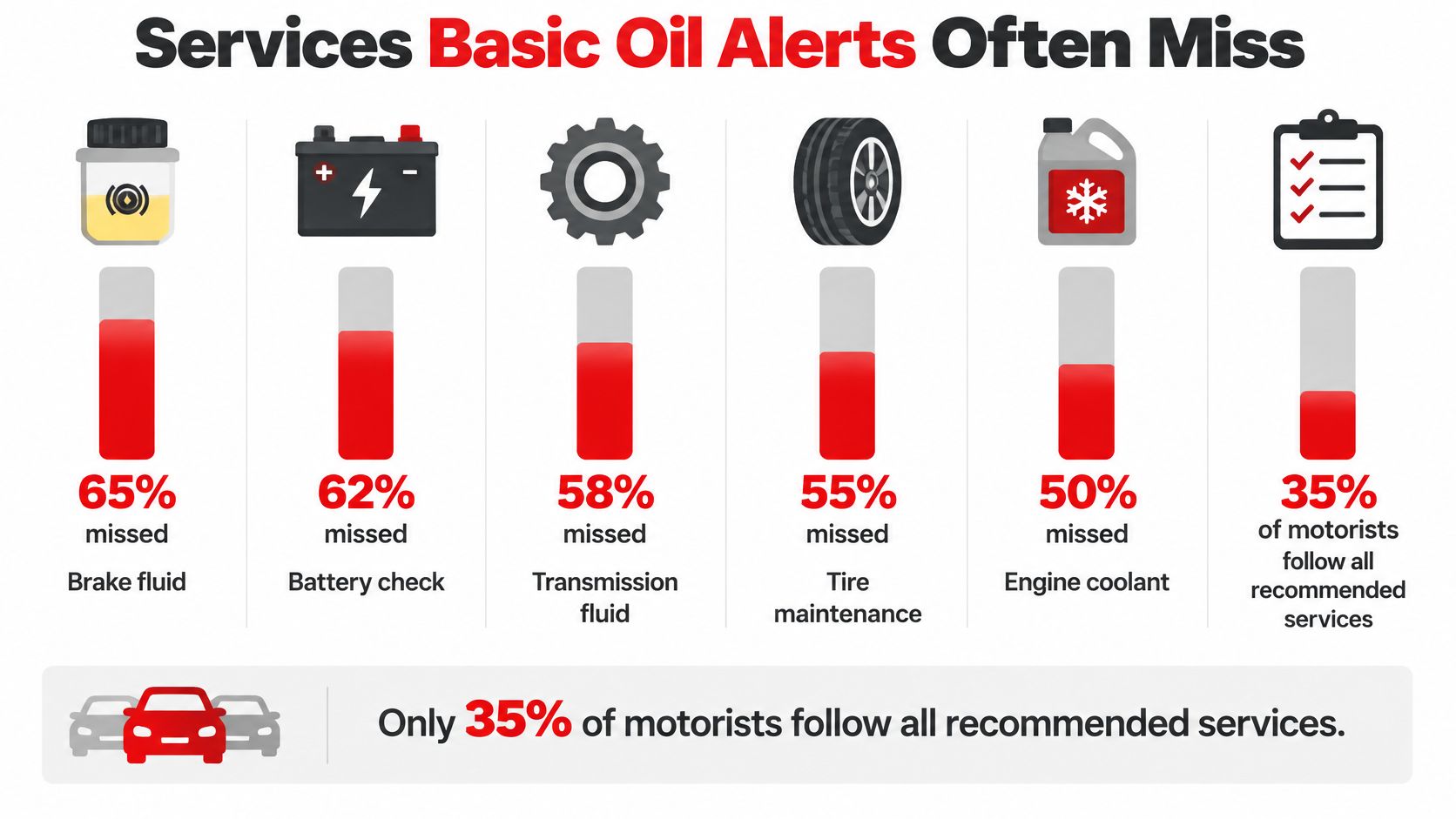
A driver can finish a long highway trip without seeing an oil-service message and still have maintenance needs to check. Basic oil alerts usually track oil, not every fluid, tire, battery, or brake service.
In AAA's survey of repair shops, repair shops reported missed maintenance across several categories. The percentages below describe shops reporting missed services, not the share of motorists who skipped each task.
Services shops most often found overdue
| Service | Shops reporting it missed | Covered by basic oil alerts? |
|---|---|---|
| Brake fluid | 88% | Often not |
| Battery check | 82% | Often not |
| Transmission fluid | 81% | Often not |
| Tire maintenance | 78% | Often not |
| Engine coolant | 77% | Often not |
| Oil change | 35% | Yes, most often |
Separate scheduled work from urgent findings
An oil reminder answers one question: whether the oil-related trigger has been reached. It doesn't confirm the condition of the brake fluid, battery, tires, or coolant. To see the wider picture, compare service history with mileage, elapsed time, inspection results, and the technician's recommendations.
Sort findings by what action they need:
- Safety-critical warnings: A brake-system or charging warning needs prompt professional assessment. Depending on the warning and symptoms, continued driving may be inappropriate.
- Inspection findings: Worn brake pads or low tire tread call for an action deadline based on measured condition. They shouldn't automatically wait for the next oil service.
- Routine maintenance: Oil and filter work can follow the vehicle's applicable maintenance timeline, unless a separate warning or fault calls for attention sooner.
covers safety defects, which are separate from ordinary scheduled maintenance. Recall documentation can also describe defects that prevent warning lamps from appearing, so a quiet dashboard cannot replace an inspection.
At each visit, ask about services outside the basic oil alert. The useful question is whether the vehicle's records and current condition support the next recommendation, and what should be handled first.
How to Check and Set Up Your Reminders
Accurate setup starts with the vehicle's instructions and evidence of its last completed service. Copying an old windshield sticker without checking either can carry an incorrect interval into the next appointment.
A setup sequence that avoids guesswork
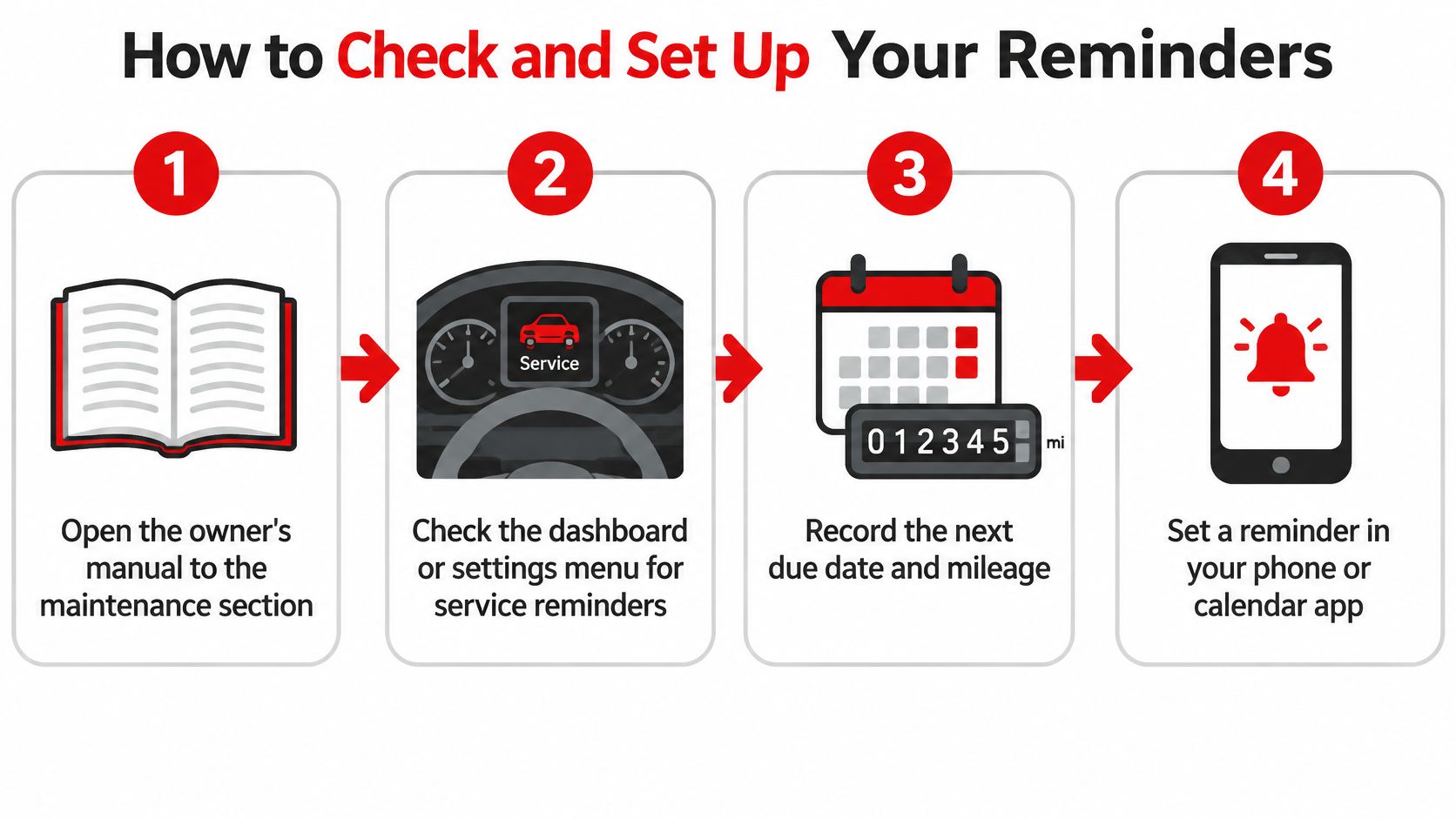
Open the owner's manual to the maintenance section. Locate the applicable time and mileage requirements, including any separate instructions for severe use, because a generic online schedule may not match the vehicle.
Check the dashboard or settings menu. Record the exact maintenance message or code before clearing anything, so the advisor can identify what prompted the alert.
Match the code to its service category. Oil, tires, and general maintenance can have separate entries, and completing one task doesn't establish that the others are finished.
Gather the last service details. Keep the service date, odometer reading, oil specification, and completed work together in a notes app or service record; missing information should be marked unknown rather than guessed.
Set the next applicable limit. Add the time deadline to a calendar and track the mileage threshold separately, updating the odometer so a distance reminder remains useful.
Confirm the correct reset after service. A explains that an unreset schedule can display a reminder again shortly after completed work, so the reset should match the operation performed.
Keep warning lights on a separate path. A new warning warrants appropriate professional diagnosis and a recall-status check rather than automatic postponement until the next scheduled visit.
The illustration summarizes the basic setup actions. The written sequence adds the checks that prevent a reminder from becoming detached from the actual maintenance record.
Confirm that the setup makes sense
The calendar deadline should agree with the applicable time interval, while the mileage entry should agree with the next service threshold. For condition-based systems, the recorded code and current display should also match the work being planned.
A reminder should be cleared because the corresponding work was completed, not merely because the message is inconvenient.
Drivers organizing maintenance savings alongside household payments can through Fintrack. A payment reminder can help reserve money, but it shouldn't replace the vehicle's maintenance schedule or an updated odometer record.
What Reminders Help You Budget For
puts maintenance, repair, and tire costs for a typical new vehicle at 11.04 cents per mile, equivalent to approximately $3.43 per day, or $103 per month, based on 31.1 miles of driving per day. The same guidance supplies the routine cost examples below.
Typical routine maintenance costs
| Maintenance item | Typical cost | Planning note |
|---|---|---|
| Oil change | $20 to $100 | Repeats at every oil interval |
| Wiper blades | $20 to $40 | Easy to overlook until visibility drops |
| Brake pads, per axle | About $300 | Plan around inspection readings |
| Tires, each | At least $200 | Track tread depth at each visit |
These are planning figures, not quotations for a particular vehicle. The actual estimate should identify the required parts, fluid specification, labor, and scope of work, including whether a brake recommendation involves pads alone or additional components.
Turn a notification into a spending plan
A useful reminder gives the owner enough notice to arrange both money and transportation. The advisor can attach an estimate to the specific task and distinguish scheduled work from a condition-based recommendation.
For example, an oil-service reminder might arrive while an inspection record shows tires approaching replacement condition. If the technician confirms that both tasks can reasonably share an appointment, the owner can plan the visit and reserve funds without treating the tire recommendation as another automatic oil-service requirement.
Combining work isn't always appropriate. A safety concern shouldn't be delayed for convenience, and a serviceable component shouldn't be replaced early solely to make a larger appointment.
Budgeting habit: An estimate attached to a specific task is more useful than an average attached to the whole vehicle.
The strongest maintenance budget therefore includes both expected recurring work and a reserve for findings that an inspection may uncover. Each reminder should lead to an itemized estimate for the actual vehicle, with a clear explanation of what is due and what remains optional or conditional.
How Shops Turn Reminders Into Repeat Visits
For a repair shop, the next reminder begins with the current repair order. An advisor can't send a credible recommendation if the record doesn't distinguish completed work, deferred work, and a dashboard message that still needs attention.
The service advisor's explanation should connect those details before the customer leaves.

Close the record before sending the next message
A useful closeout record includes the completed operation, parts and fluid specifications, measured odometer reading, next due information, technician identity, and reset confirmation. Showing each reminder's status on the repair order helps the front desk and technician give the same answer.
Consider a brake job completed while an old oil-service prompt remains active. If the oil wasn't changed, the prompt may still be legitimate; if it was changed but not reset, the display needs correction. Clearing every alert indiscriminately would conceal that distinction.
In RedAppy, each service history record includes the date, mileage, technician, and work summary, and vehicle history can be searched by name, plate, or VIN. That history contains the work recorded in the system, so outside maintenance still needs supporting information before it can inform the next recommendation.
Make follow-up useful rather than repetitive
The communication gap described in the supports explaining urgency and consequences rather than sending an unexplained service-due message. A practical outreach plan can separate:
- Now: Urgent findings with photographs, measurements, and a clear explanation of the recommended action.
- Next six months: Anticipated maintenance, subject to the vehicle's actual interval and condition.
- Monitor: Items that need another measurement or inspection before replacement is justified.
Texting credits start at $3.99 for 100 messages, and the credits never expire. The useful measure isn't how many messages a shop sends, but whether each one gives the customer a relevant decision.
Privacy matters too. illustrates the range of vehicle and usage data connected services may process. An independent shop should base reminders on service dates, odometer readings, and customer-approved history, rather than collecting precise location or driving behavior it doesn't need.
Choose a Shop That Keeps Your Reminders Accurate
A trustworthy shop should be able to explain both the recommendation and the record behind it. The customer shouldn't have to choose between a dashboard message and an unexplained sales recommendation.
A practical buyer's checklist makes that conversation concrete:
- Read the displayed code: The advisor should capture the maintenance message on the repair order rather than assume every alert means an oil change.
- Check overlooked services: The inspection and history review should address brake fluid, coolant, battery condition, transmission maintenance, and tires where applicable.
- Price the actual task: Each recommendation should have an estimate tied to the vehicle and the proposed work.
- Provide a usable record: The customer should receive the service details and confirmation that the appropriate reminder was reset.
- Arrange the next visit: Booking should follow the findings and the applicable schedule, not an arbitrary repeat interval.
RedAppy's Service Timeline lists every vehicle invoice and estimate, newest first, with status, date, technician, and jobs done. Customers can also book their next service online at any time without calling; the shop receives the request and confirms it.
For shops building this workflow, the features overview provides a practical place to review the connected service-history and booking tools. The contact page offers a next step for discussing the shop's own setup.
A reminder is only as good as the record behind it.
RedAppy connects vehicle service history, digital inspections, estimates, and online booking so repair teams can support reminders with clear records. Shop owners can visit RedAppy to explore the platform and discuss a workflow that turns maintenance recommendations into well-documented appointments.
Ready to Transform Your Shop?
RedAppy helps auto repair shops create professional digital estimates with photos and videos, send them instantly via text or email, and get customer approvals in seconds. No credit card required to start.