
Visual Inspection vs Physical Inspection for Auto Shops
A customer is standing at the service counter, looking at a brake photo on a phone. The pad looks thin, but the customer can't feel the problem, so the question comes quickly: “Does this really need to be repaired now?” The photo may help approve the job. It won't answer every question about the caliper, rotor condition, or related hardware.
That moment captures the core issue behind visual inspection vs physical inspection. The choice affects repair approvals, comeback risk, technician time, documentation, and liability. A photo-rich report can make a visible recommendation understandable, while a hands-on check can prevent the shop from approving a repair based on an incomplete view.
The practical answer isn't to choose one method for every vehicle. Owners, service advisors, and technicians need a workflow that uses visual evidence for screening and communication, then moves to physical verification when the risk or uncertainty demands it. The strongest process connects both methods without making the customer repeat the conversation or the team enter the same information twice.
Table of Contents
- Introduction Why Inspection Choice Matters Right Now
- Understanding Visual and Physical Inspections in Auto Repair
- Head to Head Comparison on Accuracy Speed and Trust
- Strengths and Limits You Feel in the Bay Every Day
- When to Use Each Method in Real Shop Scenarios
- How to Run a Combined Inspection Workflow With RedAppy
- Choosing the Right Inspection Strategy for Your Shop
Introduction Why Inspection Choice Matters Right Now
A digital inspection often starts with a technician capturing a photo or short video during a multipoint check. The advisor can send that evidence with an estimate, explain what needs attention, and give the customer a clearer basis for approval. This works especially well for worn wiper blades, fluid leaks that are visible from above, tire condition, lighting faults, and other surface-level findings.
The trouble starts when the shop treats a visible sign as a complete diagnosis. A photo of a tire may show irregular wear, but it won't verify every suspension component that could have caused it. A picture of a brake assembly may show corrosion or limited pad material, but it can't replace movement checks and tactile verification when the concern involves a bearing, steering joint, or suspension component.
Research into inspection performance illustrates why the distinction matters. In related aircraft-part studies, screen-based inspection produced 70.5% accuracy, compared with 84.0% when inspectors had physical visual-tactile access. Defect classification also rose from 39.1% with screen-based inspection to 79.4% with visual-tactile access, according to the. The setting is aviation rather than automotive repair, but the operational lesson transfers: physical access can improve both finding a problem and identifying what the problem is.
Practical rule: Use visual inspection to make a condition visible and physical inspection to establish whether the vehicle is safe, serviceable, or ready for a precise repair decision.
The rest of the process should follow that rule. Visual screening helps the shop communicate quickly. Physical verification protects the repair decision when hidden wear, movement, noise, or safety-critical operation is involved. A system such as RedAppy can connect the customer-facing visual report with the internal job workflow, so the first inspection doesn't disappear when the vehicle moves to the lift.
Understanding Visual and Physical Inspections in Auto Repair
Visual inspection means evaluating what can be seen without disassembly or hands-on confirmation of internal operation. In a modern shop, that can include photos, video, technician notes, color-coded findings, and remote review by an advisor or customer. The method is useful because it creates a record of observable condition, not just a verbal statement.
A visual inspection can document a cracked belt, a leaking shock, a damaged tire sidewall, a corroded terminal, or a low fluid level when the component is accessible. It can also show the customer why the advisor is recommending attention. The boundary is equally important: a clean-looking exterior doesn't prove that an internal bearing, bushing, electrical connection, or concealed structural area is sound.
Physical inspection adds direct contact, movement, resistance, measurement, and operational testing. A technician may rock a wheel to check for play, turn a bearing to feel roughness, test steering movement, inspect fasteners, measure a component, or reproduce a noise under controlled conditions. Physical inspection doesn't always mean a complete teardown. It means the technician verifies the relevant condition through a hands-on or tool-assisted check rather than relying only on an image.
Terminology can confuse customers and even repair teams. British Columbia's says vehicle-component compliance inspection consists mainly of visual inspection activities. Colorado regulation uses physical inspection for a visual check by a certified or regular VIN inspector that verifies required vehicle information, not necessarily a mechanical teardown, as shown in the. The label matters less than the actual procedure documented by the shop.
| Inspection method | What it does well | Where it stops | Best workflow role |
|---|---|---|---|
| Visual | Documents visible conditions quickly | Can't confirm concealed or tactile faults | Screening and customer communication |
| Physical | Verifies movement, feel, operation, and access-dependent conditions | Takes bay time and can be harder to explain without images | Diagnosis and critical verification |
| Combined | Connects evidence with confirmation | Requires a defined handoff | Approval, repair, and liability control |
For customers researching a pre-purchase check, a resource such as can provide useful context about the broader safety-inspection process. In a repair shop, the same principle applies: the inspection method should match the decision being made.
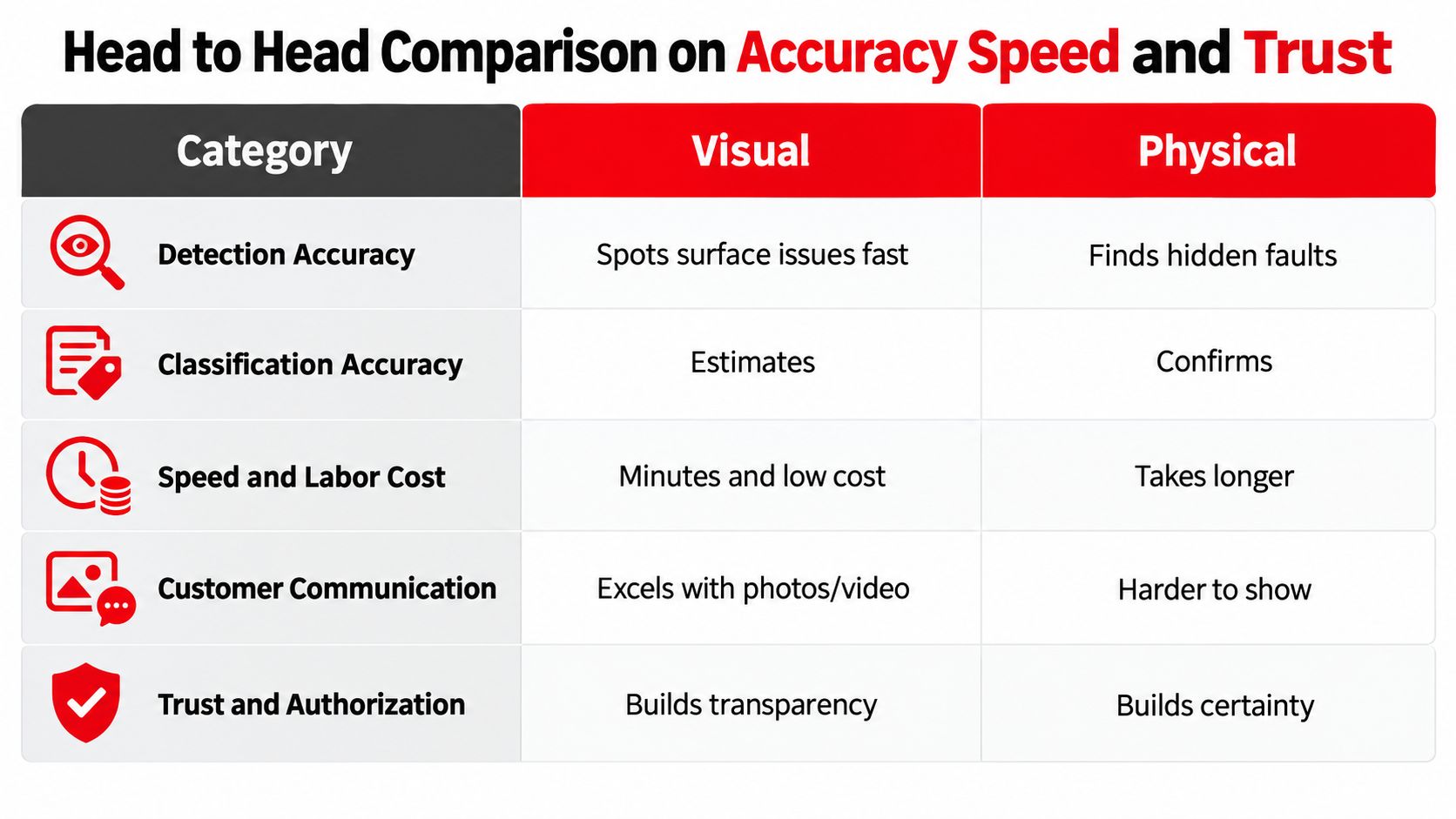
Head to Head Comparison on Accuracy Speed and Trust
The right comparison isn't “Which method wins?” It's “What decision does the shop need to support?” A visual check may be enough to recommend a visible maintenance item. A safety concern, intermittent noise, or uncertain diagnosis usually needs a more deliberate physical step.
Visual inspection is often strong at documenting what is present on the surface. It is less reliable when the defect is subtle, concealed, or dependent on movement and feel.
Detection and classification accuracy
Visual inspection gives technicians a fast way to identify surface evidence. It can reveal a torn boot, wet seal, uneven tire wear, or obvious corrosion before the advisor speaks with the customer. Physical inspection reaches conditions that images can't establish, such as bearing roughness, excessive play, binding, or a component that moves outside its intended range.
The distinction between detection and classification matters. Finding an abnormal area isn't the same as knowing its cause or severity. The aircraft inspection research linked earlier found a material difference between screen-based and visual-tactile inspection for both accuracy and defect classification, which supports using physical access when the repair decision depends on exact identification.
Speed and labor cost
Visual screening usually fits into the existing check-in or multipoint process. A technician can capture evidence while the vehicle is already being inspected, and an advisor can review the result without moving the vehicle through another bay stage.
Physical verification requires technician attention, access, and often lift time or additional testing. That makes it more expensive in labor terms, even when it prevents a larger cost later. The shop should not use speed as a reason to skip verification on a high-liability item.
Customer communication and trust
Photos and video are easy for customers to understand because they can see the condition being discussed. They also give the advisor a consistent reference when explaining an estimate by phone or through a digital report.
Physical findings can be more conclusive, but they are harder to show without a supporting image, measurement, or technician explanation. A wheel bearing that feels rough is meaningful to a technician, yet a customer may need a video of the movement or a clear note explaining the test result.
Documentation and shift consistency
Digital visual records create a durable connection between the vehicle, finding, estimate, and approval. Physical inspection notes add the reason for the decision, particularly when the technician confirms a concern that a picture alone can't prove.
Consistency depends on more than the inspection type. Lighting, acceptance criteria, camera position, and agreement between shifts can change what gets reported. Reference samples and shift-comparison checks help managers determine whether different technicians interpret the same visible condition in the same way.
Visual vs Physical Inspection Decision Matrix
| Criteria | Visual Inspection | Physical Inspection |
|---|---|---|
| Detection | Finds visible surface conditions quickly | Finds conditions requiring contact, movement, or access |
| Classification | Provides visual evidence and an initial assessment | Confirms cause, operation, and severity |
| Speed | Fits fast screening and remote review | Requires technician time and bay access |
| Customer trust | Shows the customer what the technician saw | Adds certainty when the finding isn't visible |
| Liability | Documents observable condition | Supports critical safety and repair decisions |
Strengths and Limits You Feel in the Bay Every Day
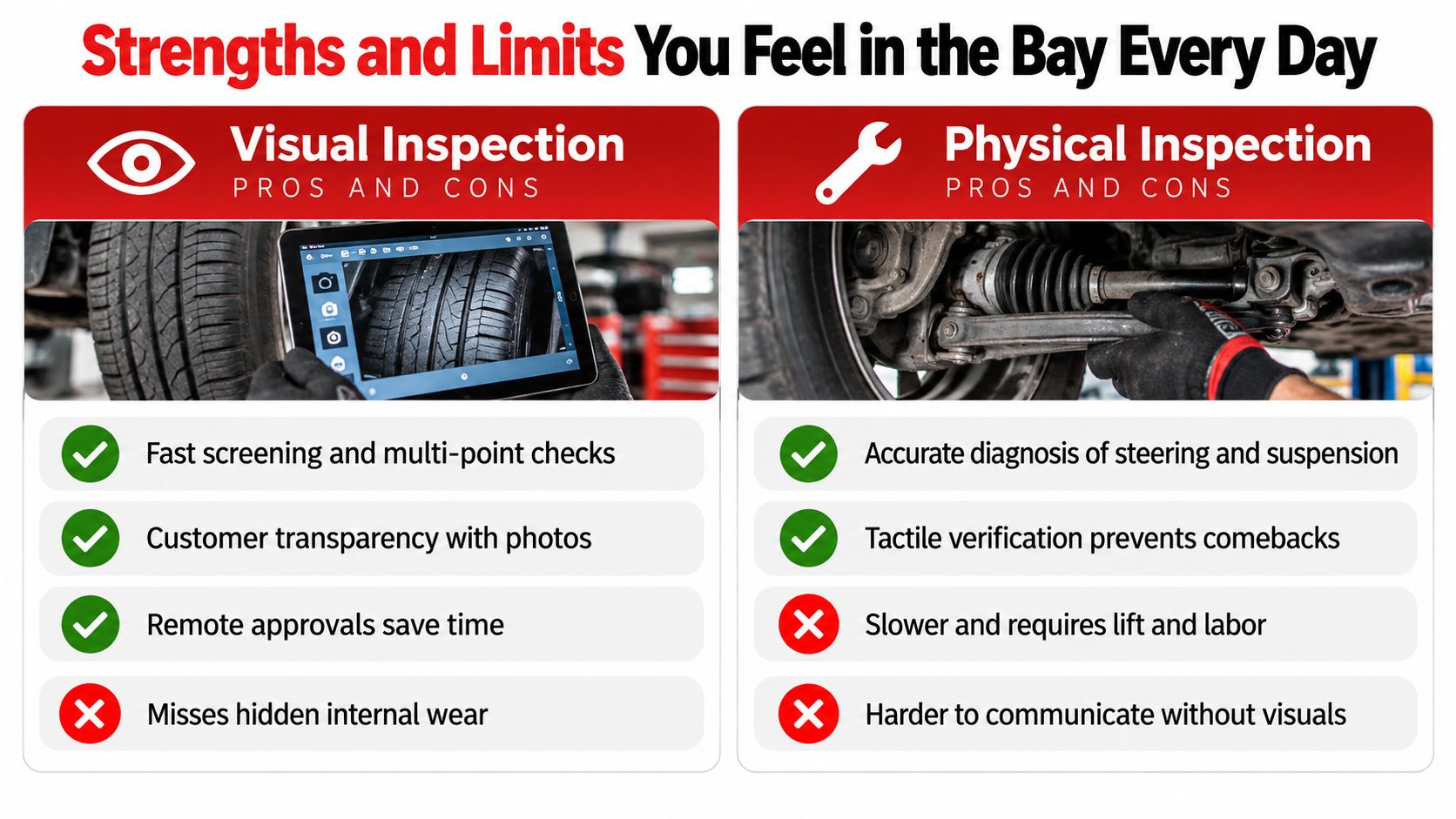
Visual inspection earns its place in a busy shop because it makes the first conversation easier. A technician can photograph a damaged tire, a leaking strut, or a worn brake component while completing a broader vehicle check. The advisor then has evidence to discuss instead of relying on “the technician recommends it.”
That evidence also helps with remote approvals. A customer at work, a fleet manager in another location, or a vehicle owner comparing estimates can review a report without standing beside the lift. The process reduces explanation gaps, but it doesn't eliminate the need to verify the condition that sits behind the image.
The visual boundary is physical, not merely procedural. A better camera can improve lighting and detail, and better training can improve interpretation, but a surface image still won't expose every subsurface void, delamination area, micro-crack beneath the surface, or texture-related problem. The emphasizes pairing visual inspection with other methods when internal integrity matters.
What missed defects look like operationally
Independent inspection studies show why a shop should watch sensitivity, not just apparent neatness. One medical imaging study reported joint-level sensitivity of 0.14 and specificity of 0.97 for photo-based visual inspection, while video raised sensitivity only to 0.24, according to the. The context isn't automotive repair, but the pattern is relevant: visual review may be better at confirming no obvious issue than finding every subtle one.
Another inspection study cited in that source found inspectors incorrectly accepted 23% of chips with anomalies and incorrectly rejected 2% of defect-free chips. In a shop, the equivalent risk is not an annoying false alarm. It can be a customer leaving with an unresolved safety concern because the visible evidence looked acceptable.
What physical verification adds
Physical inspection is strongest when the vehicle's behavior matters. Steering and suspension components may look intact while still showing looseness, binding, damaged bearings, fluid loss, or excessive play. A tactile check can also separate a likely cause from a visible symptom, preventing a parts-swapping approach that creates cost without solving the complaint.
The trade-off is capacity. Physical checks consume technician time, lift availability, and often a clearer diagnostic plan. If every visible observation triggers a full hands-on procedure, the shop slows down and customers wait. If no visible observation ever triggers one, the shop accepts avoidable risk.
Consistency can matter as much as method. A dark inspection area, unclear acceptance standard, or different interpretation between shifts can produce missed findings even when the same defect is present. Managers should define what requires a photo, what requires a measurement, and what requires physical confirmation before the estimate is presented.
When to Use Each Method in Real Shop Scenarios
The most useful decision happens at write-up, before the advisor promises a repair or quotes a diagnosis. The question is not just whether the technician can take a picture. It is whether the customer's decision depends on something that an image cannot establish.
Use visual inspection first for routine screening and communication. Exterior lighting, tire tread condition, visible leaks, battery-terminal corrosion, wiper wear, fluid levels, belt condition, and obvious body or glass damage can often begin with photos and notes. Visual evidence is also useful for building an initial estimate when the repair path is clear from what the technician can see.
Move to physical inspection when the concern involves movement, feel, operation, noise, or concealed condition. Steering play, suspension looseness, bearing condition, brake pull, intermittent electrical faults, vibration, driveline noise, and warranty disputes deserve hands-on verification. The physical check may be limited and targeted, but the record should state what the technician tested and what the result was.
California's Bureau of Automotive Repair handbook provides a direct example of why combined methods matter. Its safety-inspection guidance says steering and suspension systems require a physical and visual inspection, with verification of items such as secure steering-column fastening, free bearing rotation without binding, power-steering fluid level and leaks, and rack-and-pinion or steering-gear concerns including bent tie rods, damaged wiring, or excessive play. The shows that a look-over alone isn't enough for every safety-related decision.
A simple advisor checklist can keep the workflow practical:
- Can the customer see the condition? Start with a clear photo or video if the answer is yes.
- Does the decision depend on play, binding, noise, pressure, temperature, or operation? Schedule physical verification.
- Could the issue be hidden behind a cover, inside a component, or below the visible surface? Don't treat a visual result as a final diagnosis.
- Does a regulation, warranty, fleet policy, or shop standard require a specific procedure? Follow that requirement and document it.
- Will the customer approve work remotely? Pair the visual report with concise physical-test notes when the repair decision goes beyond surface evidence.
The combined choice often gives the best balance. Visual evidence earns the conversation, while physical verification earns confidence in the recommendation.
How to Run a Combined Inspection Workflow With RedAppy
A combined workflow should feel like one inspection to the customer, not two disconnected processes. The technician begins with a visual screen, records the visible evidence, and flags the items that need hands-on verification. The advisor can then separate “visible recommendation” from “confirmed diagnosis” without losing the vehicle history.
Capture the evidence at the vehicle
The technician uses a tablet or phone to capture relevant photos and short videos, not a random gallery of every component. Each image should answer a customer question: What is worn? Where is the leak? How does the damage compare with a serviceable condition? A written note adds the finding, location, and recommended next check.
Color-coded results can help the advisor scan the report, but the color should support a defined shop standard rather than replace one. A red finding should identify an urgent or unacceptable condition according to the shop's criteria, while a yellow result should show that monitoring or further verification is appropriate.
Send the right items to physical verification
The technician or foreman marks concerns that require movement checks, measurements, access, or operational testing. Physical results should sit beside the original visual evidence, so the advisor can explain how the shop moved from an observed symptom to a verified recommendation.
RedAppy supports digital vehicle-inspection workflows with photos, videos, technician notes, estimates, customer-facing reports, vehicle history, a Digital Shop Board, and team scheduling in one platform. That setup can help the shop pass a visual finding into the next physical step without recreating the job on paper or in a separate message thread.
Build approval around evidence
The advisor sends the visual report and estimate before teardown when the customer needs to approve diagnostic or repair time. The customer can see the visible condition, while the estimate and notes explain which items still require physical confirmation.
Fast communication matters because a clear report loses value if the customer receives it long after the inspection. Shops reviewing broader tactics for can apply the same principle here, respond while the vehicle is still in the workflow, and keep the approval conversation attached to the job.
Once approval arrives, the team updates the Digital Shop Board, performs the physical verification, records the result, and adjusts the estimate only when the findings justify it. The customer gets a traceable chain from image to test to repair.
Choosing the Right Inspection Strategy for Your Shop
A single-bay garage should lean on visual inspection for efficient screening and customer communication, then reserve physical verification for safety-critical, uncertain, or complaint-driven work. A high-volume operation needs defined handoff rules so one technician's “looks acceptable” doesn't become another technician's “needs repair.” A mobile mechanic may rely heavily on visual documentation at the customer's location, then explain clearly when a lift-based or deeper physical check is required elsewhere.
Shop managers should standardize lighting, photo angles, acceptance criteria, and required notes. Reference samples and shift-comparison studies can expose disagreements that individual coaching may miss. Those controls improve measurement consistency without pretending that every inspection can be reduced to a photograph.
AI and machine vision can strengthen visual workflows by helping teams organize images, highlight anomalies, and apply repeatable review criteria. They don't remove the need for physical validation when the decision depends on internal integrity, tactile feedback, movement, or safety operation.
The strongest strategy is therefore combined, but not indiscriminate. Visual inspection starts the approval conversation. Physical inspection confirms the decisions that carry greater technical or liability risk. RedAppy can connect those stages through digital reports, estimates, customer approvals, vehicle history, and job-status visibility. Shop owners can explore RedAppy features or contact the team through the RedAppy contact page to map the workflow to their operation.
RedAppy gives auto shops a connected way to capture photo and video evidence, build estimates, share inspection reports, record approvals, and move verified work through the shop workflow. Visit RedAppy to see how visual screening and physical verification can work together without losing the customer, the technician, or the approval trail.
Ready to Transform Your Shop?
RedAppy helps auto repair shops create professional digital estimates with photos and videos, send them instantly via text or email, and get customer approvals in seconds. No credit card required to start.