
What Is a Multi Point Vehicle Inspection and Why It Matters
A multi point vehicle inspection is a structured check of many safety, mechanical, electrical, and body systems, not a single component. European roadside data recorded deficiencies in 21.3% of brake checks, 20.1% of tyre checks, 29.8% of light checks, and 5.6% of fuel or oil leakage checks, which is why every finding should be classified as safe, monitor, or repair.
A customer may arrive because the brake pedal feels soft, yet the inspection can reveal an under-inflated tyre, a leaking shock absorber, a failed brake light, or a worn wiper. The technician's job isn't to tick boxes. The job is to identify what was observed, explain its consequence, and give the service advisor a defensible order of priority.
Table of Contents
- What a Multi Point Vehicle Inspection Actually Means
- Core Checkpoints in a Complete Multi Point Inspection
- Why Safety Comes First in Inspection Priorities
- What 25 Points vs 100 Points Really Means
- Turning Findings into Photo-Rich Digital Reports
- How Multi Point Inspections Help Shops and Customers
- Common Misconceptions and a Practical Compliance Checklist
What a Multi Point Vehicle Inspection Actually Means
A vehicle enters the bay for a complaint about vibration under braking. The technician checks the brake system, but a proper inspection doesn't stop there. The walk-around may reveal uneven tyre wear, a cracked lamp lens, or a fluid mark under the engine. Under the bonnet, the battery and fluid levels may raise separate questions, while a road test confirms how the vibration behaves.
That process answers what is a multi point vehicle inspection in practical terms. An MPI is a repeatable screening of numerous safety, mechanical, electrical, operational, and body systems. It isn't automatically a diagnosis, and it isn't the same as a statutory roadworthiness test. Its purpose is to establish the vehicle's current condition and identify what needs attention.
Each line should receive a useful status:
- Acceptable: No abnormal condition was observed under the inspection conditions.
- Requires monitoring: The item is usable now but shows wear, an emerging issue, or a maintenance need.
- Requires immediate repair: The condition creates a meaningful safety or reliability concern, or needs further testing before the vehicle is returned.
The reason for this broad approach is visible in European roadside inspection data. Reported deficiency rates were 21.3% for brakes, 20.1% for tyres, and 29.8% for lights, while fuel or oil leakage appeared in 5.6% of inspections. Those figures are reported in the. A check focused only on the engine or the dashboard warning light would miss defects in several other systems.
What the inspection reviews
| Inspection Zone | Typical Checks | Why It Matters |
|---|---|---|
| Brakes, tyres, wheels | Tread, wear, damage, pad condition, rotors, wheel condition | These systems affect grip, stopping, and control |
| Steering and suspension | Looseness, leaks, ride height, unusual movement | Worn parts can change handling and tyre wear |
| Lighting and visibility | Headlights, indicators, brake lights, mirrors, glazing, wipers | Other road users need to see the vehicle and the driver needs a clear view |
| Under-hood systems | Fluids, battery, belts, hoses, charging, cooling | These checks expose leaks, starting concerns, and overheating risks |
| Body and safety equipment | Existing damage, restraints, warning lamps, visible equipment | The report needs to distinguish condition from customer concern |
A useful inspection also gives the shop a baseline for the next visit. Seasonal preparation resources, such as this, can help owners think about changing driving conditions, but the technician still needs to document the actual condition of the vehicle in the bay.
Practical rule: A green result should mean “no issue observed under these inspection conditions,” not “this vehicle can never develop a fault.”
Core Checkpoints in a Complete Multi Point Inspection
A thorough MPI works like a routine physical examination. A doctor doesn't assess only the symptom that brought a patient to the clinic, and a technician shouldn't inspect only the component named on the repair order. The inspection combines a vehicle walk-around, under-hood and underbody checks, operational tests, and, when relevant, a road test.
ASE training materials require technicians to document existing body conditions and complete a multi-point inspection report. The same includes road testing to verify mechanical or hydraulic problems related to a driver's concern.
Start outside the vehicle
The exterior pass establishes context before the technician starts testing. It can include body damage, glass, mirrors, lamps, wipers, tyre condition, wheel condition, and visible leaks. Existing scratches or dents should be recorded so the customer and shop share the same starting point.
Lights deserve more than a quick glance. Headlamps, turn signals, brake lamps, hazard lamps, and rear lamps should be operated where applicable. A failed light can be a visibility problem even when the engine, brakes, and steering operate normally.
Move under the bonnet and below the vehicle
Fluid levels and leak evidence tell different stories. Engine oil, brake fluid, coolant, transmission fluid, and power-steering fluid should be checked according to the vehicle and shop procedure. A technician should record the location and character of a leak rather than writing only “leaking.”
The battery and charging system belong in the same conversation. A visual battery check may identify corrosion or damage, while testing can provide voltage or other objective evidence. Belts, hoses, cooling components, exhaust parts, and wiring also need attention because visible deterioration can become a reliability or safety issue.
Test the systems that the vehicle uses
Tyres need tread and condition checks, not just a glance. Brakes need symptom review, visual inspection, and appropriate functional testing. Steering and suspension checks look for looseness, damage, leakage, and unusual movement.
Interior items matter too. The technician can assess wipers, washers, mirrors, warning lamps, restraint-system status, and other visible safety equipment. When the original concern involves noise, vibration, pulling, braking, or shifting, a road test may be necessary to verify the symptom and determine what additional diagnosis is required.
Why Safety Comes First in Inspection Priorities
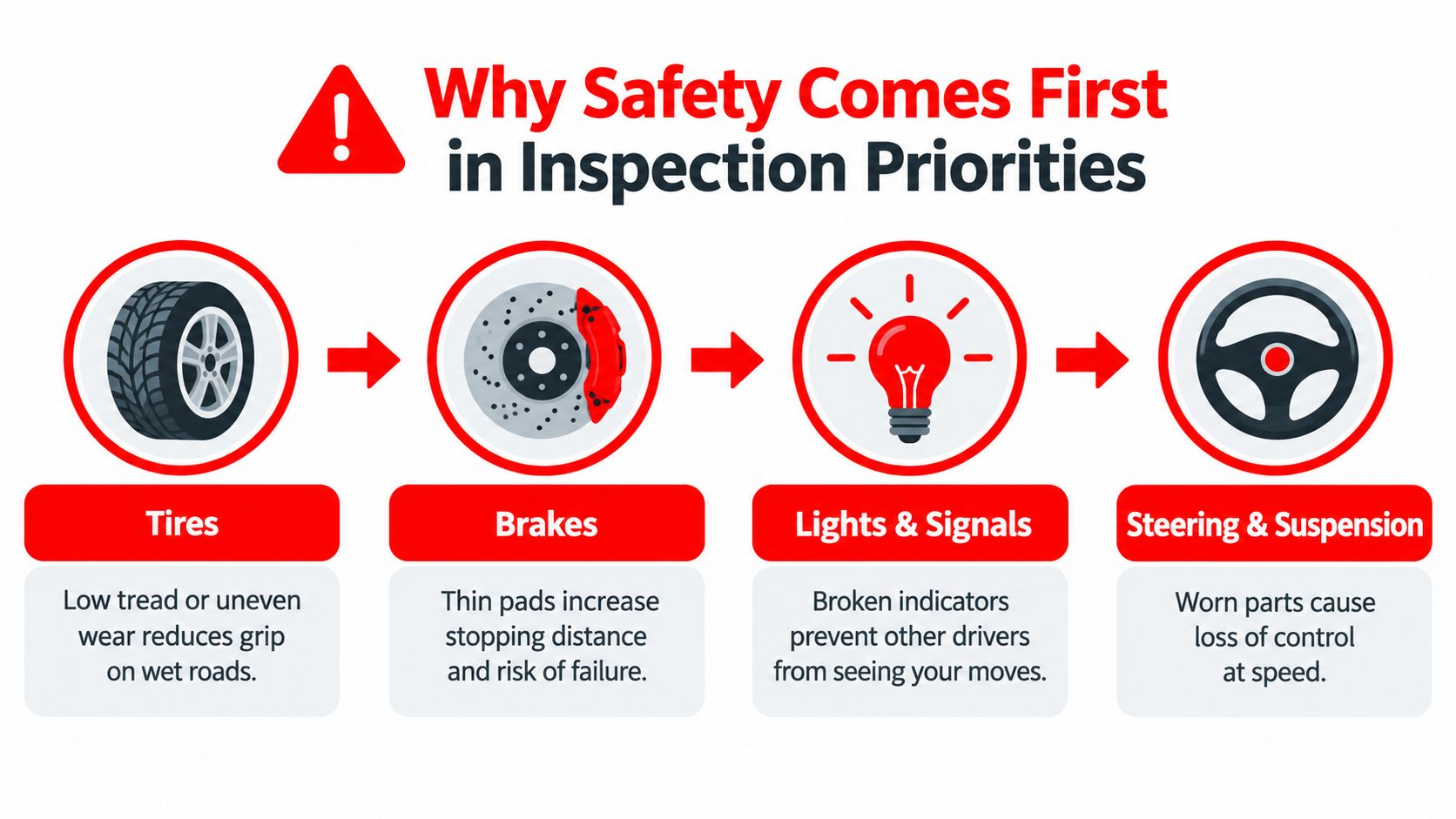
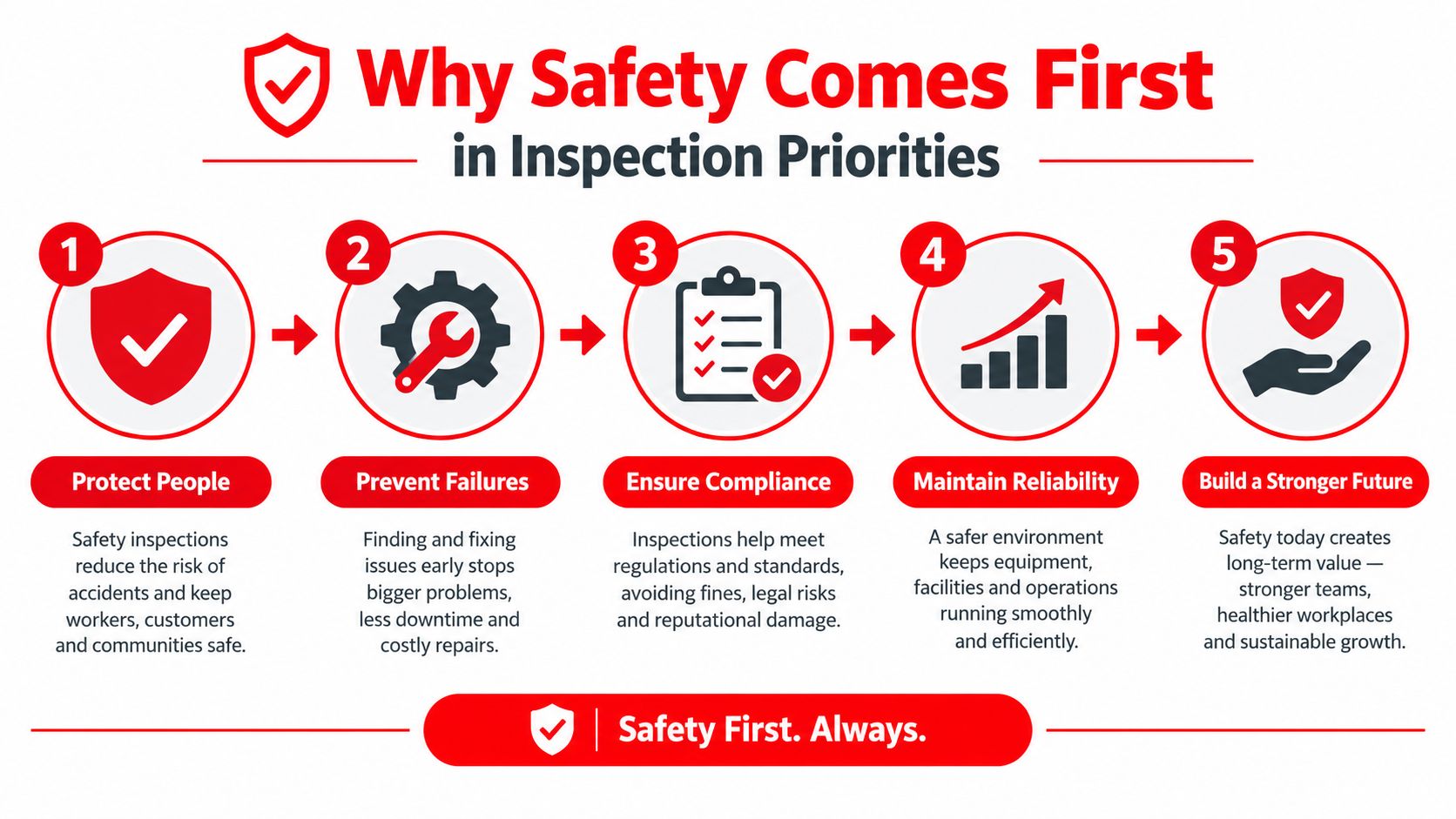
A multi point inspection isn't a flat list in which every line has equal urgency. The technician first considers what could cause loss of control, then what could limit visibility, create a fire or contamination risk, or leave the vehicle unreliable.
A practical priority sequence begins with tyres, wheels, brakes, steering, and suspension. These components influence grip, stopping, and directional control. The next group includes lights, wipers, mirrors, and glazing, because the driver and other road users need reliable visibility. The technician then examines fluids, fuel lines, wiring, and exhaust for leakage, fire, emissions, or damage risks. Battery, charging, cooling, and engine-management symptoms follow as reliability concerns.
Federal commercial vehicle rules identify frames, suspension, axles, wheels, rims, and steering systems as safety-related components. They also identify brake defects such as missing or nonfunctional braking components and loose hardware. The also reflect the wider risk picture, including sudden steering-component breakage, fuel-system leakage, wheel failure, lighting or wiper failures, and wiring problems.
Severity depends on consequence
Consider two findings that both involve wear. A worn wiper blade may reduce visibility in heavy rain, while a tyre with severe damage or an unsafe brake condition can affect control or stopping. Both belong in the report, but they shouldn't receive the same urgency.
Objective evidence makes that distinction understandable. Useful entries may include:
- Tread depth: Record the measurement for each tyre, not only “tyres okay.”
- Brake condition: Note pad or lining thickness, rotor or drum observations, and any functional-test result.
- Electrical evidence: Add a battery or charging measurement where testing was performed.
- Leak location: Identify where fluid is appearing and whether further diagnosis is needed.
- Photographs: Show damage, wear, leakage, or a component that needs replacement.
Evidence helps the technician hand work to another team member without losing context. It also gives the service advisor something clearer than an opinion when explaining why one item should be repaired today and another can be monitored.
A recommendation earns trust when the report shows the condition, the consequence, and the next action.
What 25 Points vs 100 Points Really Means
Two vehicles arrive at the same shop for pre-owned vehicle inspections. One receives a 25-point report with tyre tread recorded by position, brake measurements, battery test results, photographs, and notes about items that couldn't be tested. The other receives a 100-point report made mostly of unchecked boxes and broad statements such as “brakes passed” and “engine good.”
The first report may be the more useful inspection. The number of points describes the form, not the quality of the work. Common MPI forms may contain roughly 20 to 40 checks, while extended dealership or used-vehicle forms can exceed 100 checks, as explained in this. A “100-point inspection” doesn't automatically mean the vehicle received a more rigorous examination than a 25-point inspection.
What to ask about the points
A customer or service advisor should ask three questions:
- Which components were checked? A form should name the system or part, not hide several unrelated checks behind one label.
- What evidence was recorded? Measurements, photographs, test results, and technician notes make findings more useful.
- What does each status mean? The shop should define its acceptable, monitor, and repair categories.
The distinction between observation and testing is just as important. A technician can observe brake-pad thickness or a fluid leak without performing a complete brake-system test. A visual check may not verify intermittent faults, scan every control module, or reveal a problem inside an undismantled component.
A green result has limits
“Passed” usually means that no issue was observed under the inspection conditions and within the inspection's stated scope. It doesn't guarantee that the vehicle is defect-free, and it doesn't replace diagnosis when a symptom remains unresolved.
A credible report states what was inspected, what was measured, what was not tested, and what needs follow-up. That honesty protects the customer from false certainty and gives the shop a clear basis for a later diagnostic step.
Turning Findings into Photo-Rich Digital Reports
The inspection becomes valuable to the customer when the report answers three questions: What did the technician find, why does it matter, and what should happen next? A paper tick sheet can record a result, but a photo-rich digital report can connect the result to visible evidence, a technician note, and an estimate.
Tyres offer a straightforward example. Guidance from AAA says replacement should be considered when tread reaches 4/32 inch and advises checking for uneven wear, cuts, gouges, sidewall bulges, punctures, and incorrect pressure. The also explains that uneven wear can indicate alignment, wheel-balance, or suspension problems.
A useful digital entry records each tyre's tread depth, inflation condition, damage findings, and recommended follow-up. A photograph can show a sidewall bulge or uneven shoulder wear, while a short note can explain why the finding points toward alignment or suspension diagnosis.
Build the report around decisions
A strong workflow separates findings into clear groups:
- Safety-critical: The vehicle shouldn't continue in its current condition, or the item requires immediate attention.
- Maintenance recommendation: The vehicle remains usable, but service should be planned.
- Monitor: The condition is acceptable now and should be checked again later.
- Unable to test: The report states the limitation instead of implying a pass.
The approved repair should flow from the finding into an estimate without retyping the same information. For example, a worn wiper blade can carry a photograph, a one-line explanation, a replacement recommendation, and a single estimate item. The customer can approve that work while declining or postponing a separate maintenance recommendation.
Digital inspection workflows also need to preserve declined work and follow-up items. A shop's operational tools can extend beyond inspections, including for businesses that need organized control of vehicle keys. The principle is the same: each operational detail should have a clear owner, status, and next action.
How Multi Point Inspections Help Shops and Customers
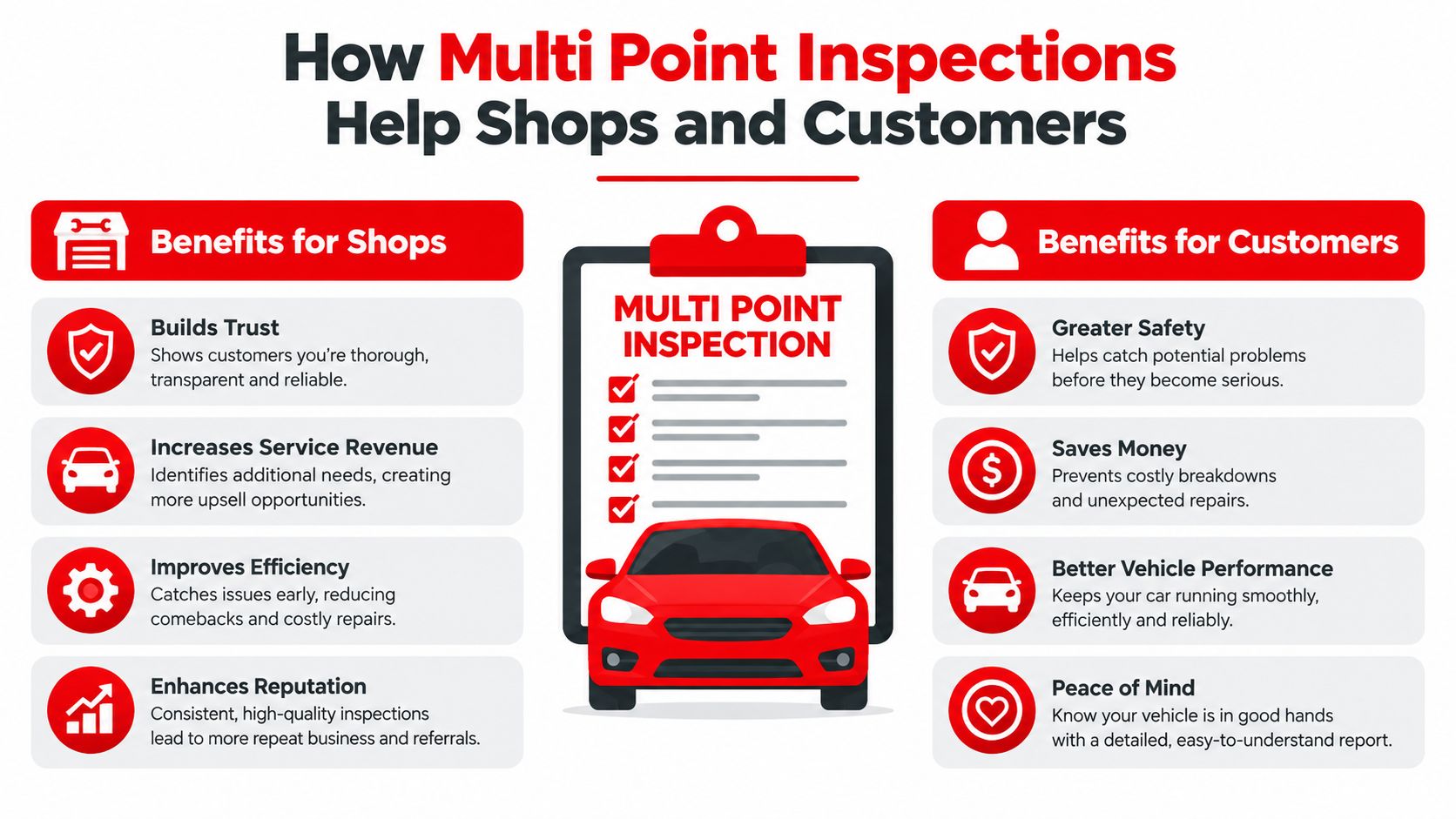
The customer sees an inspection report as a decision document. The shop sees it as a connection between the bay, the service desk, the estimate, the invoice, and the next visit. When those views line up, a recommendation feels less like a sales pitch and more like a documented maintenance decision.
Government inspection data shows why this process can uncover meaningful work. A reported that more than 529,000 vehicles, about 20% of Pennsylvania's 2.7 million registered vehicles, initially failed inspection and then underwent repairs to pass. Virginia officials reported safety problems in more than 1.4 million vehicles, or 19% of the state's 7.5 million vehicles, and approximately 700,000 vehicles were rejected for brake-related problems, including worn or defective linings, drums, pads, or rotors.
Those figures concern government inspection programs, not every shop's routine MPI. Their operational lesson is narrower and practical: systematic checks can identify defects that a single symptom-based repair visit may not address.
The customer side
A clear report helps a customer separate urgent work from planned maintenance. Photos reduce ambiguity, measurements give recommendations substance, and a visible status helps the customer decide whether to approve, defer, or monitor an item.
That clarity can also reduce surprise. If the shop documents a developing tyre issue during one visit, the customer has a written baseline before the condition becomes a roadside problem. The next advisor can explain what changed rather than starting the conversation from scratch.
The shop side
For the shop, an MPI creates a consistent handoff between technician and advisor. The advisor can build an estimate from documented findings, attach inspection evidence to the customer record, and follow up on declined work without relying on memory.
The report also creates a service history that supports future conversations. A technician can compare a previous measurement or photograph with a later inspection, while the manager can review where work is waiting for approval. RedAppy is one platform that combines digital inspections, estimates, invoicing, customer communication, and a visual shop workflow, so shops can review its inspection and shop-management features.
The inspection is the moment the shop either earns trust with evidence or loses it with unexplained recommendations.
Common Misconceptions and a Practical Compliance Checklist
A passed MPI doesn't mean the vehicle is problem-free. It means the listed items showed no issue within the inspection conditions and scope. A larger point count doesn't guarantee better work, an MPI doesn't replace a statutory inspection, and a visual observation doesn't prove that a system passed a complete functional test.
Severity also needs a consistent language. The UK MOT framework uses minor, major, and dangerous categories and instructs inspectors to match the category to the defect's nature and severity. Its examples classify an unsafe structural defect affecting steering or braking as dangerous, an obviously under-inflated tyre as minor, and an obviously inoperative item as major, as shown in the. A routine MPI isn't identical to an MOT, but the prioritization principle remains useful.
A shop can grade its inspection process with this checklist:
- Scope: Does the report state what was checked and what couldn't be tested?
- Evidence: Are measurements, photographs, diagnostic results, and leak locations recorded?
- Classification: Are safety repairs separated from maintenance and monitor items?
- Testing: Does the report distinguish visual observations from functional tests?
- Authorization: Can the customer approve selected work without confusion?
- Verification: Does the technician verify completed repairs before closing the item?
- History: Are declined recommendations retained for future follow-up?
RedAppy connects digital multi point inspections with photo-rich reports, estimates, customer approvals, invoicing, and shop-board visibility. Shops that want to make inspection evidence easier to act on can visit RedAppy to review the platform and contact the team.
Ready to Transform Your Shop?
RedAppy helps auto repair shops create professional digital estimates with photos and videos, send them instantly via text or email, and get customer approvals in seconds. No credit card required to start.