
How to Improve Customer Communication at Your Auto Repair Shop
A customer is sitting in the waiting area, refreshing a phone and watching the clock. The vehicle was dropped off hours ago, but nobody has confirmed whether the inspection started, what the technician found, or when the car might be ready. By the time the advisor finally calls, the customer isn't only worried about the repair. The customer is questioning whether the shop is organized enough to handle it.
That moment is common, and it rarely starts with bad intentions. Advisors get pulled into phone calls, technicians find unexpected problems, parts arrive late, and a busy front counter loses track of who still needs an update. The solution isn't asking one naturally friendly employee to communicate better. Customer communication needs a repeatable workflow, with clear messages assigned to each stage of the repair.
Table of Contents
- What Customers Actually Expect From Your Shop
- The Five Touchpoints That Build Trust
- Writing Estimates Customers Understand
- Using Photo Inspections to Win Approvals
- Follow-Up Workflows That Earn Reviews
- Turning It All Into a Repeatable System
What Customers Actually Expect From Your Shop
Customers don't expect a shop to predict every repair complication. They do expect the shop to explain what is happening before they have to ask. A useful first message confirms the vehicle's arrival, repeats the reported concern, and sets the next communication point. Even when the diagnosis isn't complete, silence shouldn't be the default.
Research from found that 88% of consumers wanted repair updates at least weekly, while 45% expected updates every two to three days during the repair. The same research identified transparent, detailed explanations of repair needs as the most important factor in satisfaction. Getting the frequency of contact right increased the repairer satisfaction score by 0.27 points on a one-to-five scale.
That finding matters at the front counter. A customer may accept a longer repair timeline when the shop explains the cause, the dependency, and the next decision. A customer who receives no acknowledgment often assumes the vehicle has been forgotten, even when a technician is working carefully behind the scenes.
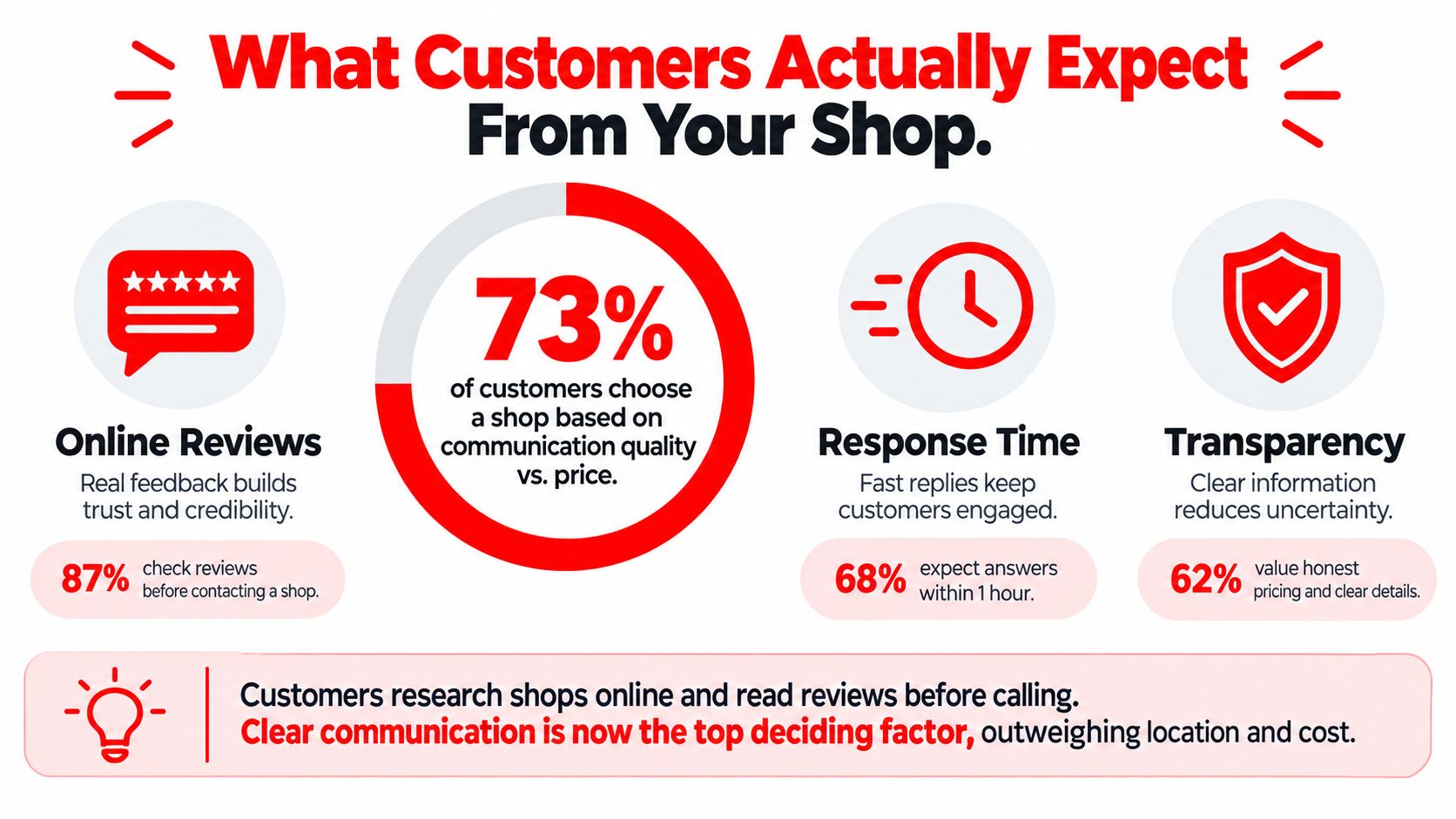
Silence creates avoidable doubt
The shop usually loses trust through small gaps:
- Vague timing: “It should be ready later” gives the customer no useful planning information.
- Missing acknowledgment: A vehicle arrives, but the customer receives no confirmation that the concern was recorded.
- Surprise charges: The pickup conversation introduces work or fees that weren't explained during approval.
- Inconsistent language: One advisor says the vehicle is safe to drive, while another says it needs immediate attention.
Customers also compare the experience with every other service interaction in their lives. Restaurants provide order updates, delivery services show progress, and home-service companies confirm arrival windows. Auto repair involves more technical uncertainty, so plain explanations matter even more.
The J.D. Power customer service index study identified four communication-related measures among its 10 most influential KPIs: focusing on customer needs, keeping customers informed of service status, greeting the customer immediately on arrival, and contacting the customer after service to confirm satisfaction. The study included 55,210 verified owners and lessees, which reinforces a practical point: communication isn't a personality trait belonging to one excellent advisor. It is a shop-wide operating discipline.
A consistent brand voice helps every advisor sound clear without sounding scripted. Guidance on an can help a shop define language that remains professional, direct, and human across texts, emails, and invoices.
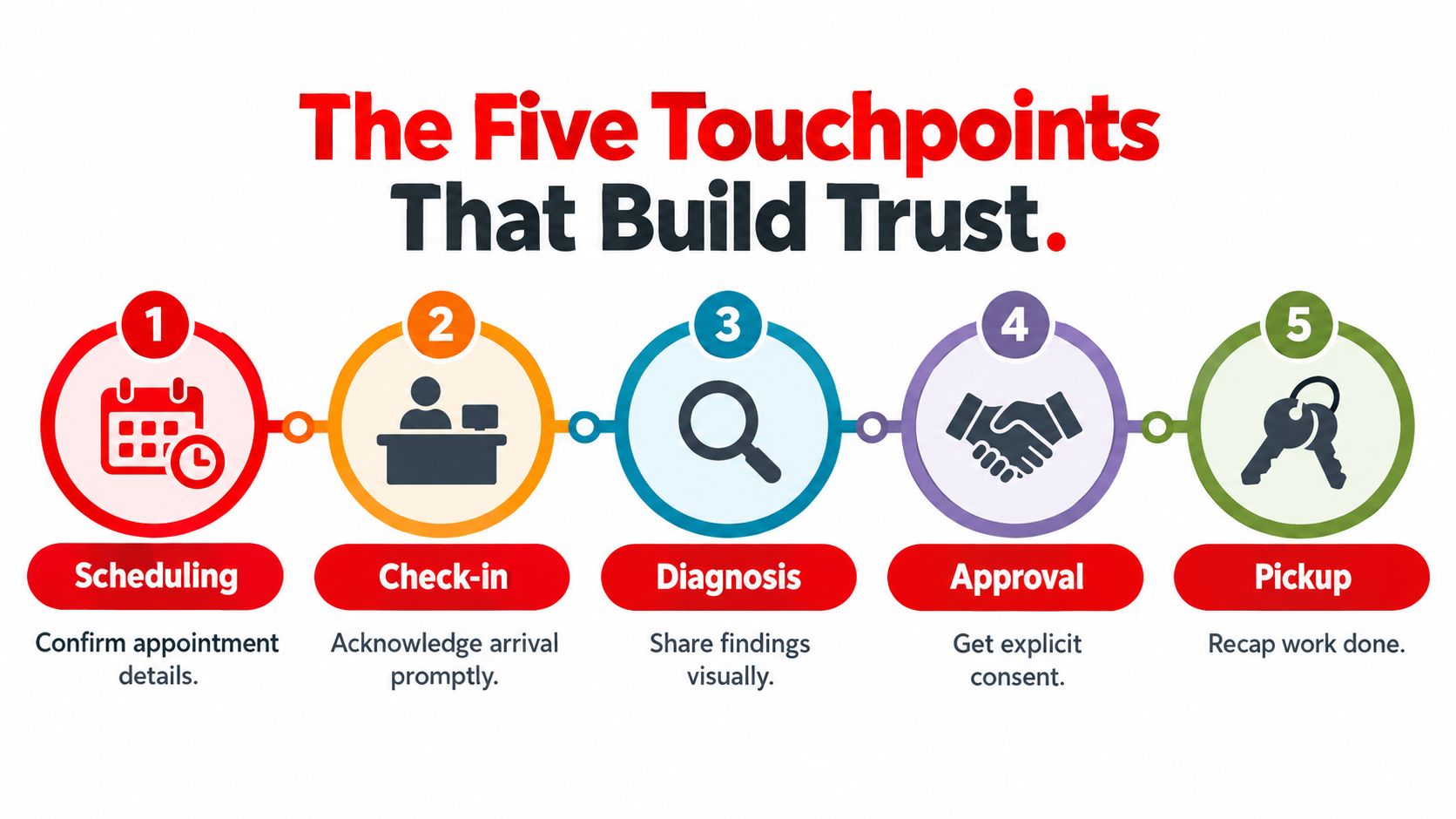
The Five Touchpoints That Build Trust
The customer experiences the repair in a sequence. Each touchpoint should answer the question that is most likely to be forming at that moment.
Scheduling
The unspoken question is, “Did the shop understand the problem, and what should happen next?”
A service advisor can say: “The appointment is set for Tuesday morning. The concern recorded is a vibration under braking. The vehicle will be checked in on arrival, and the advisor will contact the customer after the initial inspection.”
The message should confirm the concern in the customer's language, establish the drop-off expectation, and identify the next communication point. Repeating “vibration under braking” is more useful than recording “brake issue,” because the technician and advisor now have the same starting description.
Check-in
The customer wants proof that the vehicle and concern have entered the shop's process.
A useful script is: “The vehicle is checked in, and the braking concern is attached to the repair order. The technician will inspect the front and rear systems and report the findings before additional work is started.”
An immediate acknowledgment prevents the customer from wondering whether the car is sitting untouched. It also gives the advisor a natural opportunity to confirm contact preferences and approval limits.
Diagnosis
The customer is asking, “What did the shop find, and when will a decision be possible?”
A concise message works better than a technical dump: “The inspection found uneven wear at the front braking system. The advisor is preparing the findings now and will send the estimate after the cause is confirmed.”
The diagnosis message doesn't need every detail. It needs the main finding, the current stage, and the next action. The concern, cause, and correction framework also gives the advisor a simple structure for explaining technical work without hiding behind shorthand.
Approval
The question changes to, “What must happen now, and what can wait?”
The advisor should present choices in useful tiers: “The front brake repair is the immediate recommendation. The fluid service is preventive, and the tire replacement can be planned for a later visit. The estimate separates each option so the customer can approve only the work that fits the current priority.”
The customer needs a decision, not a single unexplained total. A shop that sends one large number forces the customer to choose between blind approval and delay.
Pickup
The final question is, “What was done, and what should the driver watch for?”
A clear handoff sounds like this: “The approved brake work is complete, and the vehicle passed the post-repair test drive. The invoice shows the completed correction, and the customer should contact the shop if the original vibration returns.”
A mid-repair status update deserves special attention because many shops skip it. The supports treating communication as a sequence rather than a single handoff. A message during the repair protects trust when the vehicle remains in the bay longer than expected.
Practical rule: Every message should answer what happened, what happens next, and when the customer will hear from the shop again.
The scripts should live in the shop's communication templates, not only in an experienced advisor's memory. That way, a new employee, a manager covering the counter, and a second location can deliver the same basic experience.
Writing Estimates Customers Understand
A trustworthy estimate tells a coherent story. It starts with the customer's concern, identifies the confirmed cause, and explains the correction in language a driver can understand. “Brake noise, inspect and repair” leaves too much unanswered. “Customer reports squeal during braking. Inspection found worn front pads and a pronounced rotor lip. Replace front pads and rotors, then perform a road test” gives the customer a reason for the recommendation.
Industry guidance on recommends separating required work, safety-related recommendations, preventive maintenance, work that can be planned later, parts, labor, expected repair duration, and the amount requiring approval. That structure prevents the estimate from looking like a pile of unrelated charges.
| Vague Line Item | Customer-Ready Line Item |
|---|---|
| Brake service | Replace worn front brake pads and rotors. Parts and labor are listed separately. Post-repair road test included. |
| Diagnose noise | Inspect customer-reported clicking during turns, identify the confirmed cause, and provide repair options before work begins. |
| Tune-up | Replace the specified maintenance items due for the vehicle's service interval, with each part and labor operation shown separately. |
| Cooling system repair | Pressure-test the cooling system, identify the leak location, replace the failed component, refill with the specified coolant, and verify the result. |
What makes an estimate feel suspicious
Customers become cautious when fees appear only at the bottom, technician shorthand replaces an explanation, or every recommendation is presented as urgent. A single total also hides the trade-off between safety work, preventive work, and items that can wait.
The advisor should frame the estimate without pressure:
“The must-do item addresses the confirmed safety concern. The should-do item reduces the chance of another service interruption but can be scheduled separately. The can-wait item should be monitored and planned before it becomes urgent. Each option is separated so the customer can make an informed decision.”
A digital approval process makes that conversation easier when the vehicle owner isn't near the shop. The customer can review the explanation, inspect the options, approve selected work, or decline it from a phone. Paper folders become a liability when the customer can't see which version was approved or when the authorization happened.
Approval records should identify the vehicle, repair order, authorized work, and customer decision. Quality-control guidance from RedAppy recommends recording authorization before work begins, tying a signature or digital approval to the vehicle and repair order, and confirming verbal authorization in writing whenever possible. That record protects the customer and the shop because both sides can refer to the same decision.
Using Photo Inspections to Win Approvals
A verbal diagnosis asks the customer to trust a description. A photo inspection gives the customer something concrete to review. The difference is especially clear with wear items, leaks, damaged components, warning lights, and conditions that are difficult to explain over a phone call.
The old process is familiar. A technician circles a worn part on a paper repair order, the advisor describes it, and the customer approves based almost entirely on the advisor's confidence. The modern version attaches a clear image, a short technician note, and a severity indicator to the relevant recommendation.
What a useful inspection includes
Photos should prove location and condition, not fill a report for its own sake. A practical inspection may include:
- A wide location shot: Shows where the component sits on the vehicle.
- A close-up: Shows the wear, leak, crack, corrosion, or damage that supports the recommendation.
- A healthy reference: Gives the customer a comparison when the difference is visible.
- A surrounding condition: Shows a fluid stain, damaged area, or related symptom.
- A dashboard image: Records a warning light or relevant gauge reading.
The advisor's language should change with the evidence. “You need new pads” asks for a decision before the customer understands the condition. “This image shows the rotor edge, and the close-up shows the remaining pad material. The recommendation addresses the measured wear and the braking concern” connects the finding to the correction.
The same report can support a customer who approves immediately and one who wants to discuss the work later. It also gives technicians and advisors a shared record, rather than forcing the advisor to reconstruct a phone conversation from memory.
Photos need context
A blurry close-up without a label creates more questions than confidence. Each image should sit beside a short note that answers three things: what the customer is seeing, why it matters, and what action the shop recommends.
Timestamped images also create a shared condition record at drop-off and during inspection. That record can reduce disagreement about whether damage or wear was present before the repair. It won't replace a careful explanation, but it gives the explanation something visible to stand on.
The shop should avoid using photos as a pressure tactic. A red indicator should identify priority, not manufacture fear. If an item can be monitored, the report should say so. Customers respond better when the advisor explains the trade-off clearly, including what can wait and what shouldn't.
Follow-Up Workflows That Earn Reviews
The repair doesn't end when the keys change hands. Pickup is the first opportunity to confirm that the customer understands the work, the invoice, and any conditions that deserve attention after leaving the shop.
The advisor should recap the completed correction on the invoice, provide the photo report, and identify the next maintenance consideration in plain language. A short handoff might sound like: “The original starting concern was the braking vibration. The approved brake work is complete, the post-repair test drive is recorded, and the invoice includes the inspection images. If the vibration returns, the shop should be contacted directly.”
A practical post-service sequence
The next communication should check whether the vehicle is performing as expected. A brief text is usually less intrusive than a long survey:
“This is the service team checking in after the repair. Is the vehicle operating as expected? If anything feels different, reply to this message so the shop can help.”
A later review request should remain short and direct, with a link to the shop's Google Business Profile. It shouldn't ask the customer to write a long testimonial or bury the request inside a marketing newsletter. The customer should understand that honest feedback is welcome.
A mileage-based re-engagement message is more useful than a calendar guess. The shop can connect the reminder to the service performed, the vehicle's mileage, or a stated maintenance recommendation. That makes the message relevant instead of making the customer feel enrolled in a generic campaign.
The communication order should stay simple:
- Text first: Send the immediate check-in and make replies easy.
- Email second: Deliver the invoice, photo report, or fuller service summary.
- Phone last: Call when the earlier messages go unanswered or when the issue needs a human conversation.
The survey of high-performing service shops published by found that 100% communicated at scheduling, check-in, diagnosis, approval, and pickup, while 78% provided status updates and 57% completed post-service follow-up. It also found that 85% identified customers not answering calls or messages as a major barrier, and 71% cited approval delays. These findings point to a practical trade-off: the shop can't control whether every customer replies, but it can make each request clear, timely, and easy to answer.
Complaints need an owner
A complaint shouldn't disappear into a shared inbox. The owner or manager should respond the same day, acknowledge the concern without arguing, and offer a specific next step.
“The manager has reviewed the concern and wants to inspect the vehicle with the customer. The shop will document what changed after the repair and explain the available resolution before making assumptions.”
That response doesn't promise an outcome before the facts are known. It does show ownership. A customer who feels heard may still give difficult feedback, but the shop has a chance to repair the relationship instead of leaving a public complaint unanswered.
Turning It All Into a Repeatable System
A shop can write excellent scripts and still deliver inconsistent communication if the workflow lives across sticky notes, personal phones, paper folders, and memory. The five touchpoints, inspection report, estimate, authorization, follow-up message, and maintenance reminder need to connect to the same repair order.
A shop management platform can start with the digital vehicle inspection. The technician's findings populate the estimate, the advisor adds plain-language explanations, and the customer receives the report through a communication channel that supports replies. Online approval then records which recommendations were accepted, declined, or deferred.
The operational advantage is continuity. A status update doesn't depend on an advisor remembering which customers are waiting. A post-service message can trigger from the completed repair order, while the next reminder can use the vehicle's recorded service information rather than a guess based only on the calendar.
For multi-location operators, standardization matters even more. Inspection templates should give every location a common starting point, while still allowing advisors to explain vehicle-specific findings. Owners can then compare approval rate, average ticket, review activity, and response time by location, using those signals to coach the process instead of relying on impressions from a single busy day.
RedAppy brings digital inspections, estimates, online approvals, two-way SMS, invoices, reminders, vehicle history, and shop workflow tools into one system for auto repair operations. It also includes a digital shop board, parts ordering across suppliers, analytics, and an AI Repair Assistant, giving shops a way to connect customer communication with the work happening in the bay.
The core issue isn't a hiring problem or a script problem. It is a system problem. When the platform places the right message at the right repair stage, consistent communication becomes the default behavior of every advisor on every repair order.
Shops ready to replace scattered messages with connected inspections, estimates, approvals, and follow-ups can review the RedAppy features or contact the team through the RedAppy contact page. A practical next step is to map the shop's current scheduling, diagnosis, approval, pickup, and follow-up messages, then identify which steps should run automatically.
Ready to Transform Your Shop?
RedAppy helps auto repair shops create professional digital estimates with photos and videos, send them instantly via text or email, and get customer approvals in seconds. No credit card required to start.